







Question: Please Answer Only (C) and (D) in a clear handwriting and step by step. I will instantly upvote clear and step by step answer Q2.
Please Answer Only (C) and (D) in a clear handwriting and step by step. I will instantly upvote clear and step by step answer
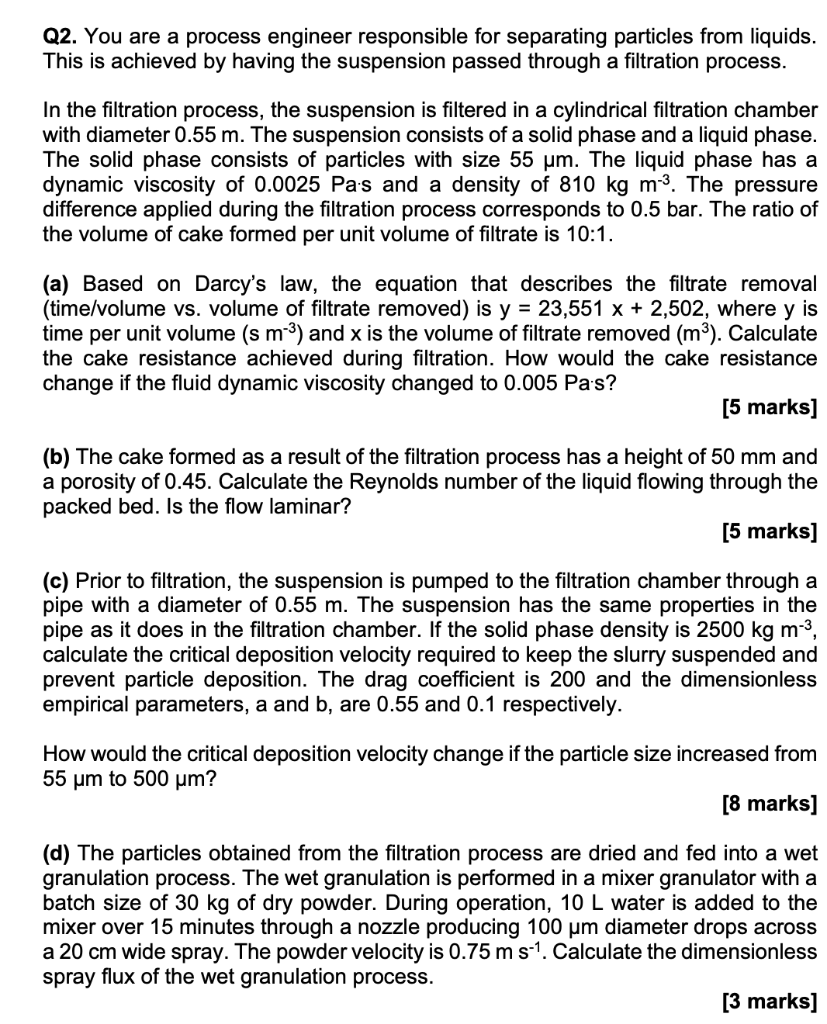
Q2. You are a process engineer responsible for separating particles from liquids. This is achieved by having the suspension passed through a filtration process. In the filtration process, the suspension is filtered in a cylindrical filtration chamber with diameter 0.55 m. The suspension consists of a solid phase and a liquid phase. The solid phase consists of particles with size 55 pm. The liquid phase has a dynamic viscosity of 0.0025 Pas and a density of 810 kg m-3. The pressure difference applied during the filtration process corresponds to 0.5 bar. The ratio of the volume of cake formed per unit volume of filtrate is 10:1. (a) Based on Darcy's law, the equation that describes the filtrate removal (time/volume vs. volume of filtrate removed) is y = 23,551 x + 2,502, where y is time per unit volume (s m) and x is the volume of filtrate removed (m). Calculate the cake resistance achieved during filtration. How would the cake resistance change if the fluid dynamic viscosity changed to 0.005 Pas? [5 marks] (b) The cake formed as a result of the filtration process has a height of 50 mm and a porosity of 0.45. Calculate the Reynolds number of the liquid flowing through the packed bed. Is the flow laminar? [5 marks] (c) Prior to filtration, the suspension is pumped to the filtration chamber through a pipe with a diameter of 0.55 m. The suspension has the same properties in the pipe as it does in the filtration chamber. If the solid phase density is 2500 kg m-3, calculate the critical deposition velocity required to keep the slurry suspended and prevent particle deposition. The drag coefficient is 200 and the dimensionless empirical parameters, a and b, are 0.55 and 0.1 respectively. How would the critical deposition velocity change if the particle size increased from 55 um to 500 um? [8 marks] (d) The particles obtained from the filtration process are dried and fed into a wet granulation process. The wet granulation is performed in a mixer granulator with a batch size of 30 kg of dry powder. During operation, 10 L water is added to the mixer over 15 minutes through a nozzle producing 100 um diameter drops across a 20 cm wide spray. The powder velocity is 0.75 m s-1. Calculate the dimensionless spray flux of the wet granulation process. [3 marks]
Step by Step Solution
There are 3 Steps involved in it

Get step-by-step solutions from verified subject matter experts
 Study Help