







Question: please answer only one lab Lab: Opera in Italy. Anyene? Your fiend Bob is an anid epera tan. He has a shen iecentine of an
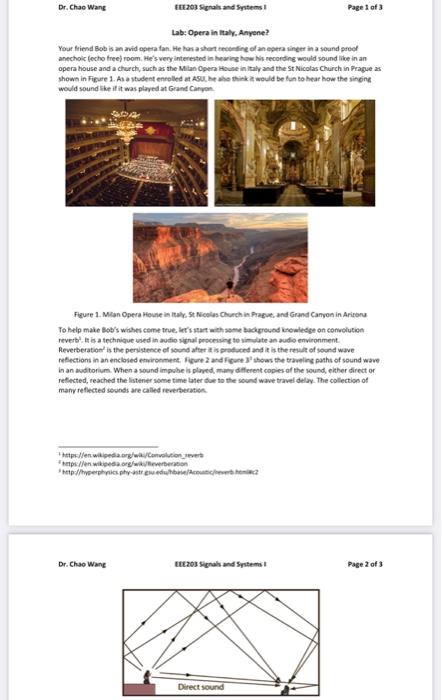
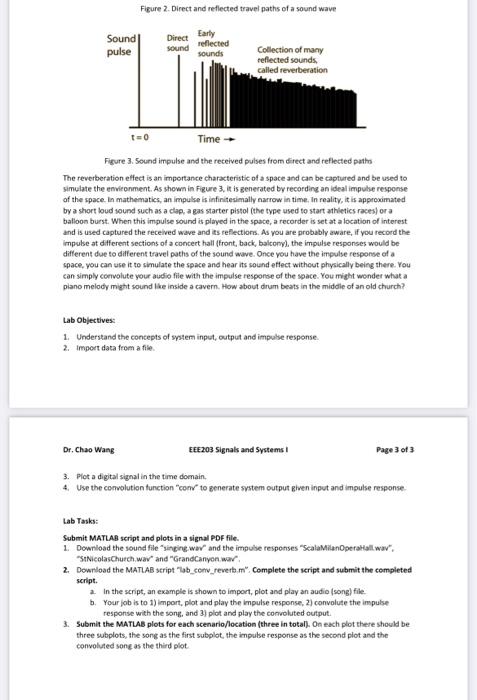
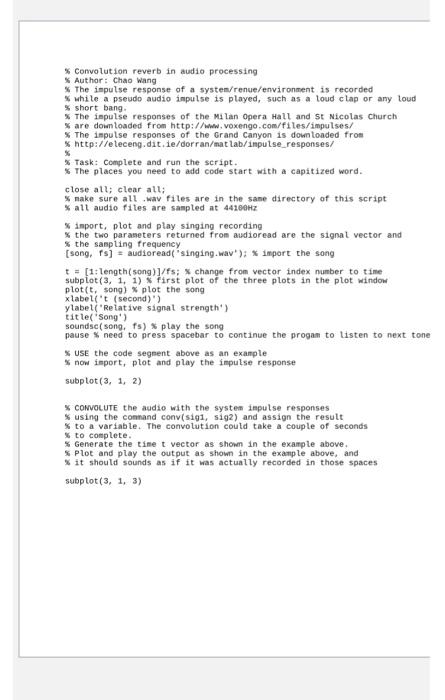
Lab: Opera in Italy. Anyene? Your fiend Bob is an anid epera tan. He has a shen iecentine of an epera singer in a sound proof anechoic (echo treef room. He's very interested in heuring how hr recoiding would yound libe in an opera house and a church, such as the Milan Opera Houne in italy and the St Nicolas Church in Prague as shown in Figure 1. As a studeet enrelled et ASu, he whe thirk e would be tun to hear how the singine would sound like if it was played at Grand Caryon. To belp make tob's withes come true ler's itart wibh some tudereund ksomledge on convolution Reverberation' is the perigtence of soond after it is prodsced and it is the rewet of sound wave refection in an enclosed etwironment. Fipure 2 and Fiene 37 thew the traveling paths of sound wave in an auditorium. When a sound impabe is ploped, mary different copies of the sound, elther direct or refected, reached the listener some time later doe to the sound wave travel delay. The collection of many reflected ievins are called revertecation. Figure 2. Direct and reflected travel paths of a sound wave Figure 3. Sound impulse and the received pulses from direct and reflected path The reverberation effect is an importance characteristic of a space and can be captured and be used to simulate the envienment. As shown in Figure 3, it is senerated by recarding an ideal impulse response of the space. In mathematics, an impulse is infinitesimally narrow in time. In reality, it is approximated by a short loud wound such as a clap, a gas starter pistol (the type used to start athletics races) or a balloon burst. When this impulse sound is played in the space, a recorder is set at a location of interest and is used captured the received wave and its reflectiors. As you are probably aware, if you record the impulse at different sections of a concert hall (front, back, balcorv), the impulse responses would be different due to different travel paths of the sound wave. Once vou have the impulse response of a space, you can use it to simulate the space and hear its sound effect without physically being thetre. You can simply comvolute your audio file with the impulse response of the space. You might wonder what a piano melody might sound lie inside a cavern. How about drum beats in the middie of an old church? Lab Oblectives: 1. Understand the contepts of system input, output and impulse response. 2. import data from a file. Dr, Chao Wang Efe203 signak and Systems I Page 3 of 3 3. Plot a digital signal in the time domain. 4. Use the comvolution function "com" to generate skitem output ghen input and impulse response. Lab Tasks: Submit MATLAB seript and plots in a signal PDF file.. 1. Downlload the sound file "singing war" and the impube responses "ScalaMilan0perablail wav". "SnNicolasChutch. wav" and "GrandCanyon ware. 2. Dowriload the MATLAB script "lab_com__reverb.m". Complete the script and submit the completed scrlpt. a. In the script, an example is shown to import, plot and play an audio (song) file. b. Your (ob is to 1) import, plot and play the impulse response, 2) convolute the impulse response with the song, and 3.) plot and play the convoluted output. 3. Submit the MATLAB plots for each scenario/location (three in total). On each plot there should be three subplots, the song as the first subplot, the imputse response as the second plot and the convoluted sone as the thind plot. \% Convolution reverb in audio processing W Author: Chao Wang \% The inpulse response of a system/renue/environment is recorded W uhile a pseudo audio inpulse is played, such as a loud clap or any loud \% shert bang. 5. The iepulse responses of the Milan opera Hall and St Nicolas Church W are dounloaded from http://hw, voxengo,com/files/impulses/ \%. The impulse responses of the Grand Canyon is downtoaded from \% http://eleceng.dit. le/dor ran/mat lab/inpulse_responses/ 56 5. Task: complete and run the script. \%. The places you need to add code start with a capitized word. close atl; clear alt; \% nake sure al1 wav files are in the sane directory of this script \% atl audio files are sampled at 44169Hz \% inport, plot and play singing recording \% the two paraseters returned from andioread are the signal vector and \% the sanpling frequency [song, fs]= audioread("singing wav'): * import the song t=[1 : length(song) ]/fs; x change from vector index number to time subplot (3,1,1) first plot of the three plots in the plot window plot(t, song) % plot the song x labet "t (second)") y label( "Re tative signat strength') title ('Song') soundsc(song, fs) \% play the song pause \% need to press spacebar to continue the progam to listen to next tone W USE the code segnent above as an example o now inport, plot and play the impulse response subptot (3,1,2) \% convoluTE the audio with the systew inpulse responses \% using the connand conv(sig1, sig2) and assign the result \% to a variable. The convolution coutd take a couple of seconds W to complete. \% Generate the time t vector as shown in the exainple above. 5. Plot and play the output as shown in the example above, and 5 it should sounds as if it was actually recorded in those spaces subptot (3,1,3) singing.wav ScalaMilanoperaHall.wav StNicolasChurch.wav GrandCanyon.wav Lab: Opera in Italy. Anyene? Your fiend Bob is an anid epera tan. He has a shen iecentine of an epera singer in a sound proof anechoic (echo treef room. He's very interested in heuring how hr recoiding would yound libe in an opera house and a church, such as the Milan Opera Houne in italy and the St Nicolas Church in Prague as shown in Figure 1. As a studeet enrelled et ASu, he whe thirk e would be tun to hear how the singine would sound like if it was played at Grand Caryon. To belp make tob's withes come true ler's itart wibh some tudereund ksomledge on convolution Reverberation' is the perigtence of soond after it is prodsced and it is the rewet of sound wave refection in an enclosed etwironment. Fipure 2 and Fiene 37 thew the traveling paths of sound wave in an auditorium. When a sound impabe is ploped, mary different copies of the sound, elther direct or refected, reached the listener some time later doe to the sound wave travel delay. The collection of many reflected ievins are called revertecation. Figure 2. Direct and reflected travel paths of a sound wave Figure 3. Sound impulse and the received pulses from direct and reflected path The reverberation effect is an importance characteristic of a space and can be captured and be used to simulate the envienment. As shown in Figure 3, it is senerated by recarding an ideal impulse response of the space. In mathematics, an impulse is infinitesimally narrow in time. In reality, it is approximated by a short loud wound such as a clap, a gas starter pistol (the type used to start athletics races) or a balloon burst. When this impulse sound is played in the space, a recorder is set at a location of interest and is used captured the received wave and its reflectiors. As you are probably aware, if you record the impulse at different sections of a concert hall (front, back, balcorv), the impulse responses would be different due to different travel paths of the sound wave. Once vou have the impulse response of a space, you can use it to simulate the space and hear its sound effect without physically being thetre. You can simply comvolute your audio file with the impulse response of the space. You might wonder what a piano melody might sound lie inside a cavern. How about drum beats in the middie of an old church? Lab Oblectives: 1. Understand the contepts of system input, output and impulse response. 2. import data from a file. Dr, Chao Wang Efe203 signak and Systems I Page 3 of 3 3. Plot a digital signal in the time domain. 4. Use the comvolution function "com" to generate skitem output ghen input and impulse response. Lab Tasks: Submit MATLAB seript and plots in a signal PDF file.. 1. Downlload the sound file "singing war" and the impube responses "ScalaMilan0perablail wav". "SnNicolasChutch. wav" and "GrandCanyon ware. 2. Dowriload the MATLAB script "lab_com__reverb.m". Complete the script and submit the completed scrlpt. a. In the script, an example is shown to import, plot and play an audio (song) file. b. Your (ob is to 1) import, plot and play the impulse response, 2) convolute the impulse response with the song, and 3.) plot and play the convoluted output. 3. Submit the MATLAB plots for each scenario/location (three in total). On each plot there should be three subplots, the song as the first subplot, the imputse response as the second plot and the convoluted sone as the thind plot. \% Convolution reverb in audio processing W Author: Chao Wang \% The inpulse response of a system/renue/environment is recorded W uhile a pseudo audio inpulse is played, such as a loud clap or any loud \% shert bang. 5. The iepulse responses of the Milan opera Hall and St Nicolas Church W are dounloaded from http://hw, voxengo,com/files/impulses/ \%. The impulse responses of the Grand Canyon is downtoaded from \% http://eleceng.dit. le/dor ran/mat lab/inpulse_responses/ 56 5. Task: complete and run the script. \%. The places you need to add code start with a capitized word. close atl; clear alt; \% nake sure al1 wav files are in the sane directory of this script \% atl audio files are sampled at 44169Hz \% inport, plot and play singing recording \% the two paraseters returned from andioread are the signal vector and \% the sanpling frequency [song, fs]= audioread("singing wav'): * import the song t=[1 : length(song) ]/fs; x change from vector index number to time subplot (3,1,1) first plot of the three plots in the plot window plot(t, song) % plot the song x labet "t (second)") y label( "Re tative signat strength') title ('Song') soundsc(song, fs) \% play the song pause \% need to press spacebar to continue the progam to listen to next tone W USE the code segnent above as an example o now inport, plot and play the impulse response subptot (3,1,2) \% convoluTE the audio with the systew inpulse responses \% using the connand conv(sig1, sig2) and assign the result \% to a variable. The convolution coutd take a couple of seconds W to complete. \% Generate the time t vector as shown in the exainple above. 5. Plot and play the output as shown in the example above, and 5 it should sounds as if it was actually recorded in those spaces subptot (3,1,3) singing.wav ScalaMilanoperaHall.wav StNicolasChurch.wav GrandCanyon.wav
Step by Step Solution
There are 3 Steps involved in it

Get step-by-step solutions from verified subject matter experts
 Study Help