







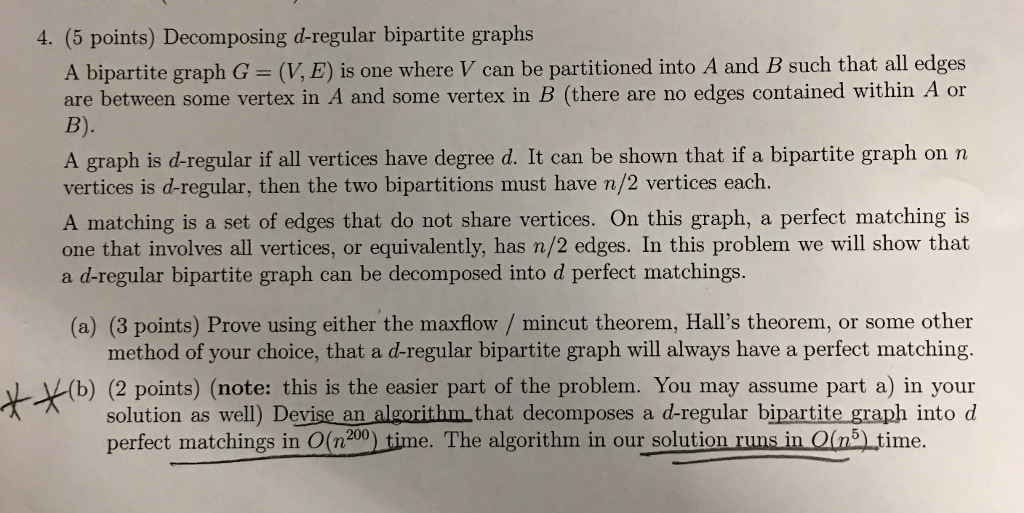
Question: Please Answer only part B. Please write the algorithm, draw diagram & explain it. Thanks for the help 4. (5 points) Decomposing d-regular bipartite graphs
 Please Answer only part B. Please write the algorithm, draw diagram & explain it. Thanks for the help
4. (5 points) Decomposing d-regular bipartite graphs A bipartite graph G = (V, E) is one where V can be partitioned into A and B such that all edges are between some vertex in A and some vertex in B (there are no edges contained within A or A graph is d-regular if all vertices have degree d. It can be shown that if a bipartite graph on n vertices is d-regular, then the two bipartitions must have n/2 vertices each A matching is a set of edges that do not share vertices. On this graph, a perfect matching is one that involves all vertices, or equivalently, has n/2 edges. In this problem we will show that a d-regular bipartite graph can be decomposed into d perfect m (a) (3 points) Prove using either the maxflow / mincut theorem, Hall's theorem, or some other method of your choice, that a d-regular bipartite graph will always have a perfect matching. (b) (2 points) (note: this is the easier part of the problem. You may assume part a) in your solution as well) Devise an algorithm that decomposes a d-regular bipartite graph into d perfect matchings in O(n200) time. The algorithm in our solution runs in Q(n5)time 4. (5 points) Decomposing d-regular bipartite graphs A bipartite graph G = (V, E) is one where V can be partitioned into A and B such that all edges are between some vertex in A and some vertex in B (there are no edges contained within A or A graph is d-regular if all vertices have degree d. It can be shown that if a bipartite graph on n vertices is d-regular, then the two bipartitions must have n/2 vertices each A matching is a set of edges that do not share vertices. On this graph, a perfect matching is one that involves all vertices, or equivalently, has n/2 edges. In this problem we will show that a d-regular bipartite graph can be decomposed into d perfect m (a) (3 points) Prove using either the maxflow / mincut theorem, Hall's theorem, or some other method of your choice, that a d-regular bipartite graph will always have a perfect matching. (b) (2 points) (note: this is the easier part of the problem. You may assume part a) in your solution as well) Devise an algorithm that decomposes a d-regular bipartite graph into d perfect matchings in O(n200) time. The algorithm in our solution runs in Q(n5)time
Step by Step Solution
There are 3 Steps involved in it

Get step-by-step solutions from verified subject matter experts
 Study Help