







Question: please answer part a only and show all steps to how equation was obtained. #1: LHHW Kinetic values determination and simulation using a RCSTR in
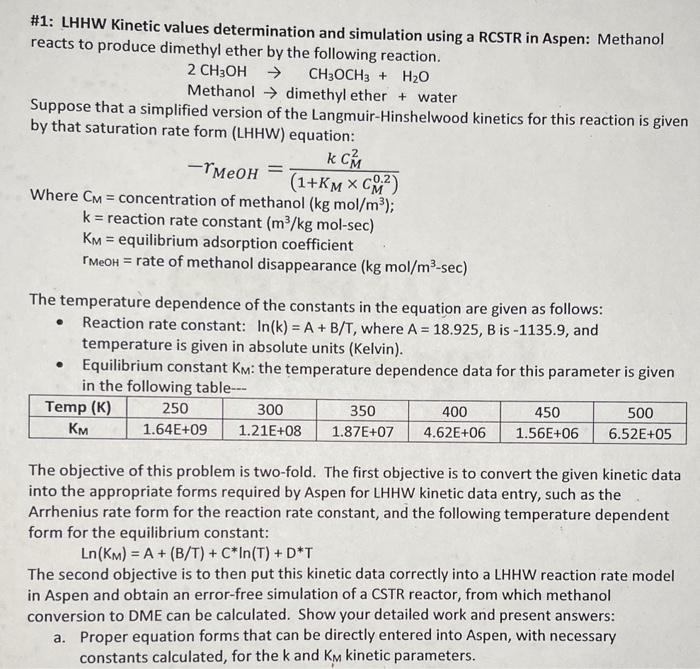
\#1: LHHW Kinetic values determination and simulation using a RCSTR in Aspen: Methanol reacts to produce dimethyl ether by the following reaction. 2CH3OHCH3OCH3+H2O Methanol dimethyl ether + water Suppose that a simplified version of the Langmuir-Hinshelwood kinetics for this reaction is given by that saturation rate form (LHHW) equation: rMeOH=(1+KMCM0.2)kCM2 Where CM= concentration of methanol (kgmol/m3); k= reaction rate constant (m3/kg mol-sec) KM= equilibrium adsorption coefficient rMeOH= rate of methanol disappearance (kgmol/m3sec) The temperature dependence of the constants in the equation are given as follows: - Reaction rate constant: ln(k)=A+B/T, where A=18.925,B is 1135.9, and temperature is given in absolute units (Kelvin). - Equilibrium constant KM : the temperature dependence data for this parameter is given in the following table-- The objective of this problem is two-fold. The first objective is to convert the given kinetic data into the appropriate forms required by Aspen for LHHW kinetic data entry, such as the Arrhenius rate form for the reaction rate constant, and the following temperature dependent form for the equilibrium constant: Ln(KM)=A+(B/T)+Cln(T)+DT The second objective is to then put this kinetic data correctly into a LHHW reaction rate model in Aspen and obtain an error-free simulation of a CSTR reactor, from which methanol conversion to DME can be calculated. Show your detailed work and present answers: a. Proper equation forms that can be directly entered into Aspen, with necessary constants calculated, for the k and KM kinetic parameters
Step by Step Solution
There are 3 Steps involved in it

Get step-by-step solutions from verified subject matter experts
 Study Help