







Question: Please answer part B completely, especially for point 2 and 3 ( ii and iii ). I really appreciate it. Thanks Assume that the Capital
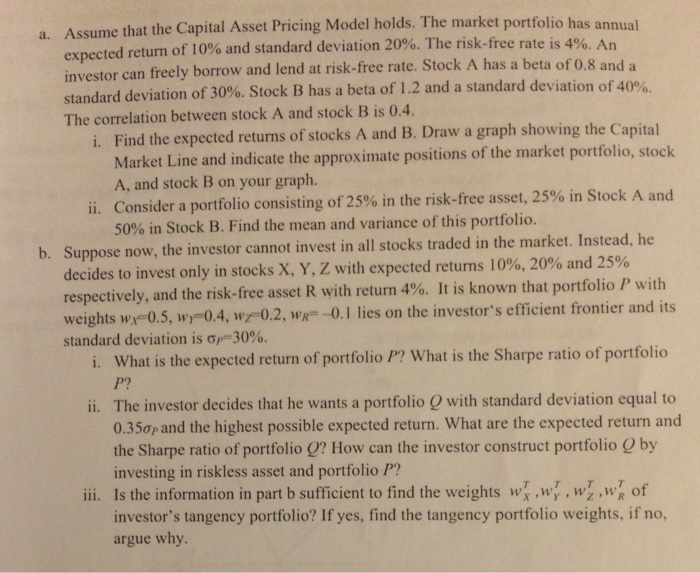
Assume that the Capital Asset Pricing Model holds. The market portfolio has annual expected return of 10% and standard deviation 20%. The risk-free rate is 4% investor can freely borrow and lend at risk-free rate. Stock A has a beta of 0.8 a standard deviation of 30%. Stock B has a beta of 1.2 and a standard deviation of 40% The correlation between stock A and stock B is 0.4 a. . An nd a Find the expected returns of stocks A and B. Draw a graph showing the Capital Market Line and indicate the approximate positions of the market portfolio, stock A, and stock B on your graph. Consider a portfolio consisting of 25% in the risk-free asset, 25% in Stock A and 50% in Stock B. Find the mean and variance of this portfolio. i. 11. b. Suppose now, the investor cannot invest in all stocks traded in the market. Instead, he decides to invest only in stocks X, Y, Z with expected returns 10%, 20% and 25% respectively, and the risk-free asset R with return 4%. It is known that portfolio P with weights wi-0.5, 4, 02, we -0.I lies on the investor's efficient frontier an 0.4, wz 0.2, wR -0.1 lies on the investor's efficient frontier and its standard deviation is -30%. What is the expected return of portfolio P? What is the Sharpe ratio of portfolio P? The investor decides that he wants a portfolio Q with standard deviation equal to 0.3Sap and the highest possible expected return. What are the expected return and the Sharpe ratio of portfolio Q? How can the investor construct portfolio O by investing in riskless asset and portfolio P? i. i. iii. Is the information in part b sufficient to find the weights w.w. of , investor's tangency portfolio? If yes, find the tangency portfolio weights, if no argue why
Step by Step Solution
There are 3 Steps involved in it

Get step-by-step solutions from verified subject matter experts
 Study Help