







Question: please answer part c 2. This question examines government spending financed by lump-sum taxes. There is a single representative household which has h = 10
please answer part c
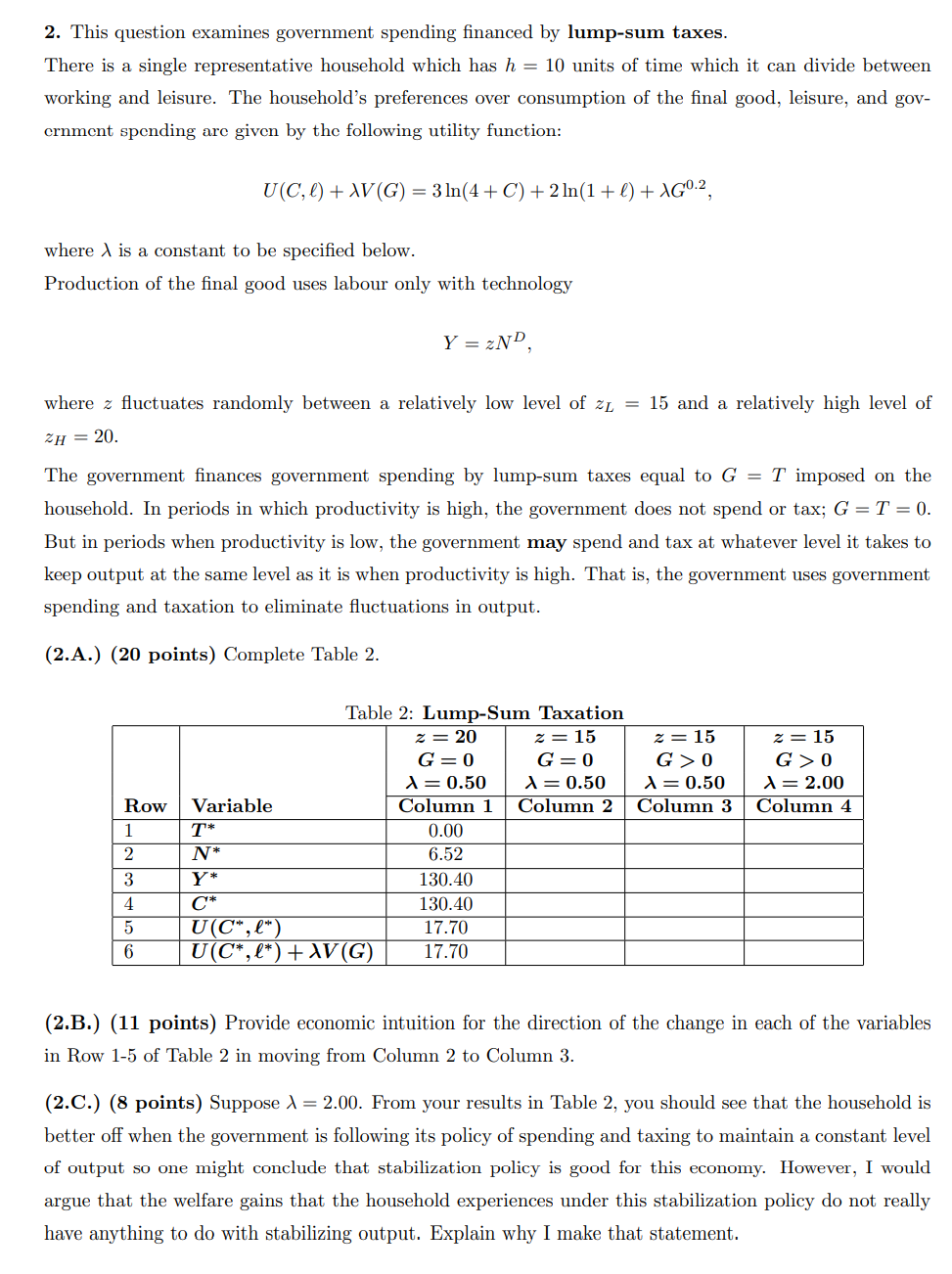
2. This question examines government spending financed by lump-sum taxes. There is a single representative household which has h = 10 units of time which it can divide between working and leisure. The household's preferences over consumption of the final good, leisure, and gov- crnment spending are given by the following utility function: U(C, 1) + XV(G) = 3 ln(4+C) + 2 ln(1 + l) + AG0.2, where is a constant to be specified below. Production of the final good uses labour only with technology Y = 2ND where z fluctuates randomly between a relatively low level of zu = 15 and a relatively high level of ZH = 20 The government finances government spending by lump-sum taxes equal to G = T imposed on the household. In periods in which productivity is high, the government does not spend or tax; G = T = 0. But in periods when productivity is low, the government may spend and tax at whatever level it takes to keep output at the same level as it is when productivity is high. That is, the government uses government spending and taxation to eliminate fluctuations in output. (2.A.) (20 points) Complete Table 2. 2= 15 G>O = 2.00 Column 4 Row 1 2 Table 2: Lump-Sum Taxation z= 20 2= 15 Z=15 G=0 G=0 G>0 = 0.50 = 0.50 =0.50 Variable Column 1 Column 2 Column 3 T* 0.00 N* 6.52 Y* 130.40 C* 130.40 U(C*, C*) 17.70 UC*,l*) + XVG) 17.70 3 4 5 6 (2.B.) (11 points) Provide economic intuition for the direction of the change in each of the variables in Row 1-5 of Table 2 in moving from Column 2 to Column 3. (2.C.) (8 points) Suppose 1 = 2.00. From your results in Table 2, you should see that the household is better off when the government is following its policy of spending and taxing to maintain a constant level of output so one might conclude that stabilization policy is good for this economy. However, I would argue that the welfare gains that the household experiences under this stabilization policy do not really have anything to do with stabilizing output. Explain why I make that statement. 2. This question examines government spending financed by lump-sum taxes. There is a single representative household which has h = 10 units of time which it can divide between working and leisure. The household's preferences over consumption of the final good, leisure, and gov- crnment spending are given by the following utility function: U(C, 1) + XV(G) = 3 ln(4+C) + 2 ln(1 + l) + AG0.2, where is a constant to be specified below. Production of the final good uses labour only with technology Y = 2ND where z fluctuates randomly between a relatively low level of zu = 15 and a relatively high level of ZH = 20 The government finances government spending by lump-sum taxes equal to G = T imposed on the household. In periods in which productivity is high, the government does not spend or tax; G = T = 0. But in periods when productivity is low, the government may spend and tax at whatever level it takes to keep output at the same level as it is when productivity is high. That is, the government uses government spending and taxation to eliminate fluctuations in output. (2.A.) (20 points) Complete Table 2. 2= 15 G>O = 2.00 Column 4 Row 1 2 Table 2: Lump-Sum Taxation z= 20 2= 15 Z=15 G=0 G=0 G>0 = 0.50 = 0.50 =0.50 Variable Column 1 Column 2 Column 3 T* 0.00 N* 6.52 Y* 130.40 C* 130.40 U(C*, C*) 17.70 UC*,l*) + XVG) 17.70 3 4 5 6 (2.B.) (11 points) Provide economic intuition for the direction of the change in each of the variables in Row 1-5 of Table 2 in moving from Column 2 to Column 3. (2.C.) (8 points) Suppose 1 = 2.00. From your results in Table 2, you should see that the household is better off when the government is following its policy of spending and taxing to maintain a constant level of output so one might conclude that stabilization policy is good for this economy. However, I would argue that the welfare gains that the household experiences under this stabilization policy do not really have anything to do with stabilizing output. Explain why I make that statement
Step by Step Solution
There are 3 Steps involved in it

Get step-by-step solutions from verified subject matter experts
 Study Help