







Question: Please answer part C using the answers from part A and B Hand in this worksheet and the requested documents in Part C. For the
Please answer part C using the answers from part A and B
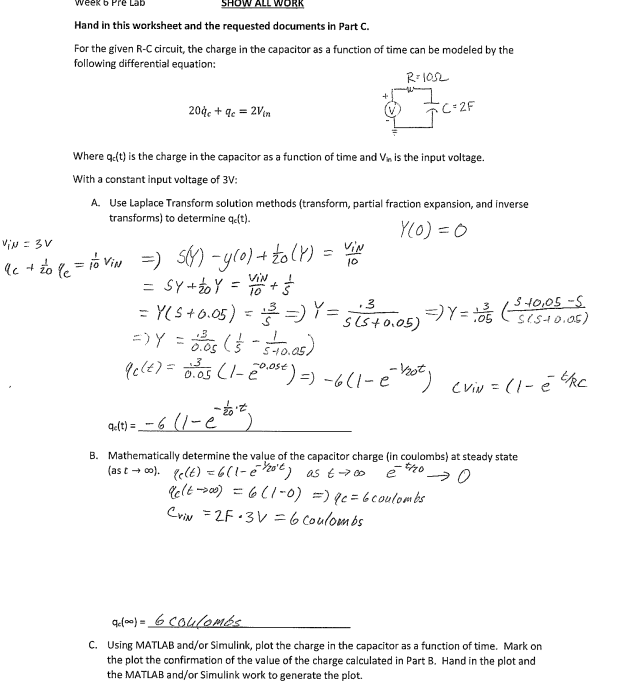
Hand in this worksheet and the requested documents in Part C. For the given R-C circuit, the charge in the capacitor as a function of time can be modeled by the following differential equation: Where qeft) is the charge in the capacitor as a function of time and Vn is the input voltage. With a constant input voltage of 3V: A. Use Laplace Transform solution methods (transform, partial fraction expansion, and inverse transforms) to determine qeft). io 340,05 o.os S-10.a5 "DOS Ge(t)s- B. Mathematically determine the value of the capacitor charge (in coulombs) at steady state C. Using MATLAB and/or Simulink, plot the charge in the capacitor as a function of time. the plot the confirmation of the value of the charge calculated in Part B. Hand in the plot and the MATLAB and/or Simulink work to generate the plot. Mark on Hand in this worksheet and the requested documents in Part C. For the given R-C circuit, the charge in the capacitor as a function of time can be modeled by the following differential equation: Where qeft) is the charge in the capacitor as a function of time and Vn is the input voltage. With a constant input voltage of 3V: A. Use Laplace Transform solution methods (transform, partial fraction expansion, and inverse transforms) to determine qeft). io 340,05 o.os S-10.a5 "DOS Ge(t)s- B. Mathematically determine the value of the capacitor charge (in coulombs) at steady state C. Using MATLAB and/or Simulink, plot the charge in the capacitor as a function of time. the plot the confirmation of the value of the charge calculated in Part B. Hand in the plot and the MATLAB and/or Simulink work to generate the plot. Mark on
Step by Step Solution
There are 3 Steps involved in it

Get step-by-step solutions from verified subject matter experts
 Study Help