







Question: Please answer parts A, B, and C for this question. The red words at the end of each question describe how to round the final
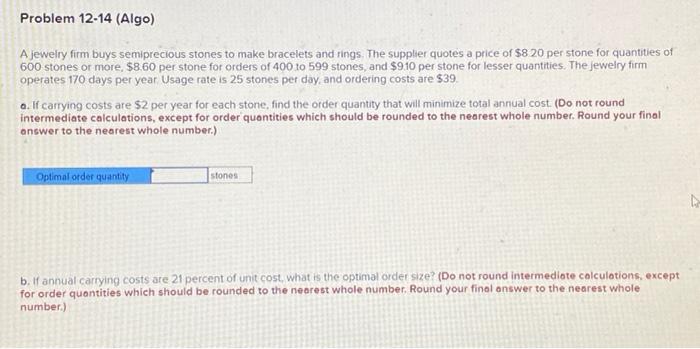
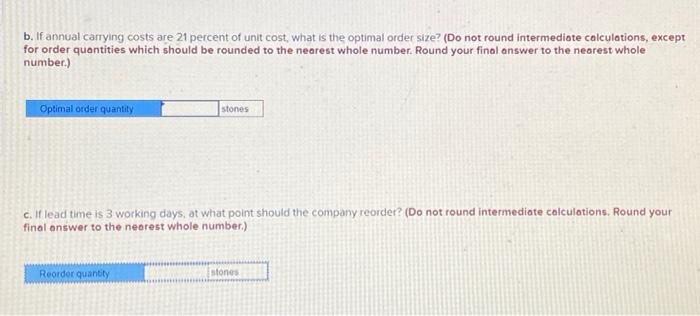
A jewelry firm buys semiprecious stones to make bracelets and rings. The supplier quotes a price of $820 per stone for quantities of 600 stones or more, $8.60 per stone for orders of 400 to 599 stones, and $910 per stone for lesser quantities. The jewelry firm operates 170 days per year. Usage rate is 25 stones per day, and ordering costs are $39. o. If carrying costs are $2 per year for each stone, find the order quantity that will minimize total annual cost. (Do not round intermediate calculations, except for order quontities which should be rounded to the nearest whole number. Round your final onswer to the nearest whole number.) b. If annual carrying costs are 21 percent of unit cost, what is the optimal order size? (Do not round intermediate calculations, except for order quantities which should be rounded to the nearest whole number. Round your final answer to the nearest whole number.) b. If annual carrying costs are 21 percent of unit cost, what is the optimal order size? (Do not round intermediate calculations, except for order quantities which should be rounded to the nearest whole number. Round your final answer to the nearest whole number.) c. If lead time is 3 working days, at what point should the company reorder? (Do not round intermediate colculations. Round your final onswer to the neorest whole number.)
Step by Step Solution
There are 3 Steps involved in it

Get step-by-step solutions from verified subject matter experts
 Study Help