







Question: Please answer problem F Problem E. Consider the following set of processes, with the length of the CPU burst given in milliseconds, the processes are
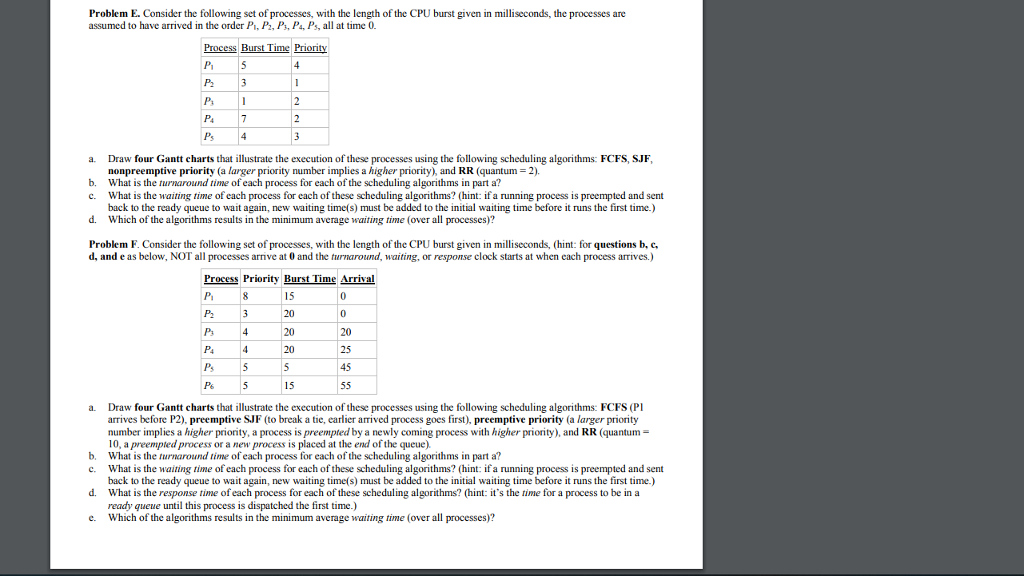 Please answer problem F
Problem E. Consider the following set of processes, with the length of the CPU burst given in milliseconds, the processes are assumed to have arrived in the order Pi, P, Ps, P4, Ps, all at time 0. Process Burst Time Priority Ps4 a. Draw four Gantt charts that illustrate the execution of these processes using the following scheduling algorithms: FCFS, SJF nonpreemptive priority (a larger priority number implies a higher priority) and RR (quantum 2) b. What is the turnaround time of each process for each of the scheduling algorithms in part a? c. What is the waiting time of each process for each of these scheduling algorithms? (hint: if a running process is preempted and sent back to the ready queue to wait again, new waiting time(s) must be added to the initial waiting time before it runs the first time.) d. Which of the algorithms results in the minimum average waiting time (over all processes)? Problem F. Consider the following set of processes, with the length of the CPU burst given in milliseconds, (hint: for questions b, c d, and e as below, NOT all processes arrive at O and the turnaround, waiting, or response clock starts at when each process arrives.) Process Priority Burst Time Arrival 15 20 20 Ps 45 Ps 15 a. Draw four Gantt charts that illustrate the execution of these processes using the following scheduling algorithms: FCFS (PI arrives before P2), preemptive SJF (to break a tie, earlier arrived process goes first), preemptive priority (a larger priority number implies a higher priority, a process is preempted by a newly coming process with higher priority), and RR (quantum 10, a preempted process or a new process is placed at the end of the queue) What is the turnaround time of each process for each of the scheduling algorithms in part a? What is the waiting tme of each process for each of these scheduling algorithms? (hint: if a running process is preempted and sent back to the ready queue to wait again, new waiting time(s) must be added to the initial waiting time before it runs the first time.) What is the response time of each process for each of these scheduling algorithms? (hint: it's the time for a process to be in a ready queue until this process is dispatched the first time.) Which of the algorithms results in b. c. d. ge waitingm e (over all processes)? e. the minimum avera
Step by Step Solution
There are 3 Steps involved in it

Get step-by-step solutions from verified subject matter experts
 Study Help