Question: please answer question 1 and 3 Application of Chapter Content Page 176 1. How is the global economy both helping and hurting Huawei? 2. If
please answer question 1 and 3
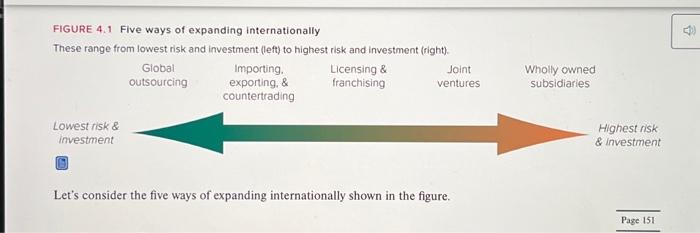
Application of Chapter Content Page 176 1. How is the global economy both helping and hurting Huawei? 2. If you were leading Huawei's expansion overseas, what type of international manager would you want to be- ethnocentric, polycentric, or geocentric? Explain your decision. 3. Based on Figure 4.1, which ways of expanding internationally has Huawei employed? Provide specific examples. 4. Huawei is based in China and looking to expand to Russia and Brazil China, Russia, and Brazil are BRICS nations. Why is this significant? 5. Assume Huawei is allowed to enter the U.S. market. Based on GLOBE cultural dimensions, the United States scores lower than China on power distance, in-group collectivism, and uncertainty avoidance. With this in mind, how would you advise Huawei, a Chinese company, to modify its practices if it plans to enter the U.S. market? Management in Action 1 Isolation of a Global Giant Huawei was founded in 1987 as a Chinese provider of communications technology and smart devices. The company has approximately 194.000 employees and serves more than 3 billion people around the world. Huawei surpassed $100 billion in annual revenue in 2018, powered by its sales of more than 200 million smartphones that year. It holds the titles of the world's largest seller of telecommunications equipment and the second-largest smartphone maker. 126 The company also boasts that almost half of Fortune 100 companies have chosen Huawei "as their partner for digital transformation.-127 Lately, however, Huawei is losing partners, entire countries in fact. In 2018 alone, the United States, United Kingdom, Australia, and New Zealand all banned the use of Huawei's 5G cellular technology. France and Germany were discussing similar bans, and authorities in Canada actually arrested Huawei's CFO on a U.S. warrant 128 The U.S. also banned shipments of parts or components to Huawei in May 2019, resulting in the inability of companies like Qualcomm and Intel to export chips. Although this ban has been lifted, Huawei found other suppliers and no longer needs components from U.S. firms. 129 These setbacks have stunted Huawei's global expansion and isolated it to the Chinese market. 4 HUAWEI'S GLOBAL AMBITIONS Huawei has had explosive growth in China. The company's revenue increased from around $20 billion in 2009 to over $100 billion in 2018, and it makes more phones than Apple. Huawei's growth has come against the backdrop of China's continued rise... providing the firm with a huge base upon which to build its initial market," the BBC reported, 130 The Chinese market is quite saturated though, and if Huawei wants to grow, it needs to expand to new markets. According to one business analyst, Europe would be the place for Huawei to launch its new products." 131 Huawei's international expansion has hit a snag, Crities accuse it of being too cozy with the Chinese Page 175 government, which has caused a backlash against both its communications technology and smartphone business, 132 A WORLD INCHING TOWARD 5G At the heart of Huawei's international expansion woes is SG technology. Let's first discuss this new wave of communications. Almost all cellular technology in the U.S. has been based on 4G technology (the "G" stands for generation) since 2010. Each cellular generation has introduced greater data transmission speed, with SG being the fastest and most responsive currently in the market. Faster transmission and responsiveness allow you to stream Netflix movies more quickly, see high-resolution Ring doorbell surveillance videos, and even do virtual reality physical therapy. This technology also makes other innovations, such as driverless cars, possible. Major U.S. carriers introduced SG in late 2018 and continue to expand it across the country, starting with highly populated cities. 133 The speed and functionality of SG technology also bring about security concerns in a globalized world. For example, critical functions and personal data can be hacked utilizing "backdoors" on a 5G platform. Some worry these backdoors may actually be exploited not just by private criminals, but also by hostile governments that control SG developers 134 AN ARM OF THE CHINESE GOVERNMENT? Huawei maintains it is a private company solely owned by its employees. In fact, the English version of the company's website specifically mentions: "No government agency or outside organization holds shares in Huawei."135 Not so fast, say the United States and several other countries. They claim that vague Chinese intelligence laws could force Huawei to hand over data to the Chinese government, not only data from Chinese smartphone users, but also data from any Huawei product user in the world. Moreover, Chinese regulations require that private companies establish Chinese Communist Party branches within them and accept state-backed investment.136 As a result, the U.S. government has said that Americans should not use imported Huawei phones, and federal footnote opens in a dialoo are banned from buying them. Other countries, including the United Kingdom, New Zealand, and Australia, have barred the company's equipment from their 5G mobile networks. 137 The United States and Canada have also gone after Huawei for other trade-related issues, including violations of sanctions against Iran. On December 1, 2018, Huawei's chief financial officer, Meng Wanzhou, was detained and charged in Canada by both American and Canadian authorities for allegedly covering up the organization's Iranian sanctions evasion scheme. The Chinese government calls the charges an attempt to stop Huawei's advancement across the globe. 138 Not all countries have joined the anti-Huawei bandwagon. In 2019. China's fellow BRICS nation, Russia, agreed to incorporate Huawei equipment in its 5G telecommunications platform. 139 Bloomberg reports that Brazil is considering Huawei for its national telecommunications needs as well.140 This essentially pits some of the largest emerging economies against North American and European nations. The Russians also are interested in a joint venture with Huawei to produce chips and software. The joint venture would include participation by the Russian government, which bolsters Western nations' claims that Huawei and its partners are government entities pretending to be commercial ones, according to Forbes. 141 THE COST OF GLOBALIZATION BRICS countries are not the only ones facilitating Huawei's international expansion. U.S. allies, such as France and Germany, have yet to ban Huawei's participation in SG development, but the reason isn't trust in the company's independence. In fact, the European Union issued an advisory report in October 2019 warning of "uncontrolled software updates, manipulation of functionalities, inclusion of functions to bypass audit mechanisms, (and) backdoors" By companies such as Huawei. The hesitation seems to be related to globalization and the costs of moving away from Huawei's technology. For example, German telecommunications operators, such as Deutsche Telekom, have already invested heavily in Huawei's technology, Chinese technology is cheaper to secure, due to a globalized environment. What isn't cheap is divesting from this technology. In fact, the American Enterprise Institute estimates that it will cost billions for the Europeans to move away from Huawei. 142 7 FIGURE 4.1 Five ways of expanding internationally These range from lowest risk and investment (left) to highest risk and Investment (right), Global Importing. Licensing & Joint outsourcing exporting, & franchising ventures countertrading Wholly owned subsidiaries Lowest risk & investment Highest risk & Investment Let's consider the five ways of expanding internationally shown in the figure. Page 151









 Study Help