Question: Please answer Question 1 and 3 only with around 100 words for each question. Don't copy other answers from chegg! Carlsberg A/S, headquartered in Denmark,
Please answer Question 1 and 3 only with around 100 words for each question. Don't copy other answers from chegg!
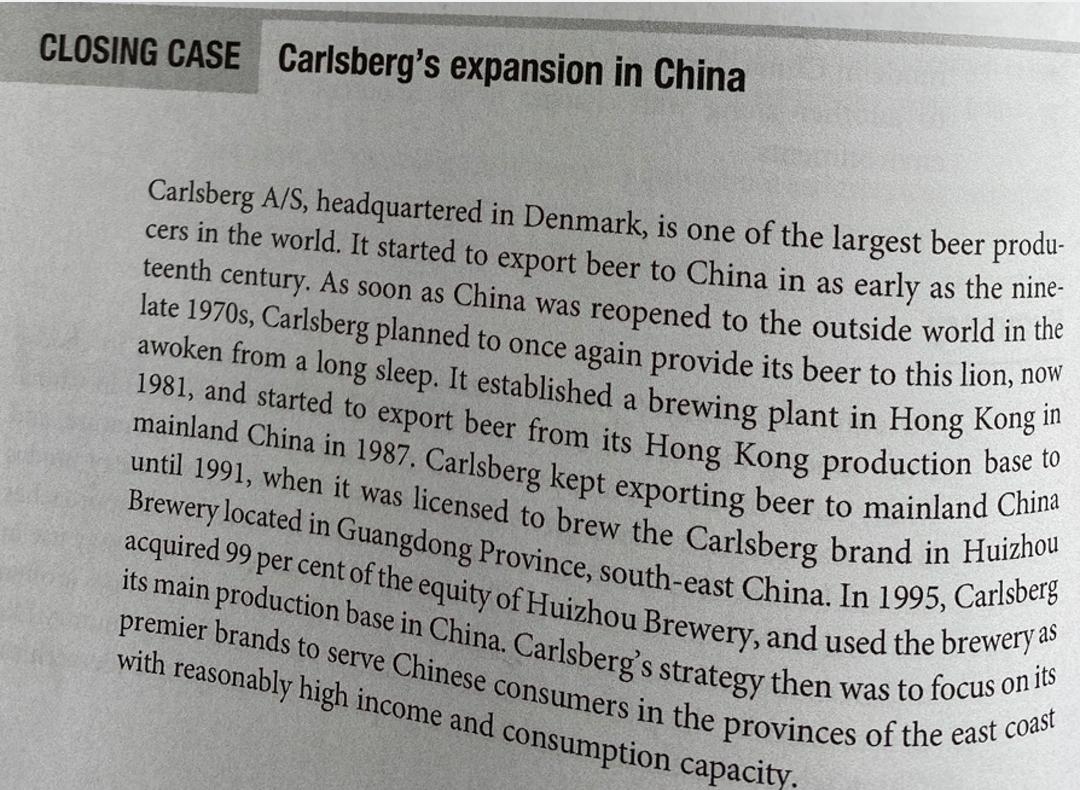
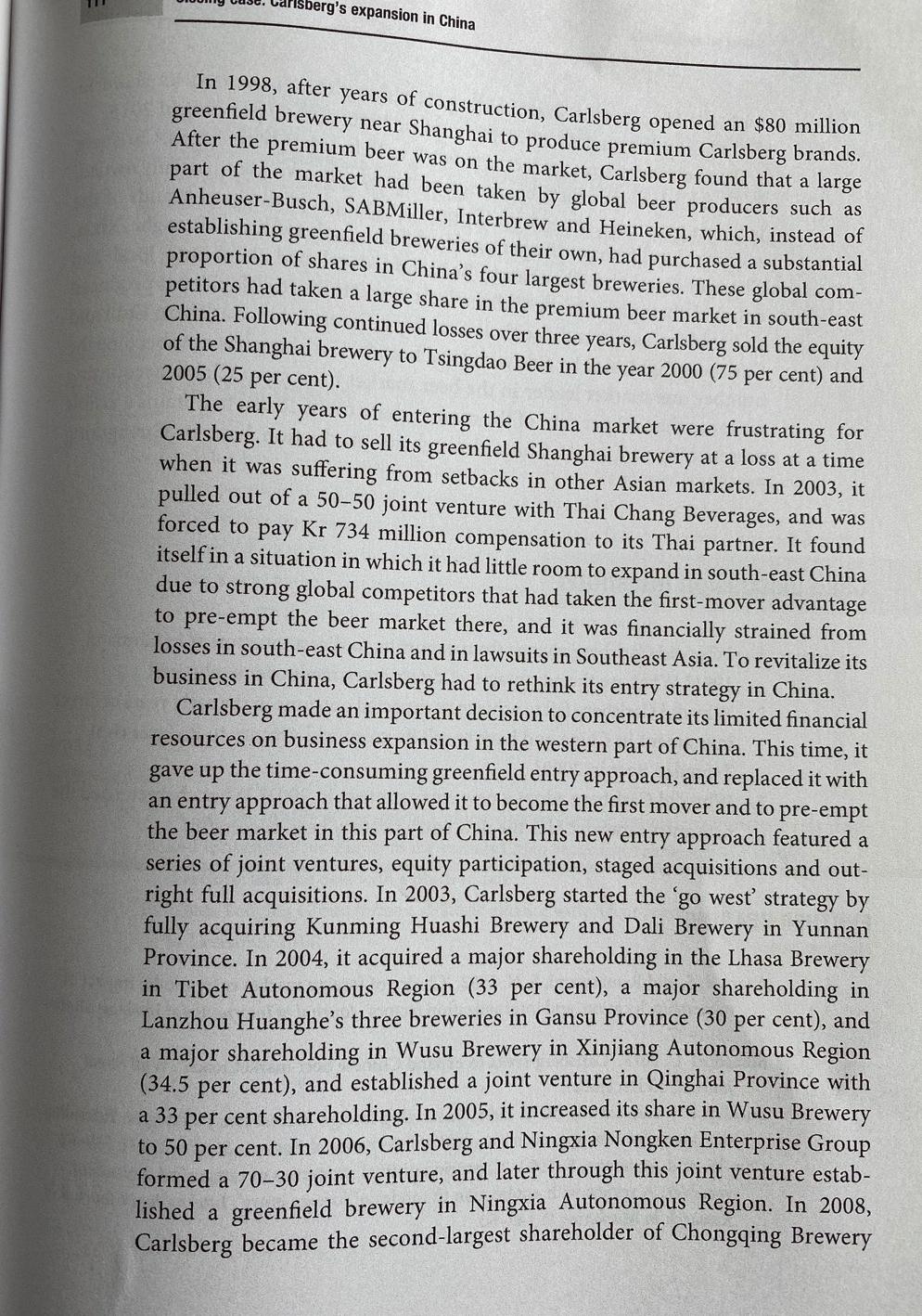
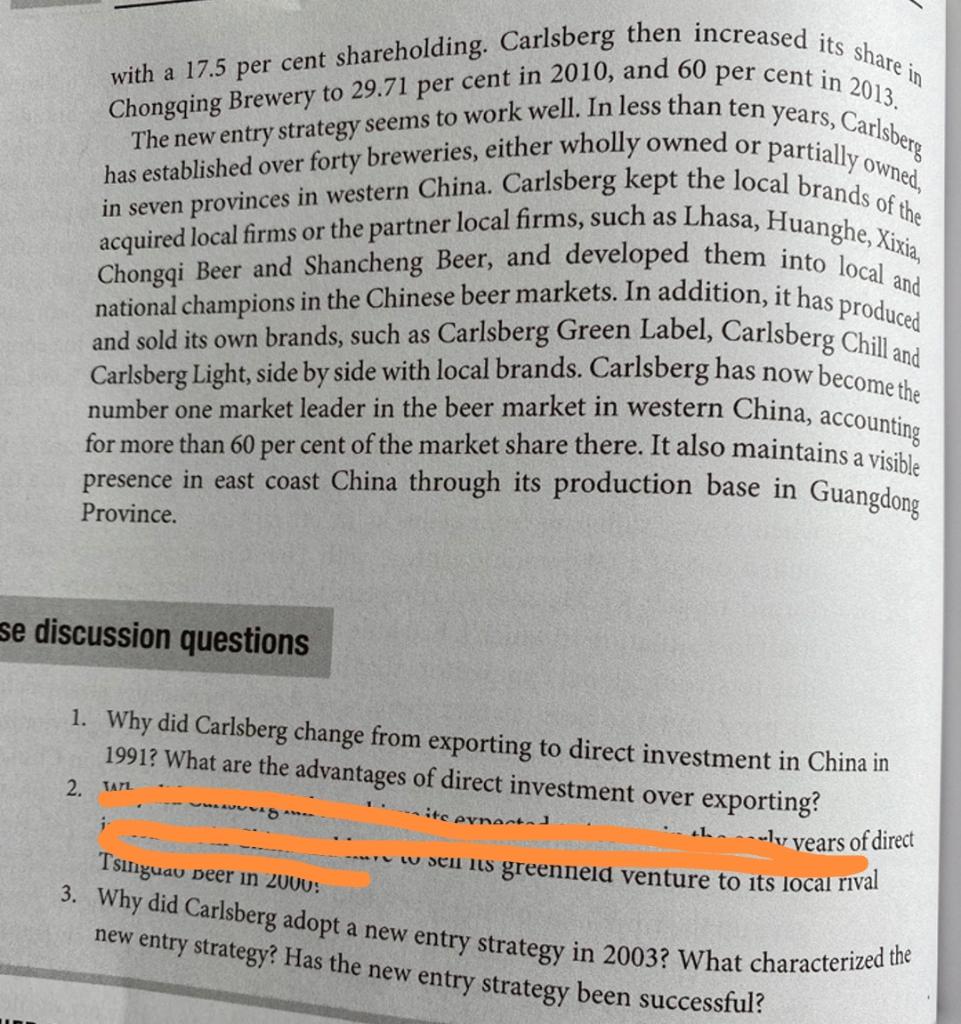
Carlsberg A/S, headquartered in Denmark, is one of the largest beer producers in the world. It started to export beer to China in as early as the nineteenth century. As soon as China was reopened to the outside world in the late 1970s, Carlsberg planned to once again provide its beer to this lion, now awoken from a long sleep. It established a brewing plant in Hong Kong in 1981, and started to export beer from its Hong Kong production base to mainland China in 1987. Carlsberg kept exporting beer to mainland China Brewery located in Guangdong Province, south-east China. In 1995, Carlsberg its main production of the equity of Huizhou Brewery, and used the brewery as its main production base in China. Carlsberg's strategy then was to focus on its premier brands to serve Chinese consumers in the provinces of the east coast with reasonably high income and consumption capacity. In 1998 , after years of construction, Carlsberg opened an $80 million greenfield brewery near Shanghai to produce premium Carlsberg brands. After the premium beer was on the market, Carlsberg found that a large part of the market had been taken by global beer producers such as Anheuser-Busch, SABMiller, Interbrew and Heineken, which, instead of establishing greenfield breweries of their own, had purchased a substantial proportion of shares in China's four largest breweries. These global competitors had taken a large share in the premium beer market in south-east China. Following continued losses over three years, Carlsberg sold the equity of the Shanghai brewery to Tsingdao Beer in the year 2000 ( 75 per cent) and 2005 (25 per cent). The early years of entering the China market were frustrating for Carlsberg. It had to sell its greenfield Shanghai brewery at a loss at a time when it was suffering from setbacks in other Asian markets. In 2003, it pulled out of a 50-50 joint venture with Thai Chang Beverages, and was forced to pay Kr 734 million compensation to its Thai partner. It found itself in a situation in which it had little room to expand in south-east China due to strong global competitors that had taken the first-mover advantage to pre-empt the beer market there, and it was financially strained from losses in south-east China and in lawsuits in Southeast Asia. To revitalize its business in China, Carlsberg had to rethink its entry strategy in China. Carlsberg made an important decision to concentrate its limited financial resources on business expansion in the western part of China. This time, it gave up the time-consuming greenfield entry approach, and replaced it with an entry approach that allowed it to become the first mover and to pre-empt the beer market in this part of China. This new entry approach featured a series of joint ventures, equity participation, staged acquisitions and outright full acquisitions. In 2003, Carlsberg started the 'go west' strategy by fully acquiring Kunming Huashi Brewery and Dali Brewery in Yunnan Province. In 2004, it acquired a major shareholding in the Lhasa Brewery in Tibet Autonomous Region (33 per cent), a major shareholding in Lanzhou Huanghe's three breweries in Gansu Province ( 30 per cent), and a major shareholding in Wusu Brewery in Xinjiang Autonomous Region (34.5 per cent), and established a joint venture in Qinghai Province with a 33 per cent shareholding. In 2005, it increased its share in Wusu Brewery to 50 per cent. In 2006, Carlsberg and Ningxia Nongken Enterprise Group formed a 70-30 joint venture, and later through this joint venture established a greenfield brewery in Ningxia Autonomous Region. In 2008, Carlsberg became the second-largest shareholder of Chongqing Brewery with a 17.5 per cent shareholding. Carlsberg then increased its share in p Chongqing Brewery to 29.71 per cent in 2010 , and 60 per cent in 2013 . The new entry strategy seems to work well. In less than ten years, Carlsberg has established over forty breweries, either wholly owned or partially owned, in seven provinces in western China. Carlsberg kept the local brands of the acquired local firms or the partner local firms, such as Lhasa, Huanghe, Xixia, Chongqi Beer and Shancheng Beer, and developed them into local and national champions in the Chinese beer markets. In addition, it has produced and sold its own brands, such as Carlsberg Green Label, Carlsberg Chill and Carlsberg Light, side by side with local brands. Carlsberg has now become the number one market leader in the beer market in western China, accounting for more than 60 per cent of the market share there. It also maintains a visible presence in east coast China through its production base in Guangdong Province. discussion questions 1. Why did Carlsberg change from exporting to direct investment in China in 1991? What are the advantages of direct investment over exporting? Tsinguau peer in suev: 3. Why did Carlsberg adopt new entry strategy? H as a new entry strategy in 2003 ? What characterized the Wew entry strategy? Has the new entry strategy been successful









 Study Help