







Question: please answer question 1. Look at Figure 1 on page 594 of the Green et al. (2019) article. It displays the Comprehensive Supply Chain Management
please answer question 
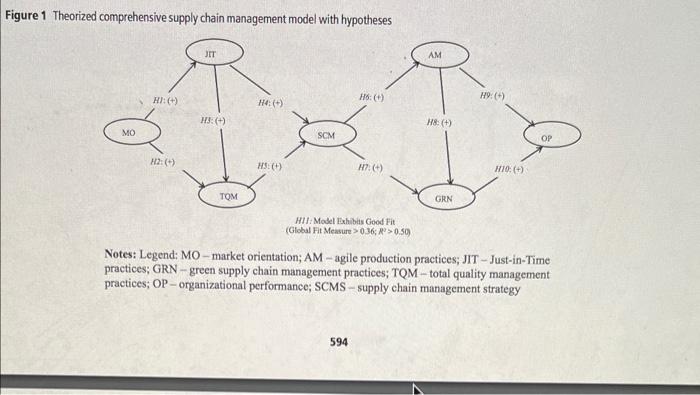
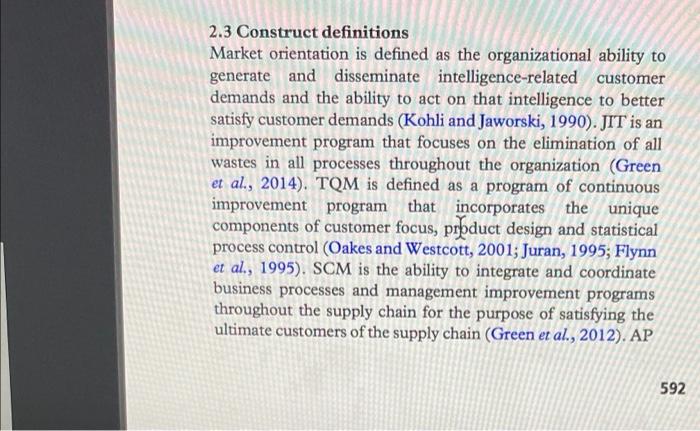
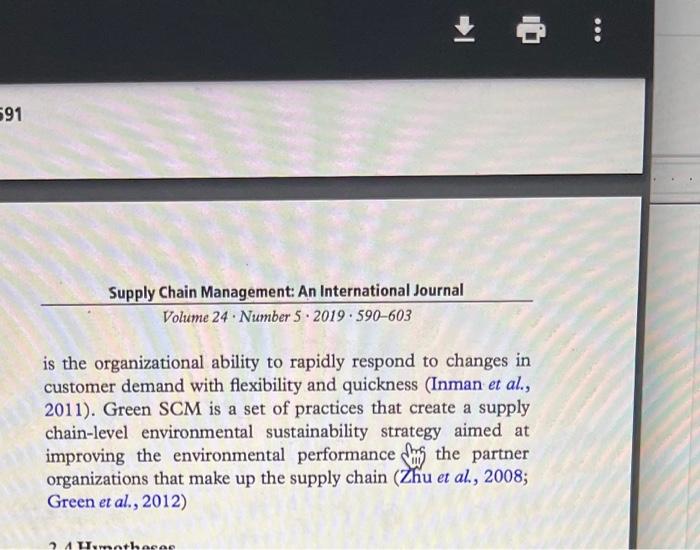
1. Look at Figure 1 on page 594 of the Green et al. (2019) article. It displays the Comprehensive Supply Chain Management Model. Note that it begins with market orientation (MO) and ends with organizational performance (OP). Now look at subsection 2.3 Construct Definitions on page 592 . How do the authors define MO and OP? Figure 1 Theorized comprehensive supply chain management model with hypotheses Notes: Legend: MO - market orientation; AM - agile production practices; JIT - Just-in-Time practices; GRN - green supply chain management practices; TQM - total quality management practices; OP - organizational performance; SCMS - supply chain management strategy 2.3 Construct definitions Market orientation is defined as the organizational ability to generate and disseminate intelligence-related customer demands and the ability to act on that intelligence to better satisfy customer demands (Kohli and Jaworski, 1990). JIT is an improvement program that focuses on the elimination of all wastes in all processes throughout the organization (Green et al., 2014). TQM is defined as a program of continuous improvement program that incorporates the unique components of customer focus, product design and statistical process control (Oakes and Westcott, 2001; Juran, 1995; Flynn et al,, 1995). SCM is the ability to integrate and coordinate business processes and management improvement programs throughout the supply chain for the purpose of satisfying the ultimate customers of the supply chain (Green et al., 2012). AP is the organizational ability to rapidly respond to changes in customer demand with flexibility and quickness (Inman et al., 2011). Green SCM is a set of practices that create a supply chain-level environmental sustainability strategy aimed at improving the environmental performance firg the partner organizations that make up the supply chain (Zhu et al., 2008; Green et al., 2012) 1. Look at Figure 1 on page 594 of the Green et al. (2019) article. It displays the Comprehensive Supply Chain Management Model. Note that it begins with market orientation (MO) and ends with organizational performance (OP). Now look at subsection 2.3 Construct Definitions on page 592 . How do the authors define MO and OP? Figure 1 Theorized comprehensive supply chain management model with hypotheses Notes: Legend: MO - market orientation; AM - agile production practices; JIT - Just-in-Time practices; GRN - green supply chain management practices; TQM - total quality management practices; OP - organizational performance; SCMS - supply chain management strategy 2.3 Construct definitions Market orientation is defined as the organizational ability to generate and disseminate intelligence-related customer demands and the ability to act on that intelligence to better satisfy customer demands (Kohli and Jaworski, 1990). JIT is an improvement program that focuses on the elimination of all wastes in all processes throughout the organization (Green et al., 2014). TQM is defined as a program of continuous improvement program that incorporates the unique components of customer focus, product design and statistical process control (Oakes and Westcott, 2001; Juran, 1995; Flynn et al,, 1995). SCM is the ability to integrate and coordinate business processes and management improvement programs throughout the supply chain for the purpose of satisfying the ultimate customers of the supply chain (Green et al., 2012). AP is the organizational ability to rapidly respond to changes in customer demand with flexibility and quickness (Inman et al., 2011). Green SCM is a set of practices that create a supply chain-level environmental sustainability strategy aimed at improving the environmental performance firg the partner organizations that make up the supply chain (Zhu et al., 2008; Green et al., 2012)
Step by Step Solution
There are 3 Steps involved in it
1 Expert Approved Answer
Step: 1 Unlock

Question Has Been Solved by an Expert!
Get step-by-step solutions from verified subject matter experts
Step: 2 Unlock
Step: 3 Unlock
 Study Help