







Question: Please answer question 2. 1. Consider A Rn*n with elements aij defined as follows: 1 if i j; i-1...n,j-1...n 2 if i-j +1; i-2...n,j-1...n-1 0
Please answer question 2.
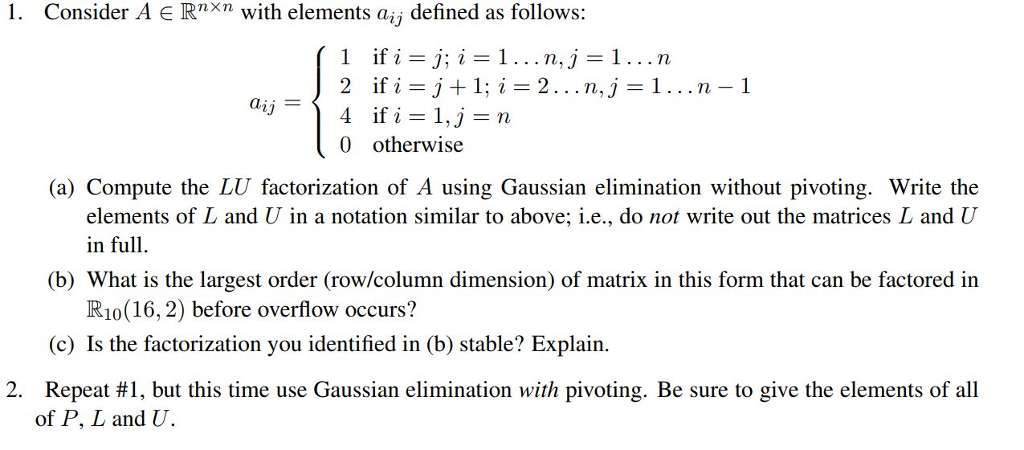
1. Consider A Rn*n with elements aij defined as follows: 1 if i j; i-1...n,j-1...n 2 if i-j +1; i-2...n,j-1...n-1 0 otherwise (a) Compute the LU factorization of A using Gaussian elimination without pivoting. Write the elements of L and U in a notation similar to above; i.e., do not write out the matrices L and U in full (b) What is the largest order (row/column dimension) of matrix in this form that can be factored in R10 (16,2) before overflow occurs? (c) Is the factorization you identified in (b) stable? Explain. Repeat #1, but this time use Gaussian elimination with pivoting. Be sure to give the elements of all 2. of P, L and U 1. Consider A Rn*n with elements aij defined as follows: 1 if i j; i-1...n,j-1...n 2 if i-j +1; i-2...n,j-1...n-1 0 otherwise (a) Compute the LU factorization of A using Gaussian elimination without pivoting. Write the elements of L and U in a notation similar to above; i.e., do not write out the matrices L and U in full (b) What is the largest order (row/column dimension) of matrix in this form that can be factored in R10 (16,2) before overflow occurs? (c) Is the factorization you identified in (b) stable? Explain. Repeat #1, but this time use Gaussian elimination with pivoting. Be sure to give the elements of all 2. of P, L and U
Step by Step Solution
There are 3 Steps involved in it

Get step-by-step solutions from verified subject matter experts
 Study Help