







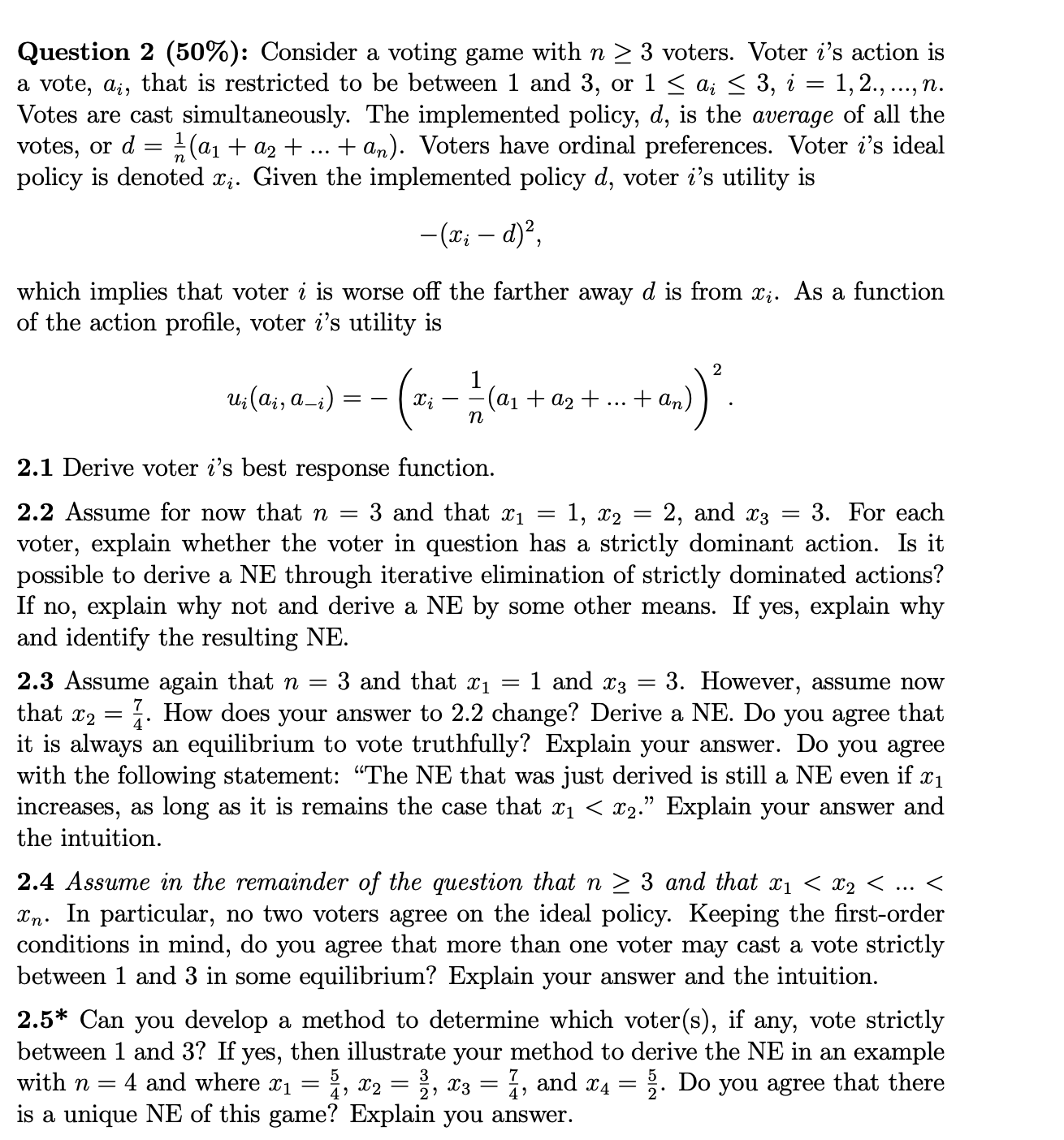
Question: please answer Question 2 (50%): Consider a voting game with n 2 3 voters. Voter i's action is a vote, a,, that is restricted to
please answer
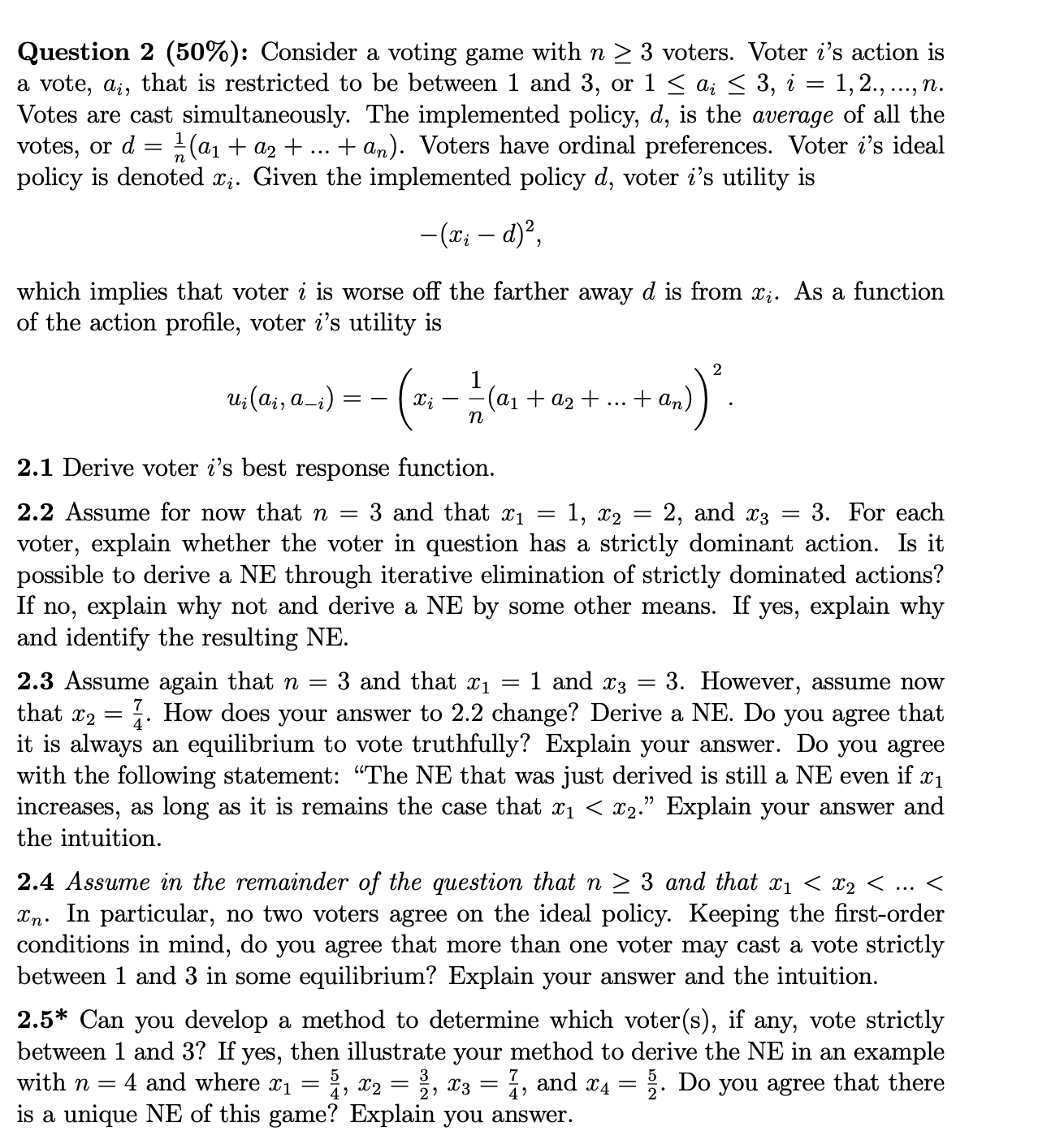
Question 2 (50%): Consider a voting game with n 2 3 voters. Voter i's action is a vote, a,, that is restricted to be between 1 and 3, or 1 5 a,- S 3, z' = 1,2., ...,n. Votes are cast simultaneously. The implemented policy, at, is the average of all the votes, or d = al + a2 + + an). Voters have ordinal preferences. Voter t's ideal policy is denoted 33,-. Given the implemented policy d, voter 71's utility is _("L'1' _ (021 which implies that voter z' is worse off the farther away d is from 33,-. As a function of the action prole, voter i's utility is 1 2 a,(a,,a_,-) = (so, E(a1 +a2 + +a,,)) . 2.1 Derive voter t's best response function. 2.2 Assume for now that n = 3 and that 3:1 = 1, m2 = 2, and :03 = 3. For each voter, explain whether the voter in question has a strictly dominant action. Is it possible to derive a NE through iterative elimination of strictly dominated actions? If no, explain why not and derive a NE by some other means. If yes, explain why and identify the resulting NE. 2.3 Assume again that n = 3 and that 331 = 1 and x3 = 3. However, assume now that :52 = 2. How does your answer to 2.2 change? Derive a NE. Do you agree that it is always an equilibrium to vote truthfully? Explain your answer. Do you agree with the following statement: \"The NE that was just derived is still a NE even if :61 increases, as long as it is remains the case that 3:1
Step by Step Solution
There are 3 Steps involved in it

Get step-by-step solutions from verified subject matter experts
 Study Help