







Question: Please answer question #3!! Case: The Court Decides: Johnson v. Misericordia Community Hospital. 248 The Law of Healthcare Administration (continued from previous page) Discussion Questions
Please answer question #3!!
Case:
The Court Decides: Johnson v. Misericordia Community Hospital.
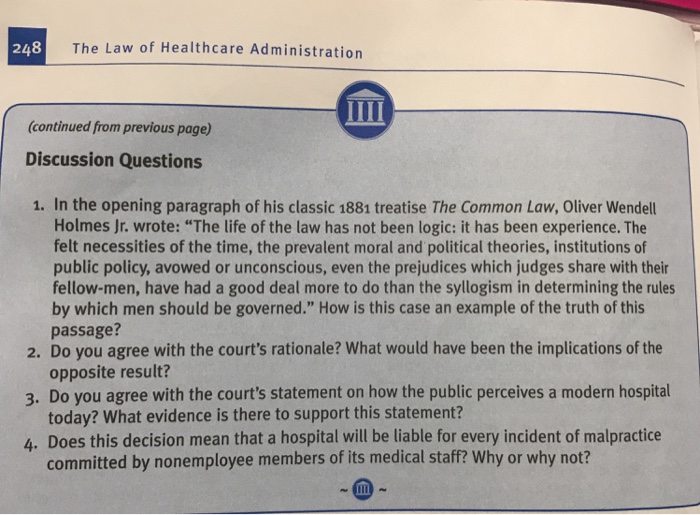
248 The Law of Healthcare Administration (continued from previous page) Discussion Questions 1. In the opening paragraph of his classic 1881 treatise The Common Law, Oliver Wendell Holmes Jr. wrote: "The life of the law has not been logic: it has been experience. The felt necessities of the time, the prevalent moral and political theories, institutions of public policy, avowed or unconscious, even the prejudices which judges share with their fellow-men, have had a good deal more to do than the syllogism in determining the rules by which men should be governed." How is this case an example of the truth of this passage? 2. Do you agree with the court's rationale? What would have been the implications of the opposite result? 3. Do you agree with the court's statement on how the public perceives a modern hospital today? What evidence is there to support this statement? 1. Does this decision mean that a hospital will be liable for every incident of malpractice committed by nonemployee members of its medical staff? Why or why not? 248 The Law of Healthcare Administration (continued from previous page) Discussion Questions 1. In the opening paragraph of his classic 1881 treatise The Common Law, Oliver Wendell Holmes Jr. wrote: "The life of the law has not been logic: it has been experience. The felt necessities of the time, the prevalent moral and political theories, institutions of public policy, avowed or unconscious, even the prejudices which judges share with their fellow-men, have had a good deal more to do than the syllogism in determining the rules by which men should be governed." How is this case an example of the truth of this passage? 2. Do you agree with the court's rationale? What would have been the implications of the opposite result? 3. Do you agree with the court's statement on how the public perceives a modern hospital today? What evidence is there to support this statement? 1. Does this decision mean that a hospital will be liable for every incident of malpractice committed by nonemployee members of its medical staff? Why or why notStep by Step Solution
There are 3 Steps involved in it
1 Expert Approved Answer
Step: 1 Unlock

Question Has Been Solved by an Expert!
Get step-by-step solutions from verified subject matter experts
Step: 2 Unlock
Step: 3 Unlock
 Study Help