



Question: Please Answer Question 4, completing what is stated in question 3 but for cyclobutadiene rather than benzene One of the main reasons for the stability
Please Answer Question 4, completing what is stated in question 3 but for cyclobutadiene rather than benzene
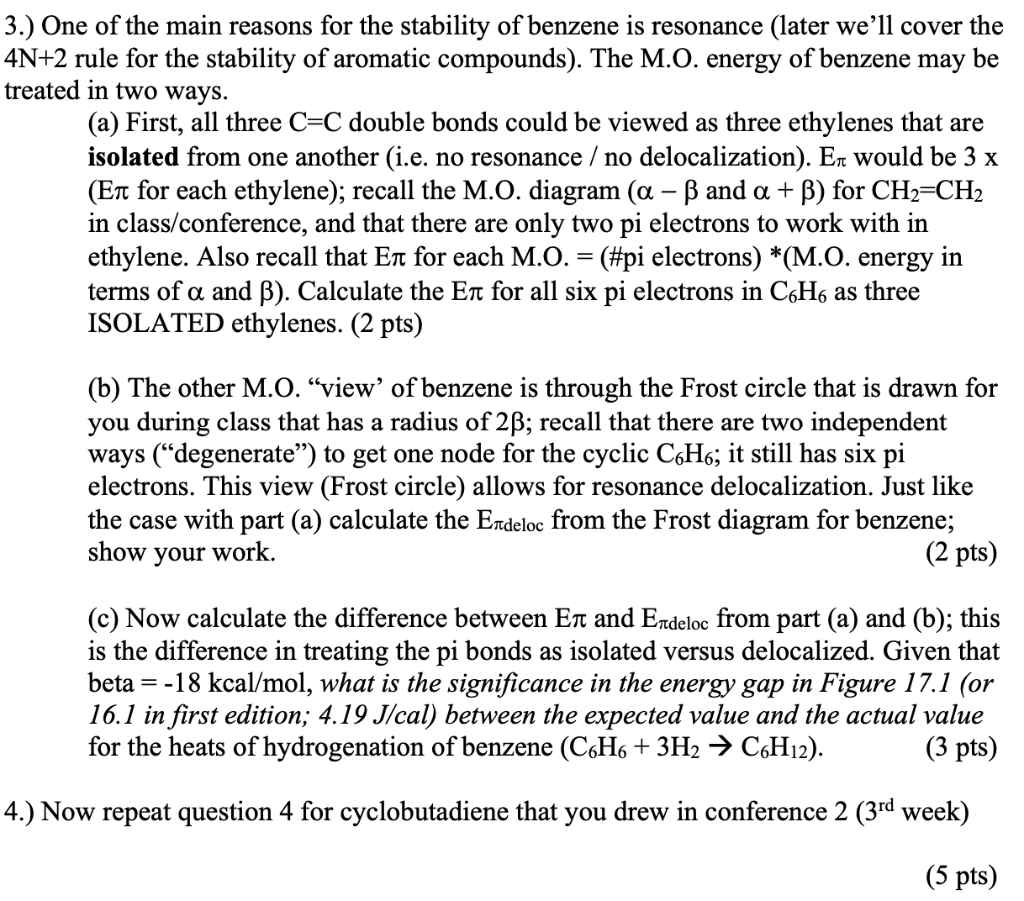
One of the main reasons for the stability of benzene is resonance (later we'll cover the N+2 rule for the stability of aromatic compounds). The M.O. energy of benzene may be reated in two ways. (a) First, all three C=C double bonds could be viewed as three ethylenes that are isolated from one another (i.e. no resonance / no delocalization). E would be 3x (E for each ethylene); recall the M.O. diagram ( and +) for CH2=CH2 in class/conference, and that there are only two pi electrons to work with in ethylene. Also recall that E for each M.O. =(# pi electrons) (M.O. energy in terms of and ). Calculate the E for all six pi electrons in C6H6 as three ISOLATED ethylenes. ( 2 pts) (b) The other M.O. "view' of benzene is through the Frost circle that is drawn for you during class that has a radius of 2; recall that there are two independent ways ("degenerate") to get one node for the cyclic C6H6; it still has six pi electrons. This view (Frost circle) allows for resonance delocalization. Just like the case with part (a) calculate the Edeloc from the Frost diagram for benzene; show your work. (2 pts) (c) Now calculate the difference between E and Edeloc from part (a) and (b); this is the difference in treating the pi bonds as isolated versus delocalized. Given that beta =18kcal/mol, what is the significance in the energy gap in Figure 17.1 (or 16.1 in first edition; 4.19J/cal ) between the expected value and the actual value for the heats of hydrogenation of benzene (C6H6+3H2C6H12). (3 pts) Now repeat question 4 for cyclobutadiene that you drew in conference 2(3rd week)
Step by Step Solution
There are 3 Steps involved in it

Get step-by-step solutions from verified subject matter experts