







Question: Please answer question 5 2. Beta is often estimated by linear regression. A model commonly used is called the market model, which is: Rt Ra=
![Rt Ra= ai + Bi [RMt - Ra] + t In this](https://dsd5zvtm8ll6.cloudfront.net/si.experts.images/questions/2024/10/66ff78cb6c880_63466ff78cad7b54.jpg)
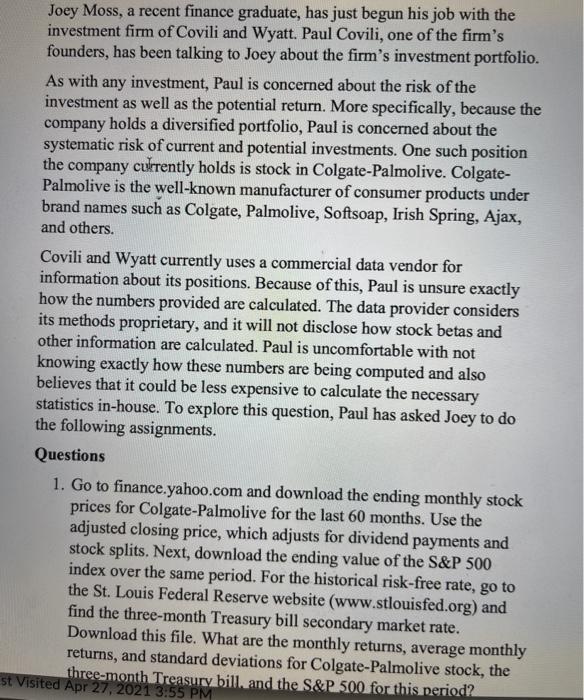
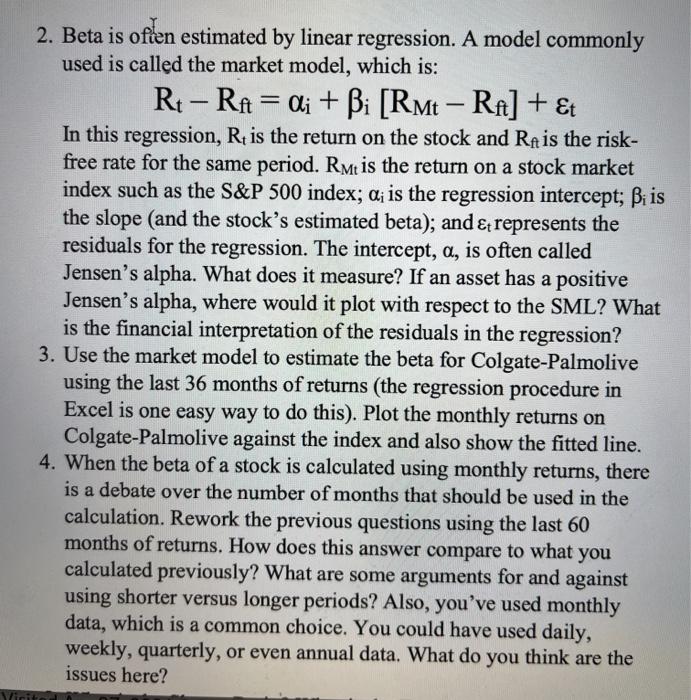
2. Beta is often estimated by linear regression. A model commonly used is called the market model, which is: Rt Ra= ai + Bi [RMt - Ra] + t In this regression, Rt is the return on the stock and Rais the risk- free rate for the same period. RMt is the return on a stock market index such as the S&P 500 index; a; is the regression intercept; B; is the slope (and the stocks estimated beta); and et represents the residuals for the regression. The intercept, a, is often called Jensen's alpha. What does it measure? If an asset has a positive Jensen's alpha, where would it plot with respect to the SML? What is the financial interpretation of the residuals in the regression? 3. Use the market model to estimate the beta for Colgate-Palmolive using the last 36 months of returns (the regression procedure in Excel is one easy way to do this). Plot the monthly returns on Colgate-Palmolive against the index and also show the fitted line. 4. When the beta of a stock is calculated using monthly returns, there is a debate over the number of months that should be used in the calculation. Rework the previous questions using the last 60 months of returns. How does this answer compare to what you calculated previously? What are some arguments for and against using shorter versus longer periods? Also, you've used monthly data, which is a common choice. You could have used daily, weekly, quarterly, or even annual data. What do you think are the issues here? licit issues here? 5. What is the Sharpe Ratio? What is the Treynor ratio? What is the information ratio? (using the last 36 months of returns)
Step by Step Solution
There are 3 Steps involved in it

Get step-by-step solutions from verified subject matter experts
 Study Help