







Question: Please answer question 5 an and b. Show work. 5. Sketch the following graphs and label the asymptote(s) if existed. Then, state their domain, range
Please answer question 5 an and b. Show work.
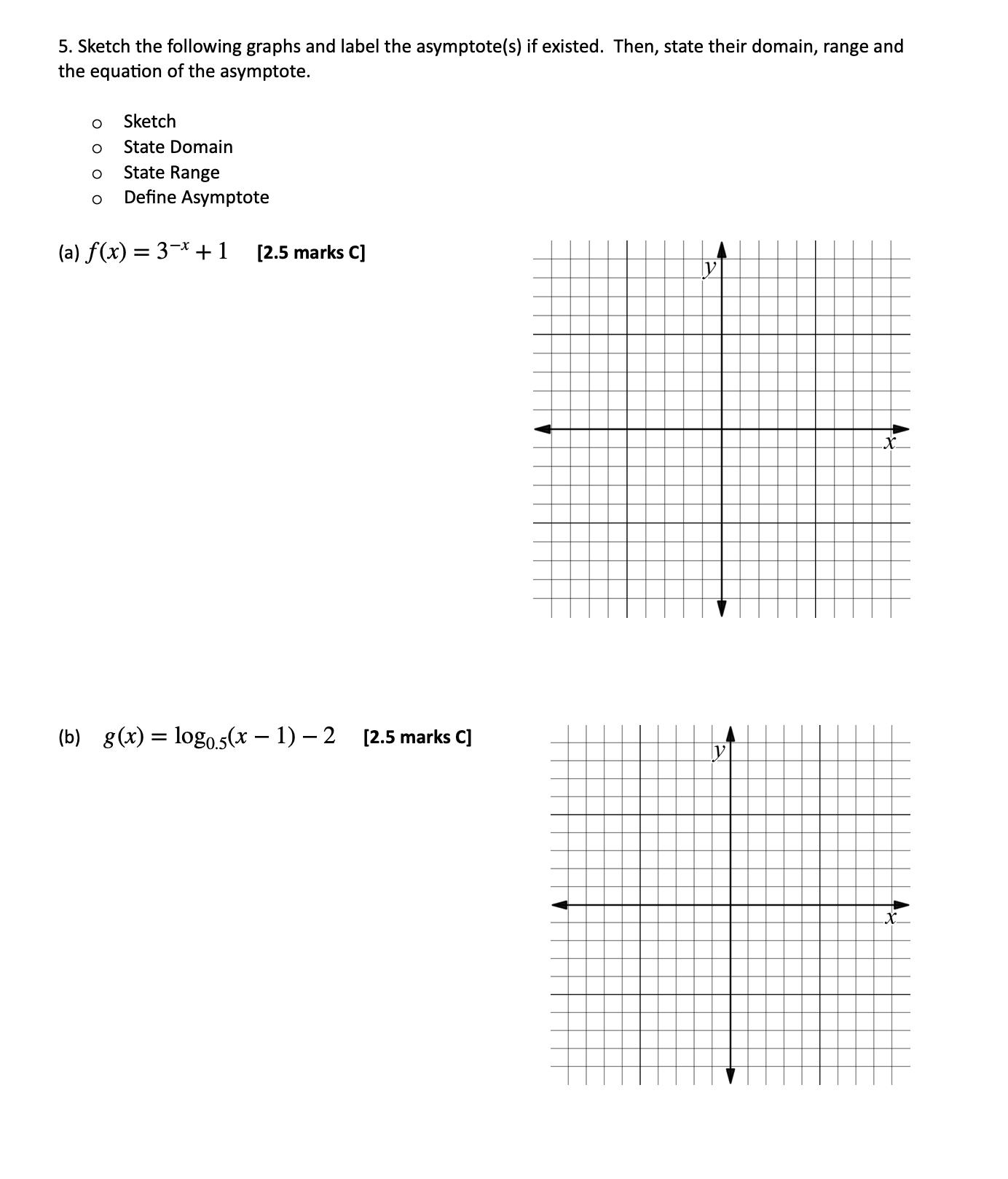
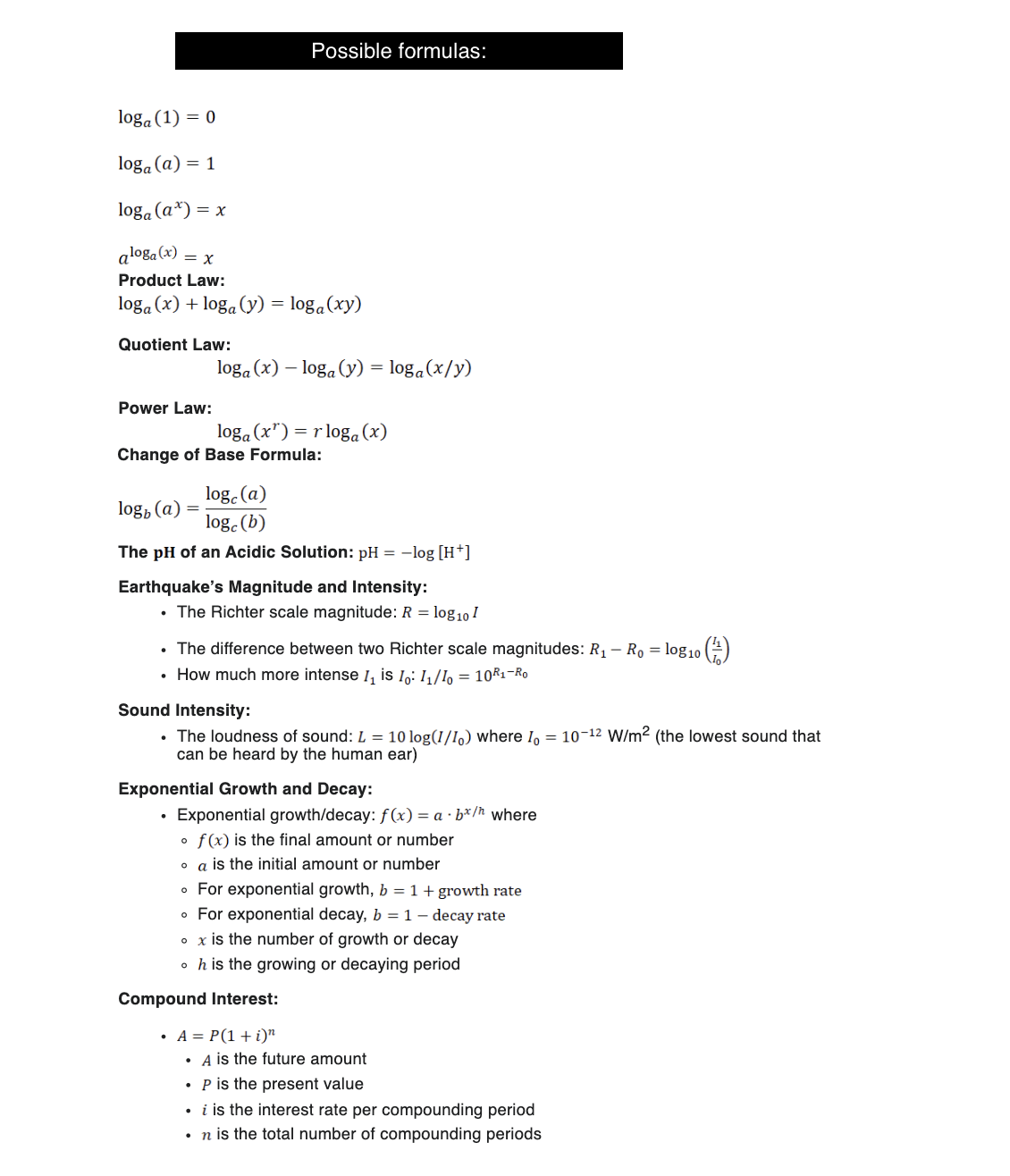
5. Sketch the following graphs and label the asymptote(s) if existed. Then, state their domain, range and the equation of the asymptote. O Sketch O State Domain State Range o Define Asymptote (a) f(x) = 3-* +1 [2.5 marks C] (b) 8(x) = 10go.5(x - 1) - 2 [2.5 marks C]Possible formulas: log,(1) =0 log,(a)=1 log,(a) = x a]8a () X Product Law: loga (x) + loga (y) = loga (xy) Quotient Law: logg (x) log, (y) = loga(x/y) Power Law: log, (x") = rlog, (x) Change of Base Formula: log.(a) log.(b) The pH of an Acidic Solution: pH = log [H] log, (a) = Earthquake's Magnitude and Intensity: - The Richter scale magnitude: R =logo I The difference between two Richter scale magnitudes: R, Ry = log, C') 0 How much more intense I, is I, I, /I, = 10817 %o Sound Intensity: . The loudness of sound: L = 10 log(i/I,) where I, = 10712 W/m? (the lowest sound that can be heard by the human ear) Exponential Growth and Decay: Exponential growth/decay: f(x) = a - b*/* where o f(x) is the final amount or number o g is the initial amount or number o For exponential growth, b = 1 + growth rate o For exponential decay, b = 1 decay rate o x is the number of growth or decay o his the growing or decaying period Compound Interest: A=P(A+D" A is the future amount = P is the present value = i is the interest rate per compounding period n is the total number of compounding periods
Step by Step Solution
There are 3 Steps involved in it

Get step-by-step solutions from verified subject matter experts
 Study Help