







Question: please answer question 5 and complete A through D CareMedi Importing Medical Supplies ahead of a Pandemic - The Year 2023 CareMed Inc. sells a
![medical supplies used in hospitals and private practices [see Appendix 1]. CareMed](https://dsd5zvtm8ll6.cloudfront.net/si.experts.images/questions/2024/11/67304020aa025_39267304020244a9.jpg)
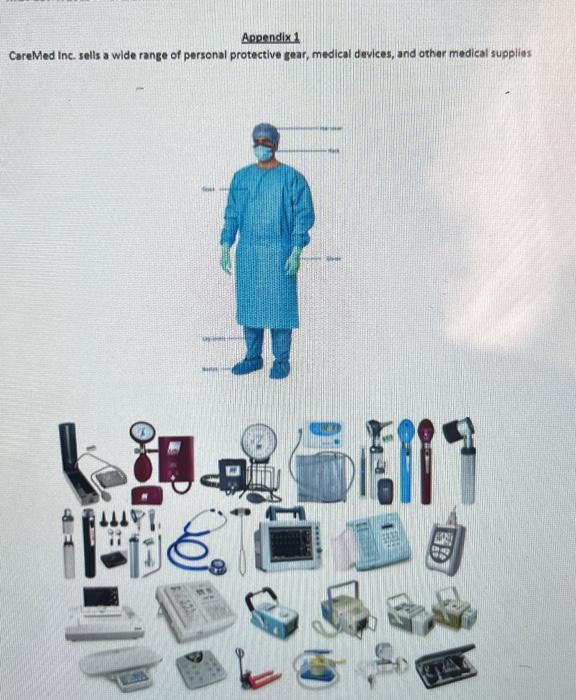
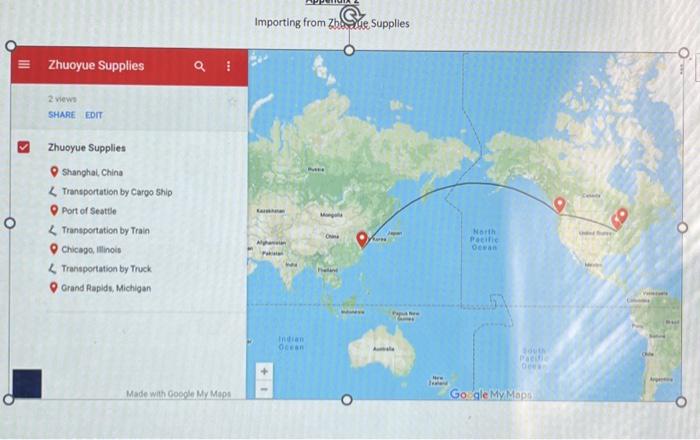
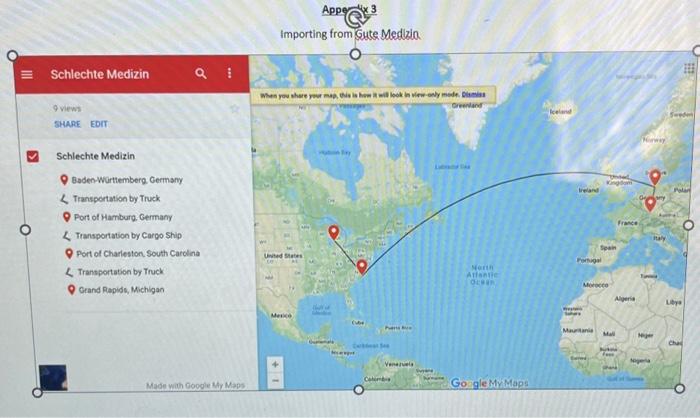
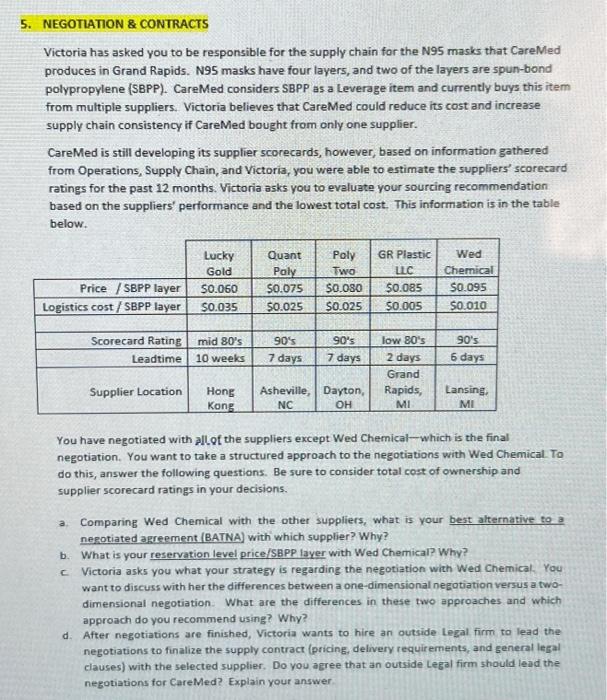
CareMedi Importing Medical Supplies ahead of a Pandemic - The Year 2023 CareMed Inc. sells a wide range of personal protective gear, medical devices, and other medical supplies used in hospitals and private practices [see Appendix 1]. CareMed was founded ten years ago by Morgan Melendez and Victoris Contreras, two nurses who met while completing their MBAs at Grand Valley State University. The company is headquartered in Grand Rapids, Michigan, and has 623 amployees and revenues of nearly $1 billion per year. CareMed's sales occur in the United States. However, the company imports 80% of its products from suppliers outside the US. To manage international suppliers, the company has offices in Shanghai, Chins, and Eindhoven, Netherlands. The medical device market in the US is governed by strict regulations and standards, designed to ensure patient safety. Imported medical equipment must undergo rigorous government certification before it can be sold in US markets. Certifying that imported supplies meet US regulatory standards rapresents one of the bigsest cost drivers for CareMed. Morgan and Victoria have been watching the news closely and are concerned about a novel coronavirus that has emerged in Central Asia. The new virus, called the Eurasian Steppe Virus 2023 (or ESV-2023), is highly contagious and has been spreading quickly westward from Georgia to Russia and Turkey. China and other Asian countries to the east have not yet been affected. The World Health Organization (WHO) has been closely monitoring the virur's spread. The WHO is working closely with the government of Turkey to stop the spread of the virus, but these efforts have been hampered by the political instability in the region and a lack of funding from the international community. If the WHO's afforts are unsuccessful, the virus could reach Europe and the US in 6 weeks to 8 weeks. Morgan and Victoria think that it is only a matter of time before the virus spreads to Europe and the United States. When that happens, Morgan and Victoria are expecting a major surge in demand for exactly the types of medical supplies that CareMed sells. When that happens, CareMed expects annual unit sales of at least 150,000 units with average revenue per unit sale of 51,000 . To prepare for a possible surge in demand, Morgan and Victoria are considering onboarding a new supplier. They have found two potential suppliers: Zoueve Supplies located in Shanghai, China, and Gute Meglizic, located in the Baden Wuerttembers region of Germany. Thuprue-Supplies (Shanghai) Thecver specializes in high quality healthcare products. The company has annual revenues of roughly S2.2 bilion. It has long-term contracts with well-known US medical suppliers including Cardinal Health, Mckesson, and Henry Schein. The company is 1509001 certified and has been awarded the prestigious AME Award for Manufacturing Excellence. However, in-depth reporting by the Wall Street Journol sugtests that Zhepere is currently undergoing a leadership change that has caused its service leveis (lead time, on-time delivery, etc.) to drop off. The company's operations are entirely inhouse. Its production faclities Nelecktedt in the Shanghal FreeTrode Zone (SFTZ). Operating in the SFIZ provides n.owrober.9t benefits to Zouevere, This includes the elimination of usual export duties - although exports from the SFTZ are subject to the 25% taritfs recently Imposed by the US. It also makes it easier for Zbuoueg to maintain quality and comply with US medical certification guidelines. At the same time, Chinese authorities maintain tight control over the SFIZ and therefore would be able to quickly shut down exports from the SFTZ if an outbreak were to occurin China - or if political tensions with the US were to flare. If CareMed were to purchase products from Zlyoxue, the likely route would be as follows: Products would be palletized, placed in a contalner for shipment, and then moved by train a short distance to the Port of Shanghai. There, product would be losded onto a container ship. The container ship would depart Shanghal and arrive at the Port of Seattle, Washington, in approximately 13 days. At the Port of Seattie, containerized products would be load directly onto trains and shipped to Chicago via rali, In Chicago, cargo would be unloaded and palletized product would be loaded onto trucks and shipped to CareMed Warehouses in Grand Rapids. The entire process is estimated to take from 24 to 28 daya [See Appendix2]. Zhuover has a minimum order quantity of 1 container per month. Gute Medizio GmbH (Germany) Gute Medlzjo was established five years ago and had revenues of roughly 5750 million last year. The company sells a wide range of medical products. Gute Giglzjo has an outsourced production model for personal protective gear, such as mudical masks, gowns, and gloves. A network of suppliers in the Czech Republic makes the products then ship praducts to Gute Medizio for distribution. The company also operates several inhouse factories in the Baden Wuerttembers region of Germany. These inhouse factories produce medical devices such as eye and aar scopes, stethoscopes, blood pressure monitors, and other small-scale equipment. Guse, Mitdjijo then ships all products from Germany to customers around the world. Gute Medirjo representatives suggested that both the personal protective gear and medical aquipment are compliant with US standards, although it is not clear whether this is the same as being cartifled. CareMed has asked for additional information on this point but has not heard back from their contact yet. Still, the company has executed some short-term contracts for a few well-known medical equipment companies. If CareMed were to purchase products from Gute-Wedlzio, the likely route would be as follows: Products warehoused in Baden Wuerttemberg, in southern Germany, would be pallatized, placed on trucks, and shipped to the Port of Hamburg. In northern Germany. From there, products would be loaded into a shipping container and placed onto a container ship. The container ship would depart Hamburg and arrive at the Port of Charleston, South Carolina, in approximately 21 days. At the Port of Charleston, palletized product would be loaded back onto trucks and shipped to CareMed warehouses in Grand Raplds. The entire process is estimated to take from 28 to 31 days (See Appendix 3). Gute. Medliajo has a minimum order quantity of 2 containers per month. CareMed's internal Production Capabilities CareMed is primarily a medical supplies distributor. In other words, CareMed typleally purchases finished goods from external supplirs and then solls them to customers in the US. As noted above, all. of CareMed's sales occur in the US and the company imports 80% of its products from international suppliers. Still, CareMed does have some options for internal production. It has a small inhouse facility that produces personal protective gear. This facility produced about 10%6 of CareMed's medical supplies last year. But with an expansion, Morgan and Victoria think that the facility could ramp up production to a volume aqua to approximately 50% of the expected increase in sales. Such an expansion would require substantial fixed investment and the redesign of existing processes. An expanded tacility would likely be able to begin production in 12 weeks. Relevant Data CareMed has collected the following data to conduct is analysis of its different potential options. Costs for Appendix.1 c Zhuoyue Supplies O Shanghal, China 4 Transportation by Cargo ship 9 Port of seatlle \& Transportation by Train P Chicago, illinois \& Transportation by Truck Grand Rapids, Michigan Schlechte Medizin Baden Wurttemberg Cermany Transpertation by Truck Port of Hamburg. Germany Transportation by Cargo Ship Port of Charleston South Carclina 4 Transportation by Truck Grand Rapids, Michigan 5. NEGOTLATION \& CONTRACTS Victoria has asked you to be responsible for the supply chain for the N95 masks that CareMled produces in Grand Rapids. N95 masks have four layers, and two of the layers are spun-bond polypropylene (SBPP). CareMed considers SBPP as a Leverage item and currently buys this item from multiple suppliers. Victoria believes that CareMed could reduce its cost and increase supply chain consistency if CareMed bought from only one supplier. CareMed is still developing its supplier scorecards, however, based on information gathered from Operations, Supply Chain, and Victoria, you were able to estimate the suppliers' scorecard ratings for the past 12 months. Victoria asks you to evaluate your sourcing recommendation based on the suppliers' performance and the lowest total cost. This information is in the table below. You have negotiated with allot the suppliers except Wed Chemical-which is the final negotiation. You want to take a structured approach to the negotiations with Wed Chemical To do this, answer the following questions. Be sure to consider total cost of ownership and supplier scorecard ratings in your decisions. a. Comparing Wed Chemical with the other suppliers, what is your best alternative to a negotiated agreement (BATNA) with which supplier? Why? b. What is your reservation level price/SBPP layer with Wed Chemical? Why? c. Victoria asks you what your strategy is regarding the negotiation with Wed Chemical. You want to discuss with her the differences between a one-dimensional negotiation versus a twodimensional negotiation. What are the differences in these two approaches and which approach do you recommend using? Why? d. After negotiations are finished, Victoria wants to hire an outside legal firm to lead the negotiations to finalize the supply contract (pricing, delivery requirements, and general legal. clauses) with the selected supplier. Do you agree that an outside Legal firm should lead the negotiations for CareMed? Explain your answer CareMedi Importing Medical Supplies ahead of a Pandemic - The Year 2023 CareMed Inc. sells a wide range of personal protective gear, medical devices, and other medical supplies used in hospitals and private practices [see Appendix 1]. CareMed was founded ten years ago by Morgan Melendez and Victoris Contreras, two nurses who met while completing their MBAs at Grand Valley State University. The company is headquartered in Grand Rapids, Michigan, and has 623 amployees and revenues of nearly $1 billion per year. CareMed's sales occur in the United States. However, the company imports 80% of its products from suppliers outside the US. To manage international suppliers, the company has offices in Shanghai, Chins, and Eindhoven, Netherlands. The medical device market in the US is governed by strict regulations and standards, designed to ensure patient safety. Imported medical equipment must undergo rigorous government certification before it can be sold in US markets. Certifying that imported supplies meet US regulatory standards rapresents one of the bigsest cost drivers for CareMed. Morgan and Victoria have been watching the news closely and are concerned about a novel coronavirus that has emerged in Central Asia. The new virus, called the Eurasian Steppe Virus 2023 (or ESV-2023), is highly contagious and has been spreading quickly westward from Georgia to Russia and Turkey. China and other Asian countries to the east have not yet been affected. The World Health Organization (WHO) has been closely monitoring the virur's spread. The WHO is working closely with the government of Turkey to stop the spread of the virus, but these efforts have been hampered by the political instability in the region and a lack of funding from the international community. If the WHO's afforts are unsuccessful, the virus could reach Europe and the US in 6 weeks to 8 weeks. Morgan and Victoria think that it is only a matter of time before the virus spreads to Europe and the United States. When that happens, Morgan and Victoria are expecting a major surge in demand for exactly the types of medical supplies that CareMed sells. When that happens, CareMed expects annual unit sales of at least 150,000 units with average revenue per unit sale of 51,000 . To prepare for a possible surge in demand, Morgan and Victoria are considering onboarding a new supplier. They have found two potential suppliers: Zoueve Supplies located in Shanghai, China, and Gute Meglizic, located in the Baden Wuerttembers region of Germany. Thuprue-Supplies (Shanghai) Thecver specializes in high quality healthcare products. The company has annual revenues of roughly S2.2 bilion. It has long-term contracts with well-known US medical suppliers including Cardinal Health, Mckesson, and Henry Schein. The company is 1509001 certified and has been awarded the prestigious AME Award for Manufacturing Excellence. However, in-depth reporting by the Wall Street Journol sugtests that Zhepere is currently undergoing a leadership change that has caused its service leveis (lead time, on-time delivery, etc.) to drop off. The company's operations are entirely inhouse. Its production faclities Nelecktedt in the Shanghal FreeTrode Zone (SFTZ). Operating in the SFIZ provides n.owrober.9t benefits to Zouevere, This includes the elimination of usual export duties - although exports from the SFTZ are subject to the 25% taritfs recently Imposed by the US. It also makes it easier for Zbuoueg to maintain quality and comply with US medical certification guidelines. At the same time, Chinese authorities maintain tight control over the SFIZ and therefore would be able to quickly shut down exports from the SFTZ if an outbreak were to occurin China - or if political tensions with the US were to flare. If CareMed were to purchase products from Zlyoxue, the likely route would be as follows: Products would be palletized, placed in a contalner for shipment, and then moved by train a short distance to the Port of Shanghai. There, product would be losded onto a container ship. The container ship would depart Shanghal and arrive at the Port of Seattle, Washington, in approximately 13 days. At the Port of Seattie, containerized products would be load directly onto trains and shipped to Chicago via rali, In Chicago, cargo would be unloaded and palletized product would be loaded onto trucks and shipped to CareMed Warehouses in Grand Rapids. The entire process is estimated to take from 24 to 28 daya [See Appendix2]. Zhuover has a minimum order quantity of 1 container per month. Gute Medizio GmbH (Germany) Gute Medlzjo was established five years ago and had revenues of roughly 5750 million last year. The company sells a wide range of medical products. Gute Giglzjo has an outsourced production model for personal protective gear, such as mudical masks, gowns, and gloves. A network of suppliers in the Czech Republic makes the products then ship praducts to Gute Medizio for distribution. The company also operates several inhouse factories in the Baden Wuerttembers region of Germany. These inhouse factories produce medical devices such as eye and aar scopes, stethoscopes, blood pressure monitors, and other small-scale equipment. Guse, Mitdjijo then ships all products from Germany to customers around the world. Gute Medirjo representatives suggested that both the personal protective gear and medical aquipment are compliant with US standards, although it is not clear whether this is the same as being cartifled. CareMed has asked for additional information on this point but has not heard back from their contact yet. Still, the company has executed some short-term contracts for a few well-known medical equipment companies. If CareMed were to purchase products from Gute-Wedlzio, the likely route would be as follows: Products warehoused in Baden Wuerttemberg, in southern Germany, would be pallatized, placed on trucks, and shipped to the Port of Hamburg. In northern Germany. From there, products would be loaded into a shipping container and placed onto a container ship. The container ship would depart Hamburg and arrive at the Port of Charleston, South Carolina, in approximately 21 days. At the Port of Charleston, palletized product would be loaded back onto trucks and shipped to CareMed warehouses in Grand Raplds. The entire process is estimated to take from 28 to 31 days (See Appendix 3). Gute. Medliajo has a minimum order quantity of 2 containers per month. CareMed's internal Production Capabilities CareMed is primarily a medical supplies distributor. In other words, CareMed typleally purchases finished goods from external supplirs and then solls them to customers in the US. As noted above, all. of CareMed's sales occur in the US and the company imports 80% of its products from international suppliers. Still, CareMed does have some options for internal production. It has a small inhouse facility that produces personal protective gear. This facility produced about 10%6 of CareMed's medical supplies last year. But with an expansion, Morgan and Victoria think that the facility could ramp up production to a volume aqua to approximately 50% of the expected increase in sales. Such an expansion would require substantial fixed investment and the redesign of existing processes. An expanded tacility would likely be able to begin production in 12 weeks. Relevant Data CareMed has collected the following data to conduct is analysis of its different potential options. Costs for Appendix.1 c Zhuoyue Supplies O Shanghal, China 4 Transportation by Cargo ship 9 Port of seatlle \& Transportation by Train P Chicago, illinois \& Transportation by Truck Grand Rapids, Michigan Schlechte Medizin Baden Wurttemberg Cermany Transpertation by Truck Port of Hamburg. Germany Transportation by Cargo Ship Port of Charleston South Carclina 4 Transportation by Truck Grand Rapids, Michigan 5. NEGOTLATION \& CONTRACTS Victoria has asked you to be responsible for the supply chain for the N95 masks that CareMled produces in Grand Rapids. N95 masks have four layers, and two of the layers are spun-bond polypropylene (SBPP). CareMed considers SBPP as a Leverage item and currently buys this item from multiple suppliers. Victoria believes that CareMed could reduce its cost and increase supply chain consistency if CareMed bought from only one supplier. CareMed is still developing its supplier scorecards, however, based on information gathered from Operations, Supply Chain, and Victoria, you were able to estimate the suppliers' scorecard ratings for the past 12 months. Victoria asks you to evaluate your sourcing recommendation based on the suppliers' performance and the lowest total cost. This information is in the table below. You have negotiated with allot the suppliers except Wed Chemical-which is the final negotiation. You want to take a structured approach to the negotiations with Wed Chemical To do this, answer the following questions. Be sure to consider total cost of ownership and supplier scorecard ratings in your decisions. a. Comparing Wed Chemical with the other suppliers, what is your best alternative to a negotiated agreement (BATNA) with which supplier? Why? b. What is your reservation level price/SBPP layer with Wed Chemical? Why? c. Victoria asks you what your strategy is regarding the negotiation with Wed Chemical. You want to discuss with her the differences between a one-dimensional negotiation versus a twodimensional negotiation. What are the differences in these two approaches and which approach do you recommend using? Why? d. After negotiations are finished, Victoria wants to hire an outside legal firm to lead the negotiations to finalize the supply contract (pricing, delivery requirements, and general legal. clauses) with the selected supplier. Do you agree that an outside Legal firm should lead the negotiations for CareMed? Explain your
Step by Step Solution
There are 3 Steps involved in it

Get step-by-step solutions from verified subject matter experts
 Study Help