







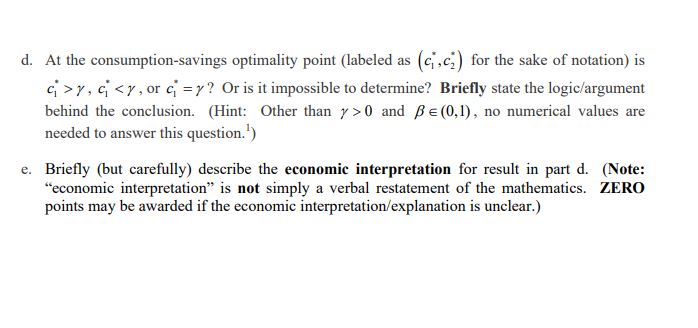
Question: Please answer question D and E based on the two images. Thank you, I will leave a good review! =) Consumption-Savings. The representative consumer's utility
Please answer question D and E based on the two images. Thank you, I will leave a good review! =)
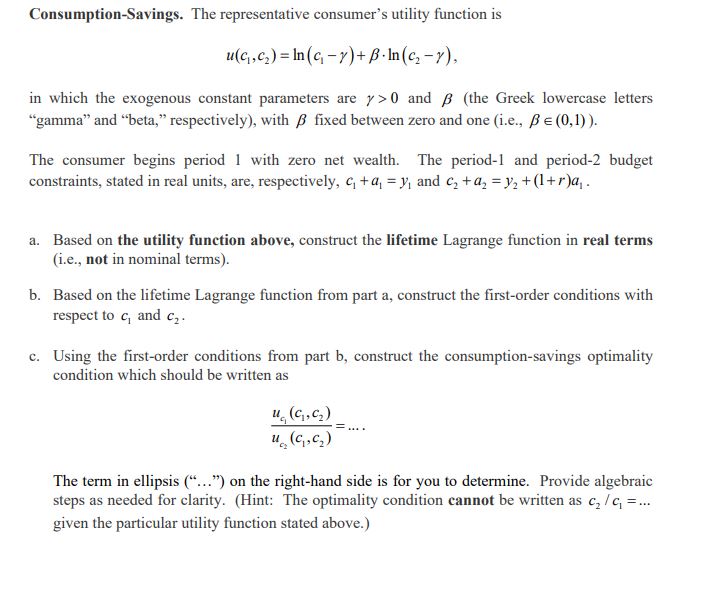
Consumption-Savings. The representative consumer's utility function is u(c , C2) = In(c - y) + B. In(cz -y). in which the exogenous constant parameters are y > 0 and B (the Greek lowercase letters "gamma" and "beta," respectively), with / fixed between zero and one (i.e., Be (0,1) ). The consumer begins period I with zero net wealth. The period-1 and period-2 budget constraints, stated in real units, are, respectively, c, +a, = y, and G, +a, =y, + (1+r)a, . a. Based on the utility function above, construct the lifetime Lagrange function in real terms (i.e., not in nominal terms). b. Based on the lifetime Lagrange function from part a, construct the first-order conditions with respect to c, and c2. c. Using the first-order conditions from part b, construct the consumption-savings optimality condition which should be written as u (G, C2) 1 ( C , C , ) The term in ellipsis ("...") on the right-hand side is for you to determine. Provide algebraic steps as needed for clarity. (Hint: The optimality condition cannot be written as c, / G =... given the particular utility function stated above.)
Step by Step Solution
There are 3 Steps involved in it

Get step-by-step solutions from verified subject matter experts
 Study Help