







Question: please answer question number 1 Note that it is very important for you to use the following rule in calculating the Quarterly Inventory Carrying Cost:
please answer question number Note that it is very important for you to use the following rule in calculating the "Quarterly Inventory Carrying Cost":
Inventory carrying costs should be based on ending quarterly inventory in excess of safety stock.
The quarterly carrying cost is $ per case, or $ per cases.
The Situation
You are the operations manager for a manufacturing plant
that produces pudding food products. One of your impor
tant responsibilities is to prepare an aggregate plan for the
plant. This plan is an important input into the annual budget
process. The plan provides information on production rates,
manufacturing labor requirements, and projected finished
goods inventory levels for the next year.
You make those little boxes of pudding mix on packag
ing lines in your plant. A packaging line has a number of
machines that are linked by conveyors. At the start of the
line, the pudding is mixed; it is then placed in small pack
ets. These packets are inserted into the small pudding boxes,
which are collected and placed in cases that hold boxes of
pudding. Finally, cases are collected and put on a pallet.
The pallets are staged in a shipping area from which they are
sent to four distribution centers. Over the years, the technol
ogy of the packaging lines has improved so that all the dif
ferent flavors can be made in relatively small batches with
no setup time to switch between flavors. The plant has of
these lines, but currently only are being used. Six employ
ees are required to run each line.
The demand for this product fluctuates from month to
month. In addition, there is a seasonal component, with peak
sales before Thanksgiving, Christmas, and Easter each year.
To complicate matters, at the end of the first quarter of each
year the marketing group runs a promotion in which special
deals are made for large purchases. Business is going well,
and the company has been experiencing a general increase
in sales.
The plant sends product to four large distribution ware
houses strategically located in the United States. Trucks move
product daily. The amounts shipped are based on maintain
ing target inventory levels at the warehouses. These targets
are calculated based on anticipated weeks of supply at each
warehouse. Current targets are set at two weeks of supply.
In the past, the company has had a policy of producing
very close to what it expects sales to be because of limited
capacity for storing finished goods. Production capacity has
been adequate to support this policy.
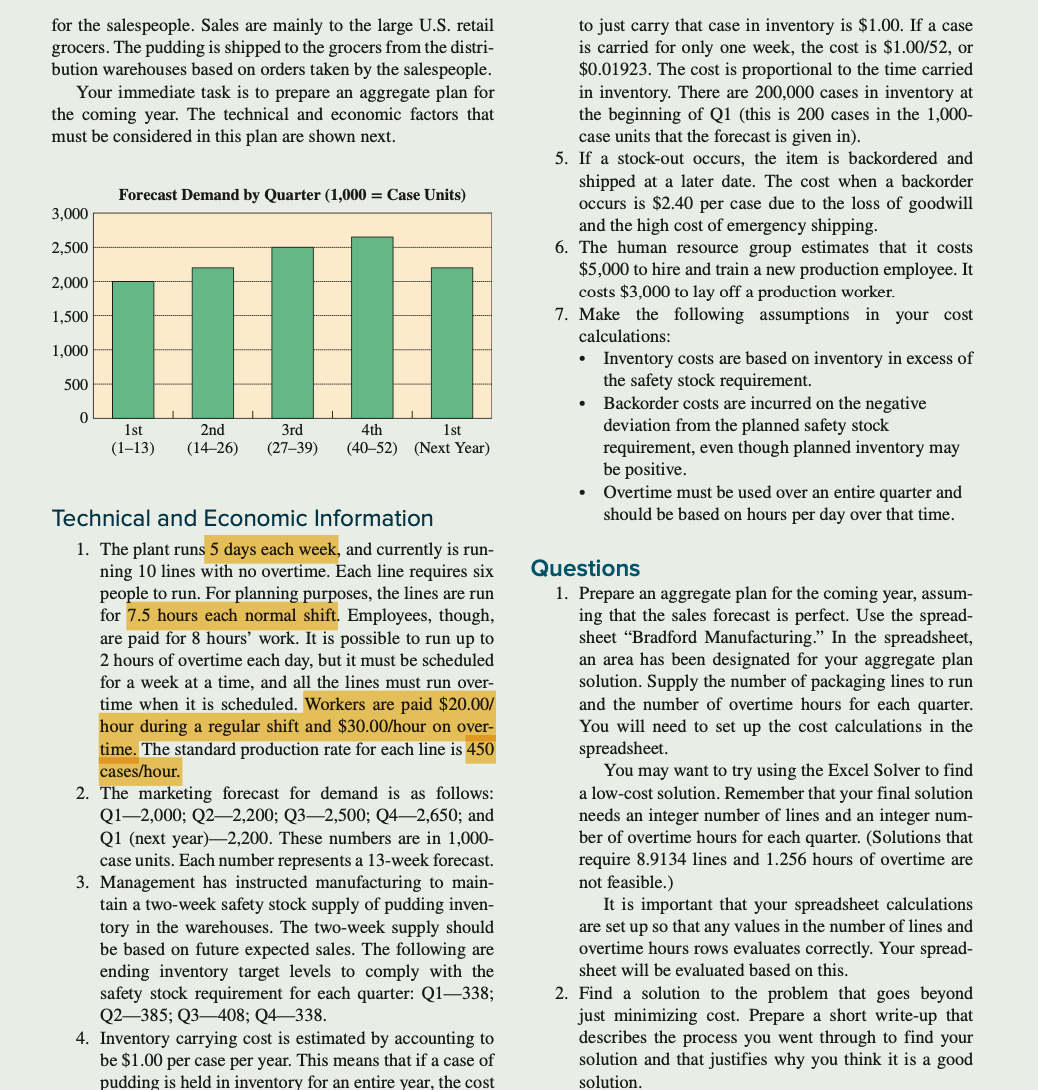
A sales forecast for next year has been prepared by the
marketing department. The forecast is based on quarterly
sales quotas, which are used to set up an incentive programfor the salespeople. Sales are mainly to the large US retail
grocers. The pudding is shipped to the grocers from the distri
bution warehouses based on orders taken by the salespeople.
Your immediate task is to prepare an aggregate plan for
the coming year. The technical and economic factors that
must be considered in this plan are shown next.
Technical and Economic Information
The plant runs days each week, and currently is run
ning lines with no overtime. Each line requires six
people to run. For planning purposes, the lines are run
for hours each normal shift. Employees, though,
are paid for hours' work. It is possible to run up to
hours of overtime each day, but it must be scheduled
for a week at a time, and all the lines must run over
time when it is scheduled. Workers are paid $
hour during a regular shift and $hour on over
time. The standard production rate for each line is
caseshour
The marketing forecast for demand is as follows:
Q; Q; Q; Q; and
Qnext year These numbers are in
case units. Each number represents a week forecast.
Management has instructed manufacturing to main
tain a twoweek safety stock supply of pudding inven
tory in the warehouses. The twoweek supply should
be based on future expected sales. The following are
ending inventory target levels to comply with the
safety stock requirement for each quarter: Q;
Q; Q; Q
Inventory carrying cost is estimated by accounting to
be $ per case per year. This means that if a case of
pudding is held in inventory for an entire year, the cost
to just carry that case in inventory is $ If a case
is carried for only one week, the cost is $ or
$ The cost is proportional to the time carried
in inventory. There are cases in inventory at
the beginning of Qthis is cases in the
case units that the forecast is given in
If a stockout occurs, the item is backordered and
shipped at a later date. The cost
Step by Step Solution
There are 3 Steps involved in it
1 Expert Approved Answer
Step: 1 Unlock

Question Has Been Solved by an Expert!
Get step-by-step solutions from verified subject matter experts
Step: 2 Unlock
Step: 3 Unlock
 Study Help