







Question: Please answer Question3 a-d no one has been answering my questions recently. Please help. 3. Simultaneous Equations. Suppose you are interested in estimating how the
Please answer Question3 a-d
no one has been answering my questions recently. Please help.
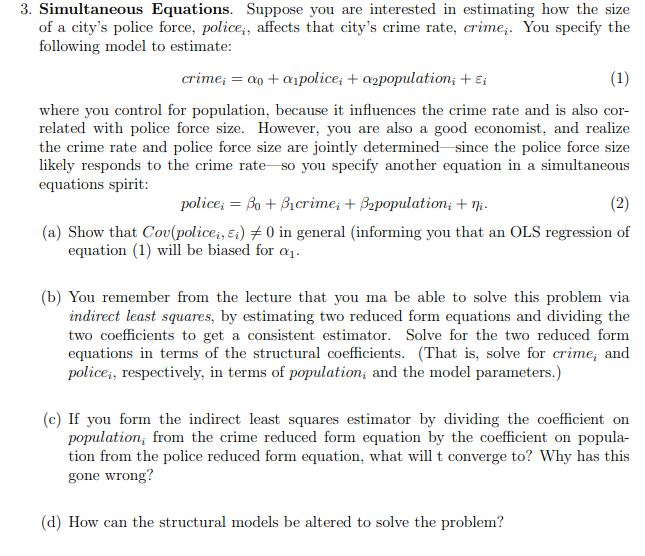
3. Simultaneous Equations. Suppose you are interested in estimating how the size of a city's police force, police,, affects that city's crime rate, crime. You specify the following model to estimate: crimei-00-alpolicei-a2populationit where you control for population, because it influences the crime rate and is also cor related with police force size. However, you are also a good economist, and realize the crime rate and police force size are jointly determined since the police force size likely responds to the crime rate so you specify another equation in a simultaneous equations spirit: police, = 0 + Acrimei + 2populationit (a) Show that Cou(policei, :) 0 in general (informing you that an OLS regression of equation (1) will be biased for a1 (b) You remember from the lecture that you ma be able to solve this problem via indirect least squares, by estimating two reduced form equations and dividing the two coefficients to get a consistent estimator. Solve for the two reduced form equations in terms of the structural coefficients. (That is, solve for crime, and policei, respectively, in terms of population and the model parameters.) (c) If you form the indirect least squares estimator by dividing the coefficient on population from the crime reduced form equation by the coefficient on popula tion from the police reduced form equation, what will t converge to? Why has this gone wrong? (d) How can the structural models be altered to solve the problem? 3. Simultaneous Equations. Suppose you are interested in estimating how the size of a city's police force, police,, affects that city's crime rate, crime. You specify the following model to estimate: crimei-00-alpolicei-a2populationit where you control for population, because it influences the crime rate and is also cor related with police force size. However, you are also a good economist, and realize the crime rate and police force size are jointly determined since the police force size likely responds to the crime rate so you specify another equation in a simultaneous equations spirit: police, = 0 + Acrimei + 2populationit (a) Show that Cou(policei, :) 0 in general (informing you that an OLS regression of equation (1) will be biased for a1 (b) You remember from the lecture that you ma be able to solve this problem via indirect least squares, by estimating two reduced form equations and dividing the two coefficients to get a consistent estimator. Solve for the two reduced form equations in terms of the structural coefficients. (That is, solve for crime, and policei, respectively, in terms of population and the model parameters.) (c) If you form the indirect least squares estimator by dividing the coefficient on population from the crime reduced form equation by the coefficient on popula tion from the police reduced form equation, what will t converge to? Why has this gone wrong? (d) How can the structural models be altered to solve the
Step by Step Solution
There are 3 Steps involved in it

Get step-by-step solutions from verified subject matter experts
 Study Help