Question: PLEASE ANSWER QUESTIONS 1 & 2 Popping the Cork Nomacore Mission: We help wineries and retailers ensure their wines present as intended, delight the consumer

PLEASE ANSWER QUESTIONS 1 & 2
PLEASE ANSWER QUESTIONS 1 & 2 Popping the CorkPLEASE ANSWER QUESTIONS 1 & 2 Popping the Cork

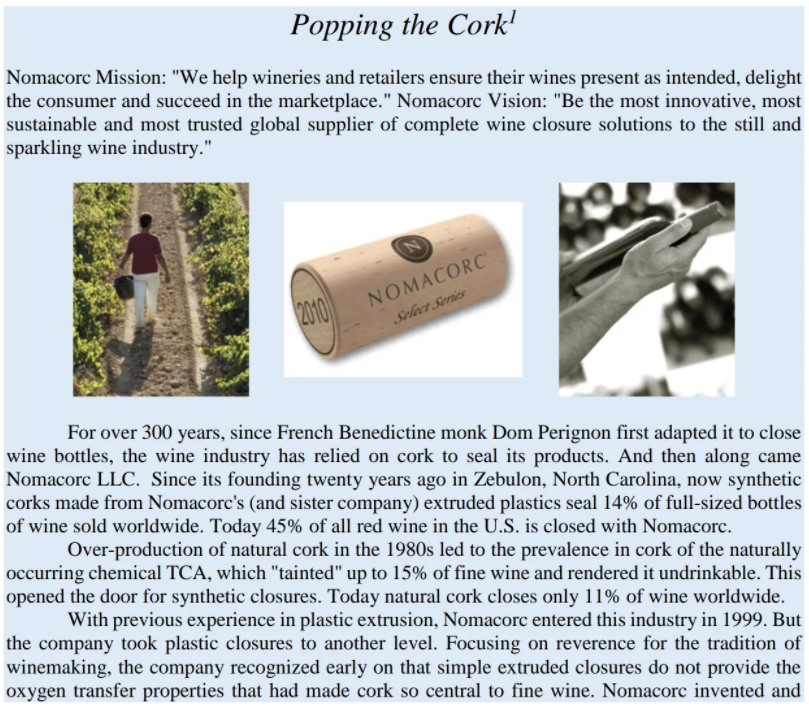
Popping the Cork Nomacore Mission: "We help wineries and retailers ensure their wines present as intended, delight the consumer and succeed in the marketplace." Nomacorc Vision: "Be the most innovative, most sustainable and most trusted global supplier of complete wine closure solutions to the still and sparkling wine industry." N 2010) NOMACORC Select Series For over 300 years, since French Benedictine monk Dom Perignon first adapted it to close wine bottles, the wine industry has relied on cork to seal its products. And then along came Nomacorc LLC. Since its founding twenty years ago in Zebulon, North Carolina, now synthetic corks made from Nomacorc's (and sister company) extruded plastics seal 14% of full-sized bottles of wine sold worldwide. Today 45% of all red wine in the U.S. is closed with Nomacorc. Over-production of natural cork in the 1980s led to the prevalence in cork of the naturally occurring chemical TCA, which "tainted" up to 15% of fine wine and rendered it undrinkable. This opened the door for synthetic closures. Today natural cork closes only 11% of wine worldwide. With previous experience in plastic extrusion, Nomacorc entered this industry in 1999. But the company took plastic closures to another level. Focusing on reverence for the tradition of winemaking, the company recognized early on that simple extruded closures do not provide the oxygen transfer properties that had made cork so central to fine wine. Nomacorc invented and patented a process for co-extruding two types of plastics into a single closure - a firm inner core to hold shape, and a spongy exterior creating better fit. They have partnered with wine research institutes and hired PhDs to study "oxygen management" issues related to types of plastic, extrusion methods, and even bottle neck design. In 2010 the company introduced its Select Series closures to precisely control oxygen ingress into wine. Their research collaborations have explored not just closures, but a full spectrum of the winemaking processes and their relationship with oxygen. In 2017 they debuted Green Line, a new "category" of closures derived from sustainable, renewable sugarcane-based raw materials. With this knowledge in hand they are now designing co-extruded closures specifically for certain wineries and their varietals. In 2020 the company owns 90 patents (with 49 patents pending) related to closures for containers and the process predicting the oxidability of a wine or grape must. In 2014 the Wine Enthusiast's number 1 pick for the year (out of 17,500 reviewed) was Abbott Claim Vineyard Pinot Noir, sealed with a Nomacore closure. In 2016 it won a Wine Business award for its new oxygen scanner technology, which for the first time enables this kind of analysis to be applied directly in the wine through the use of miniaturized disposable sensors. By 2020 Nomacorc (now owned by Vinventions) has operations on five continents. It serves 8,000 wineries in 60 countries, and has sold 25 billion wine closures since its inception. QUESTIONS 1. What are the activities this company performs that create value? Are these unique? Could other companies imitate them easily? Why or why not? 2. Do the company's activities and accomplishments fulfill its mission statement

Step by Step Solution

There are 3 Steps involved in it

1 Expert Approved Answer
Step: 1 Unlock blur-text-image

Question Has Been Solved by an Expert!

Get step-by-step solutions from verified subject matter experts

Step: 2 Unlock
Step: 3 Unlock

Students Have Also Explored These Related General Management Questions!