







Question: Please answer questions 1 and 2:) 304 CHAPTER 16 Global Leadership Case Study Honeywell Identifies Future Leadership Needs For the past year, Anshuman had been
Please answer questions 1 and 2:)
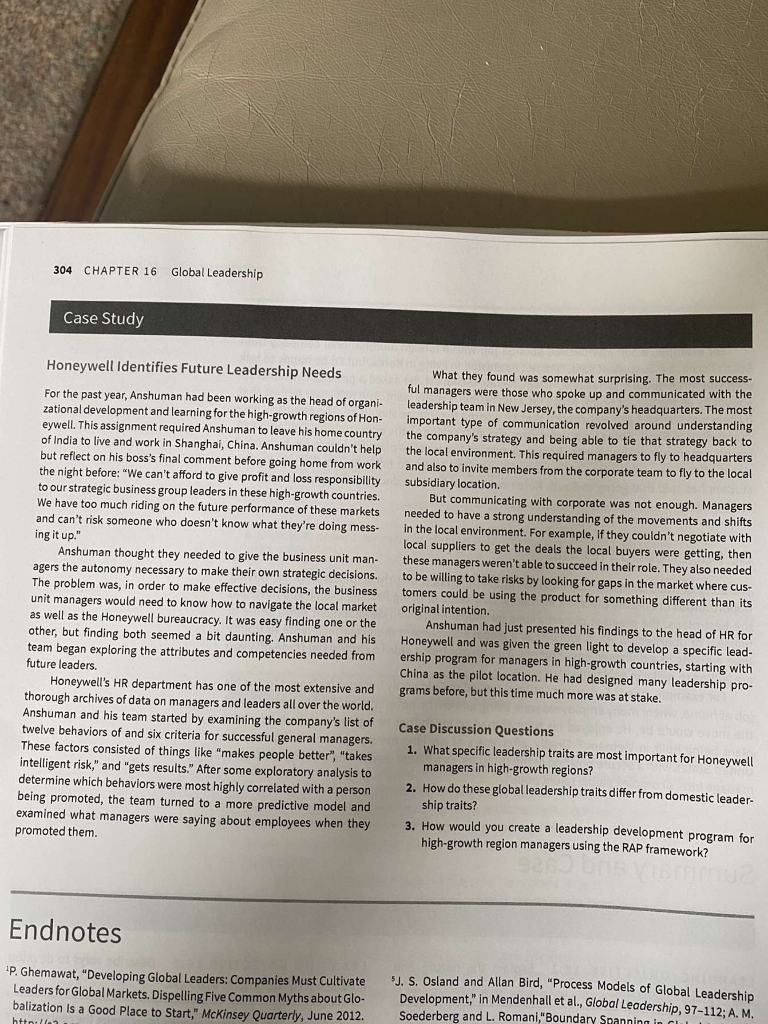
304 CHAPTER 16 Global Leadership Case Study Honeywell Identifies Future Leadership Needs For the past year, Anshuman had been working as the head of organic zational development and learning for the high-growth regions of Hon. eywell. This assignment required Anshuman to leave his home country of India to live and work in Shanghai, China. Anshuman couldn't help but reflect on his boss's final comment before going home from work the night before: "We can't afford to give profit and loss responsibility to our strategic business group leaders in these high-growth countries. We have too much riding on the future performance of these markets and can't risk someone who doesn't know what they're doing mess- ing it up." Anshuman thought they needed to give the business unit man- agers the autonomy necessary to make their own strategic decisions. The problem was, in order to make effective decisions, the business unit managers would need to know how to navigate the local market as well as the Honeywell bureaucracy. It was easy finding one or the other, but finding both seemed a bit daunting. Anshuman and his team began exploring the attributes and competencies needed from future leaders. Honeywell's HR department has one of the most extensive and thorough archives of data on managers and leaders all over the world. Anshuman and his team started by examining the company's list of twelve behaviors of and six criteria for successful general managers. These factors consisted of things like "makes people better", "takes Intelligent risk," and "gets results." After some exploratory analysis to determine which behaviors were most highly correlated with a person being promoted, the team turned to a more predictive model and examined what managers were saving about employees when they promoted them. What they found was somewhat surprising. The most success- ful managers were those who spoke up and communicated with the leadership team in New Jersey, the company's headquarters. The most important type of communication revolved around understanding the company's strategy and being able to tie that strategy back to the local environment. This required managers to fly to headquarters and also to invite members from the corporate team to fly to the local subsidiary location. But communicating with corporate was not enough. Managers needed to have a strong understanding of the movements and shifts in the local environment. For example, if they couldn't negotiate with local suppliers to get the deals the local buyers were getting, then these managers weren't able to succeed in their role. They also needed to be willing to take risks by looking for gaps in the market where cus- tomers could be using the product for something different than its original intention. Anshuman had just presented his findings to the head of HR for Honeywell and was given the green light to develop a specific lead- ership program for managers in high-growth countries, starting with China as the pilot location. He had designed many leadership pro- grams before, but this time much more was at stake. Case Discussion Questions 1. What specific leadership traits are most important for Honeywell managers in high-growth regions? 2. How do these global leadership traits differ from domestic leader. ship traits? 3. How would you create a leadership development program for high-growth region managers using the RAP framework? Endnotes P. Ghemawat, "Developing Global Leaders: Companies Must Cultivate Leaders for Global Markets. Dispelling Five Common Myths about Glo- balization is a Good Place to Start," McKinsey Quarterly, June 2012. J. S. Osland and Allan Bird, "Process Models of Global Leadership Development," in Mendenhall et al., Global Leadership, 97-112: A.M. Soederberg and L. Romani "Boundary SnanniniStep by Step Solution
There are 3 Steps involved in it
1 Expert Approved Answer
Step: 1 Unlock

Question Has Been Solved by an Expert!
Get step-by-step solutions from verified subject matter experts
Step: 2 Unlock
Step: 3 Unlock
 Study Help