







Question: please answer questions 1 through 3 and i will give you a thumbs up! The Evolution of Management Broken Down This is an article explaining
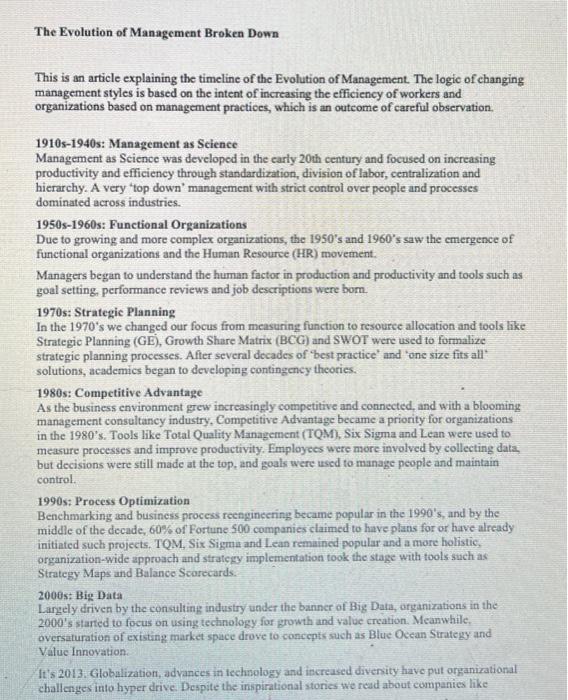
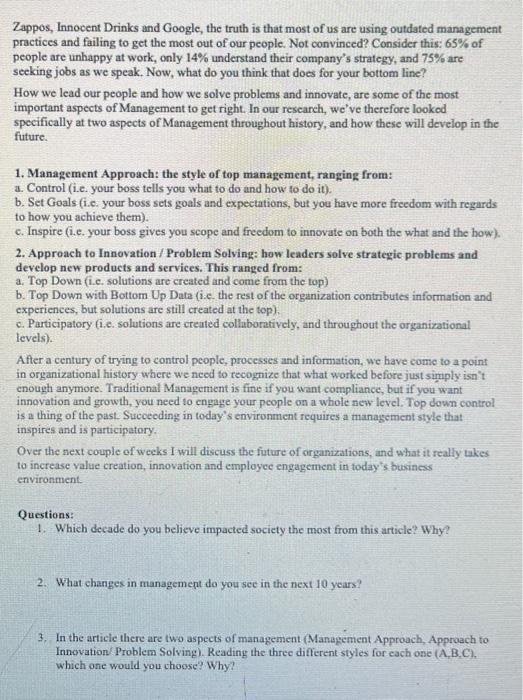
The Evolution of Management Broken Down This is an article explaining the timeline of the Evolution of Management. The logic of changing management styles is based on the intent of increasing the efficiency of workers and organizations based on management practices, which is an outeome of careful observation. 1910s-1940s: Management as Science Management as Science was developed in the carly 20 th century and focused on increasing productivity and efficiency through standardization, division of labor, centralization and hierarchy. A very 'top down' management with strict control over people and processes dominated across industries. 1950s-1960s: Functional Organizations Due to growing and more complex organizations, the 1950 's and 1960 's saw the emergence of functional organizations and the Human Resource (HR) movement. Managers began to understand the human factor in production and productivity and tools such as goal setting, performance reviews and job descriptions were born. 1970s: Strategic Planning In the 1970 's we changed our focus from measuring function to resource allocation and tools like Strategic Planning (GE), Growth Share Matrix (BCG) and SWOT were used to formalize strategic planning processes. After several decades of 'best practice' and 'one size fits all' solutions, academics began to developing contingency theories. 1980s: Competitive Advantage As the business environment grew increasingly competitive and connected, and with a blooming management consultancy industry, Competitive Advantage became a priority for organizations in the 1980's. Tools like Total Quality Management (TQM), Six Sigma and Lean were used to measure processes and improve productivity. Fmployees were more involved by collecting data, but decisions were still made at the top, and goals were used to manage people and maintain control. 1990s: Process Optimization Benchmarking and business process reengineering became popular in the 1990 's, and by the middle of the decade, 60% of Fortune 500 companies claimed to have plans for or have already initiated such projects. TQM, Six Sigma and Lean remained popular and a more holistic, organization-wide apptoach and strategy implementation took the stage with tools such as Strategy Maps and Balance Scorecards. 2000s: Big Data Largely driven by the consulting industry under the banner of Big Data, organizations in the 2000 's started to focus on using technology for growth and value creation. Meanwhile, oversaturation of existing market space drove to concepts such as Blue Ocean Strategy and Value Innovation: It's 2013. Globalization, advances in technology and increased divenity have put organizational challenges into hyper drive. Despite the inspirational stories we read about companies like Zappos, Innocent Drinks and Google, the truth is that most of us are using outdated management practices and failing to get the most out of our people. Not convinced? Consider this: 65% of people are unhappy at work, only 14% understand their company's strategy, and 75% are seeking jobs as we speak. Now, what do you think that does for your bottom line? How we lead our people and how we solve problems and innovate, are some of the most important aspects of Management to get right. In our rescareh, we've therefore looked specifically at two aspects of Management throughout history, and how these will develop in the future. 1. Management Approach: the style of top management, ranging from: a. Control (i.e. your boss tells you what to do and how to do it). b. Set Goals (i.e. your boss sets goals and expectations, but you have more freedom with regards to how you achieve them). c. Inspire (i.e. your boss gives you scope and freedom to innovate on both the what and the how). 2. Approach to Innovation / Problem Solving: how leaders solve strategic problems and develop new products and services. This ranged from: a. Top Down (i.e. solutions are created and come from the top) b. Top Down with Bottom Up Data (i.e, the rest of the organization contributes information and experiences, but solutions are still created at the top) c. Participatory (i.e. solutions are created collaboratively, and throughout the organizational levels). After a century of trying to control people, processes and information, we have come to a point in organizational history where we need to recognize that what worked before just simply isa't enough anymore. Traditional Management is fine if you want compliance, but if you want innovation and growth, you need to engage your people on a whole new level. Top down control is a thing of the past. Succeeding in today's environment requires a management style that inspires and is participatory. Over the next couple of weeks I will discuss the future of organizations, and what it really takes to increase value creation, innovation and employee engagement in today's business environment. Questions: 1. Which decade do you believe impacted society the most from this article? Why? 2. What changes in managemept do you see in the next 10 years? 3. In the article there are two aspects of management (Management Approach, Approach to Innovation/ Problem Solving). Reading the three different styles for each one (A,B,C), which one would you choose? Why
Step by Step Solution
There are 3 Steps involved in it

Get step-by-step solutions from verified subject matter experts
 Study Help