







Question: Please answer questions 13-18. Continuing Case: Cory and Tisha Dumont PART I: Financial Planning The objective of the Continuing Case is to help you synthesize
Please answer questions 13-18.
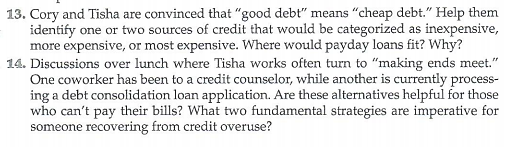
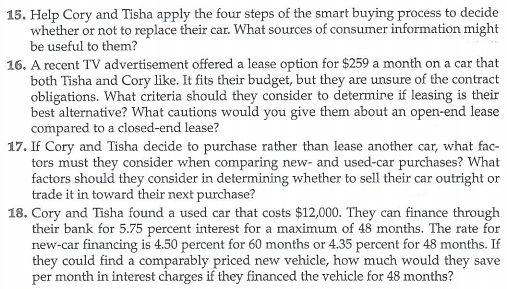
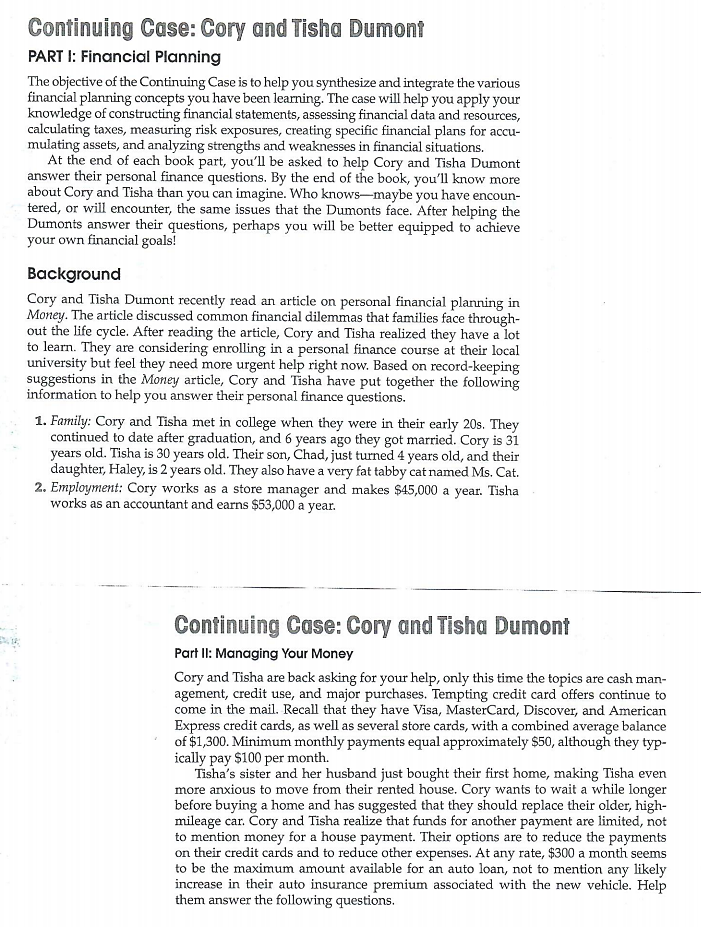
Continuing Case: Cory and Tisha Dumont PART I: Financial Planning The objective of the Continuing Case is to help you synthesize and integrate the various financial planning concepts you have been learning. The case will help you apply your knowledge of constructing financial statements, assessing financial data and resources, calculating taxes, measuring risk exposures, creating specific financial plans for accu- mulating assets, and analyzing strengths and weaknesses in financial situations. At the end of each book part, you'll be asked to help Cory and Tisha Dumont answer their personal finance questions. By the end of the book, you'll know more about Cory and Tisha than you can imagine. Who knows-maybe you have encoun- tered, or will encounter, the same issues that the Dumonts face. After helping the Dumonts answer their questions, perhaps you will be better equipped to achieve your own financial goals! Background Cory and Tisha Dumont recently read an article on personal financial planning in Money. The article discussed common financial dilemmas that families face through- out the life cycle. After reading the article, Cory and Tisha realized they have a lot to learn. They are considering enrolling in a personal finance course at their local university but feel they need more urgent help right now. Based on record-keeping suggestions in the Money article, Cory and Tisha have put together the following information to help you answer their personal finance questions. 1. Family: Cory and Tisha met in college when they were in their early 20s. They continued to date after graduation, and 6 years ago they got married. Cory is 31 years old. Tisha is 30 years old. Their son, Chad, just turned 4 years old, and their daughter, Haley, is 2 years old. They also have a very fat tabby cat named Ms. Cat. 2. Employment: Cory works as a store manager and makes $45,000 a year. Tisha works as an accountant and earns $53,000 a year. Continuing Case: Cory and Tisha Dumont Part II: Managing Your Money Cory and Tisha are back asking for your help, only this time the topics are cash man- agement, credit use, and major purchases. Tempting credit card offers continue to come in the mail. Recall that they have Visa, MasterCard, Discover, and American Express credit cards, as well as several store cards, with a combined average balance of $1,300. Minimum monthly payments equal approximately $50, although they typ- ically pay $100 per month. Tisha's sister and her husband just bought their first home, making Tisha even more anxious to move from their rented house. Cory wants to wait a while longer before buying a home and has suggested that they should replace their older, high- mileage car. Cory and Tisha realize that funds for another payment are limited, not to mention money for a house payment. Their options are to reduce the payments on their credit cards and to reduce other expenses. At any rate, $300 a month seems to be the maximum amount available for an auto loan, not to mention any likely increase in their auto insurance premium associated with the new vehicle. Help them answer the following questions. 13. Cory and Tisha are convinced that "good debt" means "cheap debt." Help them identify one or two sources of credit that would be categorized as inexpensive, more expensive, or most expensive. Where would payday loans fit? Why? 14. Discussions over lunch where Tisha works often turn to "making ends meet." One coworker has been to a credit counselor, while another is currently process- ing a debt consolidation loan application. Are these alternatives helpful for those who can't pay their bills? What two fundamental strategies are imperative for someone recovering from credit overuse? 15. Help Cory and Tisha apply the four steps of the smart buying process to decide whether or not to replace their car. What sources of consumer information might be useful to them? 16. A recent TV advertisement offered a lease option for $259 a month on a car that both Tisha and Cory like. It fits their budget, but they are unsure of the contract obligations. What criteria should they consider to determine if leasing is their best alternative? What cautions would you give them about an open-end lease compared to a closed-end lease? 17. If Cory and Tisha decide to purchase rather than lease another car, what fac- tors must they consider when comparing new- and used-car purchases? What factors should they consider in determining whether to sell their car outright or trade it in toward their next purchase? 18. Cory and Tisha found a used car that costs $12,000. They can finance through their bank for 5.75 percent interest for a maximum of 48 months. The rate for new-car financing is 4.50 percent for 60 months or 4.35 percent for 48 months. If they could find a comparably priced new vehicle, how much would they save per month in interest charges if they financed the vehicle for 48 months? Continuing Case: Cory and Tisha Dumont PART I: Financial Planning The objective of the Continuing Case is to help you synthesize and integrate the various financial planning concepts you have been learning. The case will help you apply your knowledge of constructing financial statements, assessing financial data and resources, calculating taxes, measuring risk exposures, creating specific financial plans for accu- mulating assets, and analyzing strengths and weaknesses in financial situations. At the end of each book part, you'll be asked to help Cory and Tisha Dumont answer their personal finance questions. By the end of the book, you'll know more about Cory and Tisha than you can imagine. Who knows-maybe you have encoun- tered, or will encounter, the same issues that the Dumonts face. After helping the Dumonts answer their questions, perhaps you will be better equipped to achieve your own financial goals! Background Cory and Tisha Dumont recently read an article on personal financial planning in Money. The article discussed common financial dilemmas that families face through- out the life cycle. After reading the article, Cory and Tisha realized they have a lot to learn. They are considering enrolling in a personal finance course at their local university but feel they need more urgent help right now. Based on record-keeping suggestions in the Money article, Cory and Tisha have put together the following information to help you answer their personal finance questions. 1. Family: Cory and Tisha met in college when they were in their early 20s. They continued to date after graduation, and 6 years ago they got married. Cory is 31 years old. Tisha is 30 years old. Their son, Chad, just turned 4 years old, and their daughter, Haley, is 2 years old. They also have a very fat tabby cat named Ms. Cat. 2. Employment: Cory works as a store manager and makes $45,000 a year. Tisha works as an accountant and earns $53,000 a year. Continuing Case: Cory and Tisha Dumont Part II: Managing Your Money Cory and Tisha are back asking for your help, only this time the topics are cash man- agement, credit use, and major purchases. Tempting credit card offers continue to come in the mail. Recall that they have Visa, MasterCard, Discover, and American Express credit cards, as well as several store cards, with a combined average balance of $1,300. Minimum monthly payments equal approximately $50, although they typ- ically pay $100 per month. Tisha's sister and her husband just bought their first home, making Tisha even more anxious to move from their rented house. Cory wants to wait a while longer before buying a home and has suggested that they should replace their older, high- mileage car. Cory and Tisha realize that funds for another payment are limited, not to mention money for a house payment. Their options are to reduce the payments on their credit cards and to reduce other expenses. At any rate, $300 a month seems to be the maximum amount available for an auto loan, not to mention any likely increase in their auto insurance premium associated with the new vehicle. Help them answer the following questions. 13. Cory and Tisha are convinced that "good debt" means "cheap debt." Help them identify one or two sources of credit that would be categorized as inexpensive, more expensive, or most expensive. Where would payday loans fit? Why? 14. Discussions over lunch where Tisha works often turn to "making ends meet." One coworker has been to a credit counselor, while another is currently process- ing a debt consolidation loan application. Are these alternatives helpful for those who can't pay their bills? What two fundamental strategies are imperative for someone recovering from credit overuse? 15. Help Cory and Tisha apply the four steps of the smart buying process to decide whether or not to replace their car. What sources of consumer information might be useful to them? 16. A recent TV advertisement offered a lease option for $259 a month on a car that both Tisha and Cory like. It fits their budget, but they are unsure of the contract obligations. What criteria should they consider to determine if leasing is their best alternative? What cautions would you give them about an open-end lease compared to a closed-end lease? 17. If Cory and Tisha decide to purchase rather than lease another car, what fac- tors must they consider when comparing new- and used-car purchases? What factors should they consider in determining whether to sell their car outright or trade it in toward their next purchase? 18. Cory and Tisha found a used car that costs $12,000. They can finance through their bank for 5.75 percent interest for a maximum of 48 months. The rate for new-car financing is 4.50 percent for 60 months or 4.35 percent for 48 months. If they could find a comparably priced new vehicle, how much would they save per month in interest charges if they financed the vehicle for 48 months
Step by Step Solution
There are 3 Steps involved in it

Get step-by-step solutions from verified subject matter experts
 Study Help