



Question: please answer questions 5-8! I'm not sure if I did them right. List of peaks Retention time (5) Intensity GC run 1 of perfume distillate
please answer questions 5-8! I'm not sure if I did them right.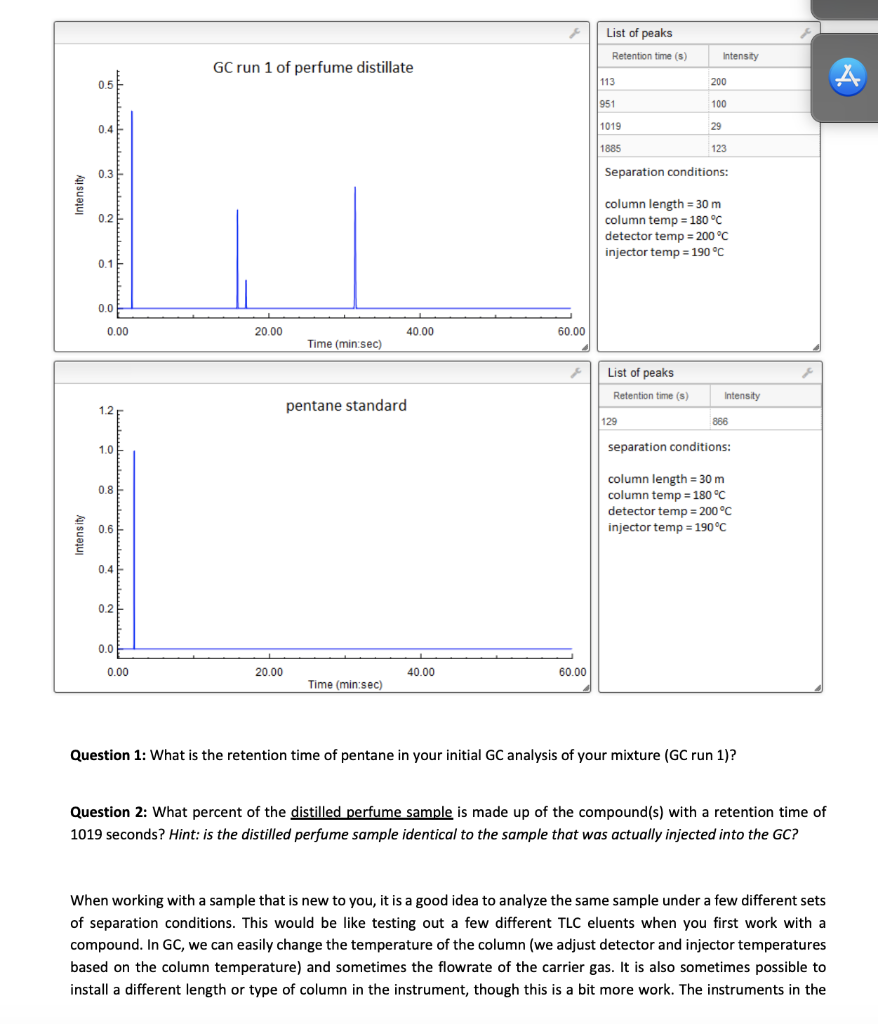
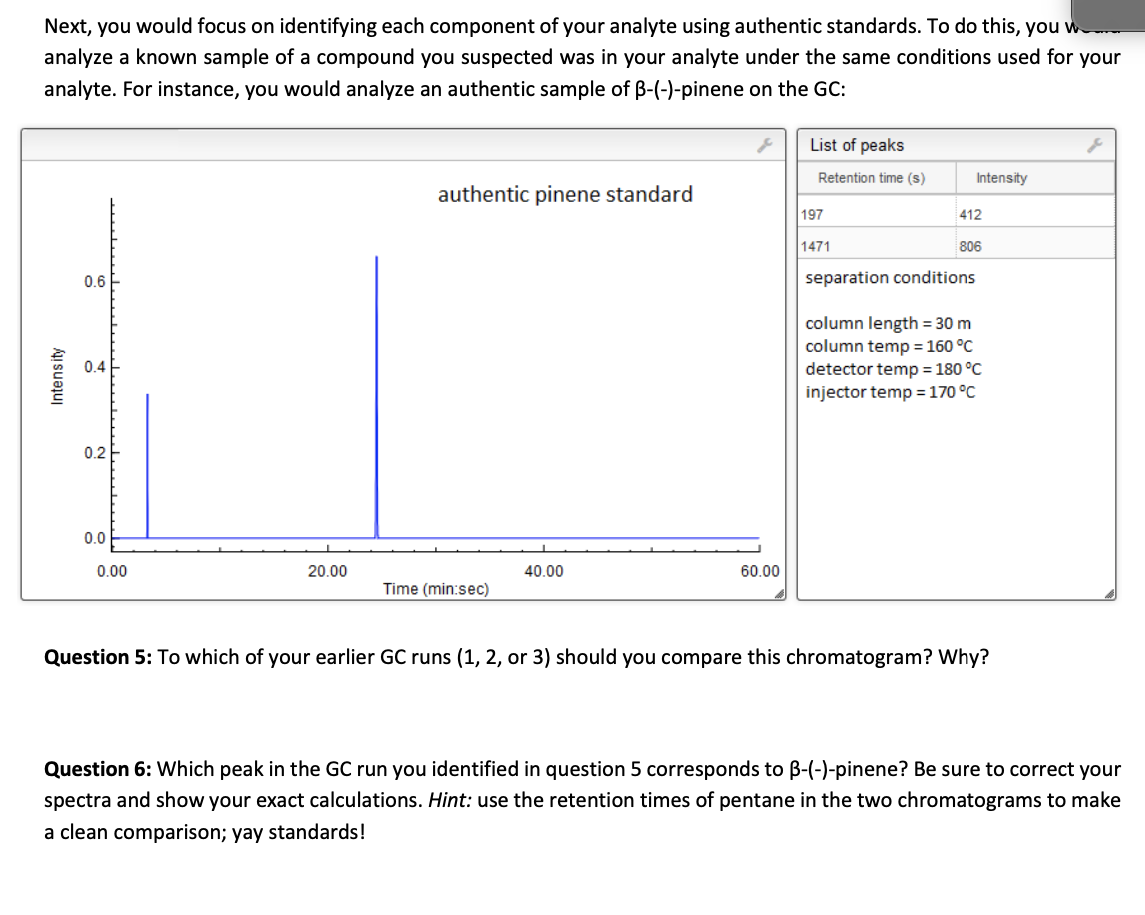
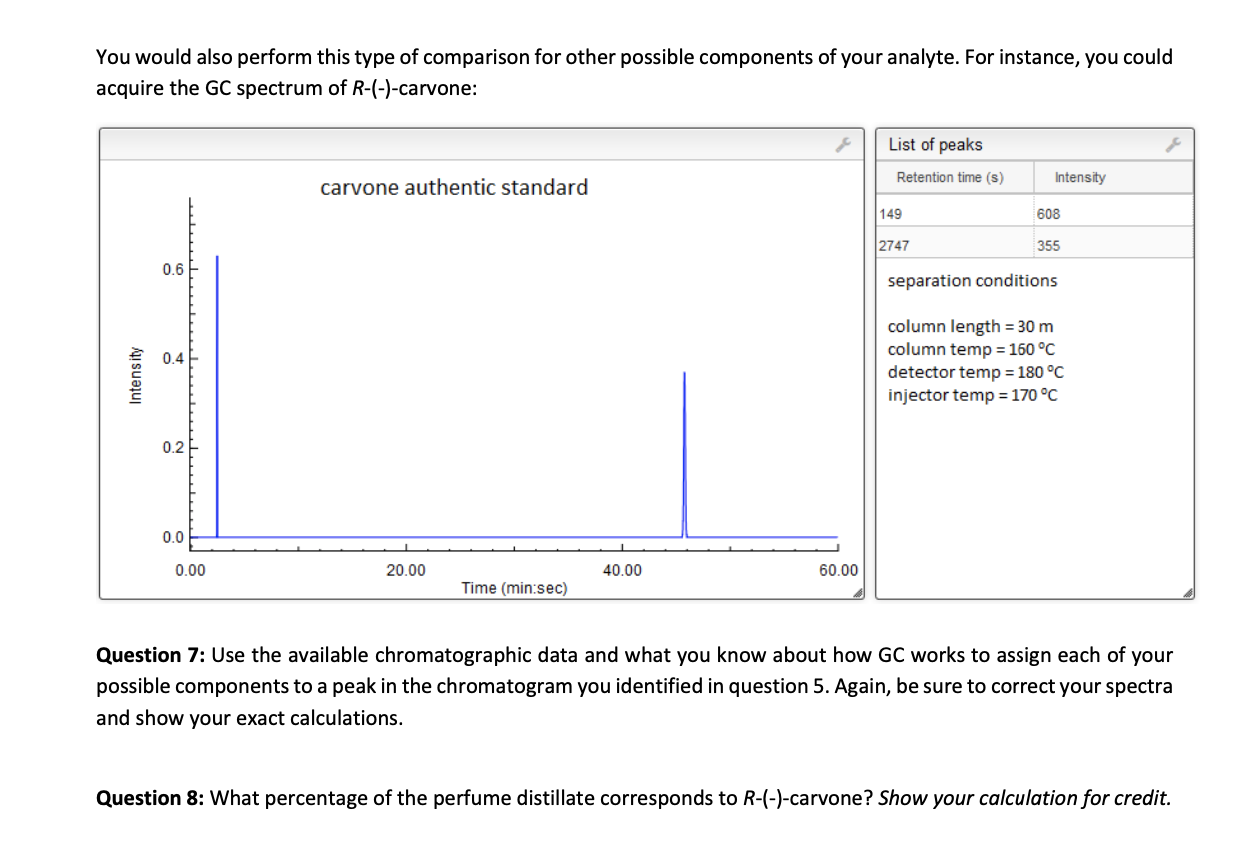
List of peaks Retention time (5) Intensity GC run 1 of perfume distillate A 0.5 113 200 951 100 0.44 1019 29 1885 123 0.3 Separation conditions: Intensity 0.21 column length = 30 m column temp = 180 C detector temp = 200C injector temp = 190 C 0.1 0.0 0.00 20.00 40.00 60.00 Time (min.sec) List of peaks Retention time (8) s) Intensity 1.2 pentane standard 129 886 1.0 separation conditions: 0.8 column length = 30 m column temp = 180 C detector temp = 200 C injector temp = 190C C 0.6 Intensity 0.4 0.2 0.0 0.00 20.00 40.00 60.00 Time (min:sec) Question 1: What is the retention time of pentane in your initial GC analysis of your mixture (GC run 1)? Question 2: What percent of the distilled perfume sample is made up of the compound(s) with a retention time of 1019 seconds? Hint: is the distilled perfume sample identical to the sample that was actually injected into the GC? When working with a sample that is new to you, it is a good idea to analyze the same sample under a few different sets of separation conditions. This would be like testing out a few different TLC eluents when you first work with a compound. In GC, we can easily change the temperature of the column (we adjust detector and injector temperatures based on the column temperature) and sometimes the flowrate of the carrier gas. It is also sometimes possible to install a different length or type of column in the instrument, though this is a bit more work. The instruments in the Next, you would focus on identifying each component of your analyte using authentic standards. To do this, you w analyze a known sample of a compound you suspected was in your analyte under the same conditions used for your analyte. For instance, you would analyze an authentic sample of B-(-)-pinene on the GC: List of peaks Retention time (s) Intensity authentic pinene standard 197 412 1471 806 0.6 separation conditions 0.4 Intensity column length = 30 m column temp = 160 C detector temp = 180 C injector temp = 170 C 0.2 0.0 0.00 20.00 40.00 60.00 Time (min:sec) Question 5: To which of your earlier GC runs (1, 2, or 3) should you compare this chromatogram? Why? Question 6: Which peak in the GC run you identified in question 5 corresponds to B-(-)-pinene? Be sure to correct your spectra and show your exact calculations. Hint: use the retention times of pentane in the two chromatograms to make a clean comparison; yay standards! You would also perform this type of comparison for other possible components of your analyte. For instance, you could acquire the GC spectrum of R-(-)-carvone: List of peaks Retention time (s) Intensity carvone authentic standard 149 608 LLLLL 2747 355 0.6 separation conditions 0.4 Intensity column length = 30 m column temp = 160 C detector temp = 180 C injector temp = 170 C 0.2 0.0 0.00 20.00 40.00 60.00 Time (min:sec) Question 7: Use the available chromatographic data and what you know about how GC works to assign each of your possible components to a peak in the chromatogram you identified in question 5. Again, be sure to correct your spectra and show your exact calculations. Question 8: What percentage of the perfume distillate corresponds to R-(-)-carvone? Show your calculation for credit. List of peaks Retention time (5) Intensity GC run 1 of perfume distillate A 0.5 113 200 951 100 0.44 1019 29 1885 123 0.3 Separation conditions: Intensity 0.21 column length = 30 m column temp = 180 C detector temp = 200C injector temp = 190 C 0.1 0.0 0.00 20.00 40.00 60.00 Time (min.sec) List of peaks Retention time (8) s) Intensity 1.2 pentane standard 129 886 1.0 separation conditions: 0.8 column length = 30 m column temp = 180 C detector temp = 200 C injector temp = 190C C 0.6 Intensity 0.4 0.2 0.0 0.00 20.00 40.00 60.00 Time (min:sec) Question 1: What is the retention time of pentane in your initial GC analysis of your mixture (GC run 1)? Question 2: What percent of the distilled perfume sample is made up of the compound(s) with a retention time of 1019 seconds? Hint: is the distilled perfume sample identical to the sample that was actually injected into the GC? When working with a sample that is new to you, it is a good idea to analyze the same sample under a few different sets of separation conditions. This would be like testing out a few different TLC eluents when you first work with a compound. In GC, we can easily change the temperature of the column (we adjust detector and injector temperatures based on the column temperature) and sometimes the flowrate of the carrier gas. It is also sometimes possible to install a different length or type of column in the instrument, though this is a bit more work. The instruments in the Next, you would focus on identifying each component of your analyte using authentic standards. To do this, you w analyze a known sample of a compound you suspected was in your analyte under the same conditions used for your analyte. For instance, you would analyze an authentic sample of B-(-)-pinene on the GC: List of peaks Retention time (s) Intensity authentic pinene standard 197 412 1471 806 0.6 separation conditions 0.4 Intensity column length = 30 m column temp = 160 C detector temp = 180 C injector temp = 170 C 0.2 0.0 0.00 20.00 40.00 60.00 Time (min:sec) Question 5: To which of your earlier GC runs (1, 2, or 3) should you compare this chromatogram? Why? Question 6: Which peak in the GC run you identified in question 5 corresponds to B-(-)-pinene? Be sure to correct your spectra and show your exact calculations. Hint: use the retention times of pentane in the two chromatograms to make a clean comparison; yay standards! You would also perform this type of comparison for other possible components of your analyte. For instance, you could acquire the GC spectrum of R-(-)-carvone: List of peaks Retention time (s) Intensity carvone authentic standard 149 608 LLLLL 2747 355 0.6 separation conditions 0.4 Intensity column length = 30 m column temp = 160 C detector temp = 180 C injector temp = 170 C 0.2 0.0 0.00 20.00 40.00 60.00 Time (min:sec) Question 7: Use the available chromatographic data and what you know about how GC works to assign each of your possible components to a peak in the chromatogram you identified in question 5. Again, be sure to correct your spectra and show your exact calculations. Question 8: What percentage of the perfume distillate corresponds to R-(-)-carvone? Show your calculation for credit
Step by Step Solution
There are 3 Steps involved in it

Get step-by-step solutions from verified subject matter experts