







Question: Please answer questions A-D 1. This problem asks you to apply the model of labor supply discussed in class to analyze the labor force participation
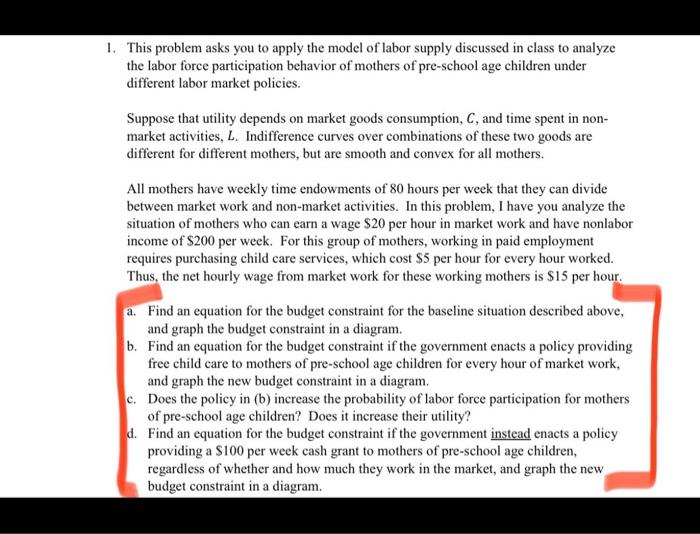
1. This problem asks you to apply the model of labor supply discussed in class to analyze the labor force participation behavior of mothers of pre-school age children under different labor market policies. Suppose that utility depends on market goods consumption, C, and time spent in non- market activities, L. Indifference curves over combinations of these two goods are different for different mothers, but are smooth and convex for all mothers. All mothers have weekly time endowments of 80 hours per week that they can divide between market work and non-market activities. In this problem, I have you analyze the situation of mothers who can earn a wage $20 per hour in market work and have nonlabor income of $200 per week. For this group of mothers, working in paid employment requires purchasing child care services, which cost $5 per hour for every hour worked. Thus, the net hourly wage from market work for these working mothers is $15 per hour. a. Find an equation for the budget constraint for the baseline situation described above, and graph the budget constraint in a diagram. b. Find an equation for the budget constraint if the government enacts a policy providing free child care to mothers of pre-school age children for every hour of market work, and graph the new budget constraint in a diagram. c. Does the policy in (b) increase the probability of labor force participation for mothers of pre-school age children? Does it increase their utility? d. Find an equation for the budget constraint if the government instead enacts a policy providing a $100 per week cash grant to mothers of pre-school age children, regardless of whether and how much they work in the market, and graph the new budget constraint in a diagram. 1. This problem asks you to apply the model of labor supply discussed in class to analyze the labor force participation behavior of mothers of pre-school age children under different labor market policies. Suppose that utility depends on market goods consumption, C, and time spent in non- market activities, L. Indifference curves over combinations of these two goods are different for different mothers, but are smooth and convex for all mothers. All mothers have weekly time endowments of 80 hours per week that they can divide between market work and non-market activities. In this problem, I have you analyze the situation of mothers who can earn a wage $20 per hour in market work and have nonlabor income of $200 per week. For this group of mothers, working in paid employment requires purchasing child care services, which cost $5 per hour for every hour worked. Thus, the net hourly wage from market work for these working mothers is $15 per hour. a. Find an equation for the budget constraint for the baseline situation described above, and graph the budget constraint in a diagram. b. Find an equation for the budget constraint if the government enacts a policy providing free child care to mothers of pre-school age children for every hour of market work, and graph the new budget constraint in a diagram. c. Does the policy in (b) increase the probability of labor force participation for mothers of pre-school age children? Does it increase their utility? d. Find an equation for the budget constraint if the government instead enacts a policy providing a $100 per week cash grant to mothers of pre-school age children, regardless of whether and how much they work in the market, and graph the new budget constraint in a diagram
Step by Step Solution
There are 3 Steps involved in it

Get step-by-step solutions from verified subject matter experts
 Study Help