



Question: Please answer questions A-H and show computations. Thank You! The Gilster Company The Gilster Company, a machine tooling firm, has several plants. One plant, located
Please answer questions A-H and show computations. Thank You!
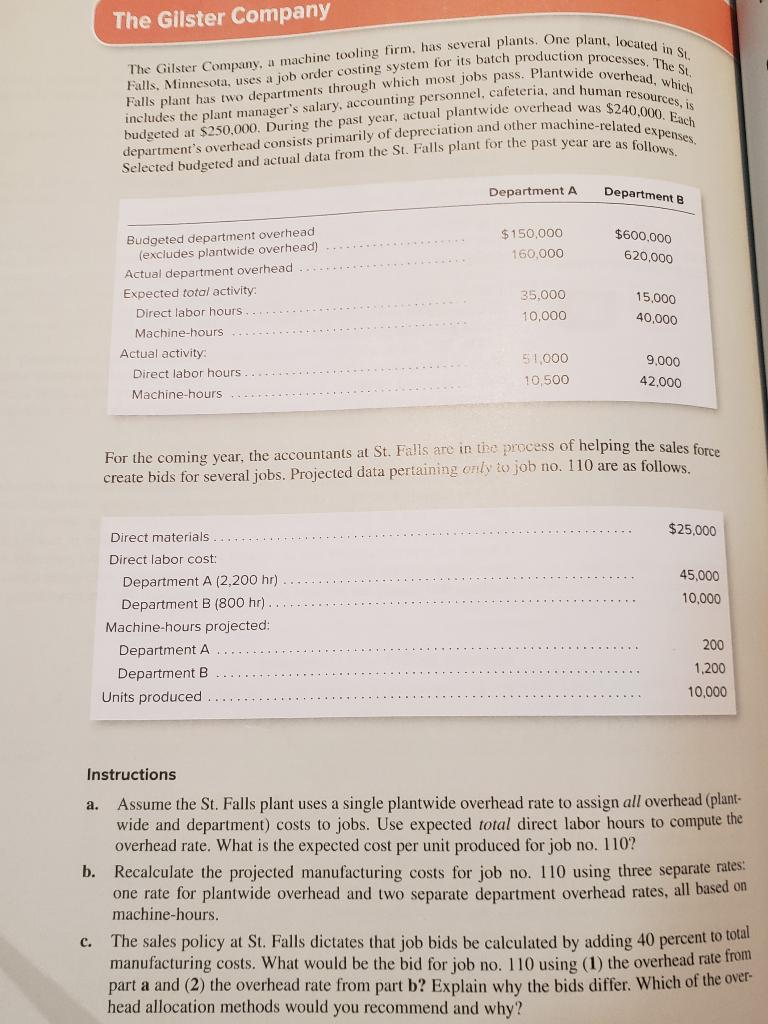
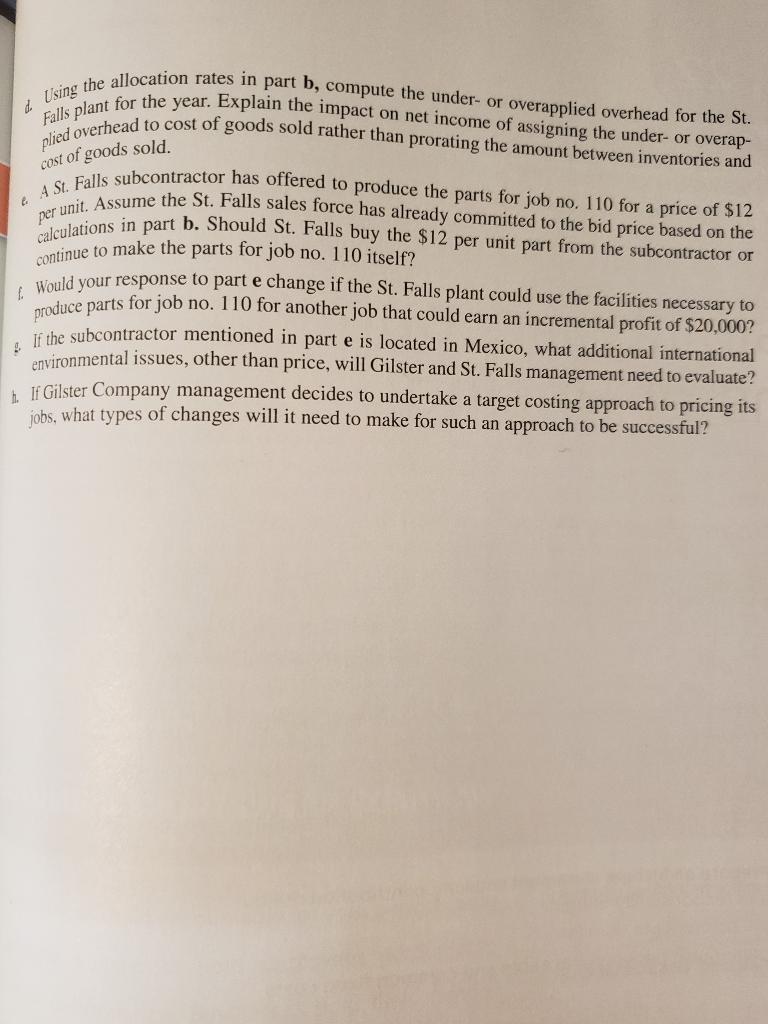
The Gilster Company The Gilster Company, a machine tooling firm, has several plants. One plant, located in St. Falls plant has two departments through which most jobs pass. Plantwide overhead, which Falls, Minnesota, uses a job order costing system for its batch production processes. The St. budgeted at $250,000. During the past year, actual plantwide overhead was $240.000. Each includes the plant manager's salary, accounting personnel, cafeteria, and human resources, is department's overhead consists primarily of depreciation and other machine-related expenses Selected budgeted and actual data from the St. Falls plant for the past year are as follows. Department A Department $150,000 $600,000 620,000 160,000 Budgeted department overhead (excludes plantwide overhead) Actual department overhead Expected total activity: Direct labor hours Machine-hours Actual activity Direct labor hours Machine-hours 35.000 10,000 15,000 40,000 51,000 10,500 9.000 42.000 For the coming year, the accountants at St. Falls are in the process of helping the sales force create bids for several jobs. Projected data pertaining only to job no. 110 are as follows. $25,000 45,000 10,000 Direct materials Direct labor cost: Department A (2,200 hr) Department B (800 hr) Machine-hours projected: Department A Department B Units produced 200 1.200 10,000 a. Instructions Assume the St. Falls plant uses a single plantwide overhead rate to assign all overhead (plant- wide and department) costs to jobs. Use expected total direct labor hours to compute the overhead rate. What is the expected cost per unit produced for job no. 110? b. Recalculate the projected manufacturing costs for job no. 110 using three separate rates: one rate for plantwide overhead and two separate department overhead rates, all based on machine-hours. The sales policy at St. Falls dictates that job bids be calculated by adding 40 percent to total manufacturing costs. What would be the bid for job no. 110 using (1) the overhead rate from part a and (2) the overhead rate from part b? Explain why the bids differ. Which of the over- head allocation methods would you recommend and why? C. Using 2 the allocation rates in part b, compute the under- or overapplied overhead for the St. Falls plant for the year. Explain the impact on net income of assigning the under-or overap- plied overhead to cost of goods sold rather than prorating the amount between inventories and 4 St. Falls subcontractor has offered to produce the parts for job no. 110 for a price of $12 per unit. Assume the St. Falls sales force has already committed to the bid price based on the calculations in part b. Should St. Falls buy the $12 per unit part from the subcontractor or continue to make the parts for job no. 110 itself? cost of goods sold. produce parts for job no. 110 for another job that could earn an incremental profit of $20,000? if the subcontractor mentioned in part e is located in Mexico, what additional international environmental issues, other than price, will Gilster and St. Falls management need to evaluate? If Gilster Company management decides to undertake a target costing approach to pricing its jobs, what types of changes will it need to make for such an approach to be successful
Step by Step Solution
There are 3 Steps involved in it

Get step-by-step solutions from verified subject matter experts