Question: Please answer questions as throughly as possible in order to get an up vote :) Case Study Altimus Brands: Managing Procurement Risk Cranfield School of
 Please answer questions as throughly as possible in order to get an up vote :)
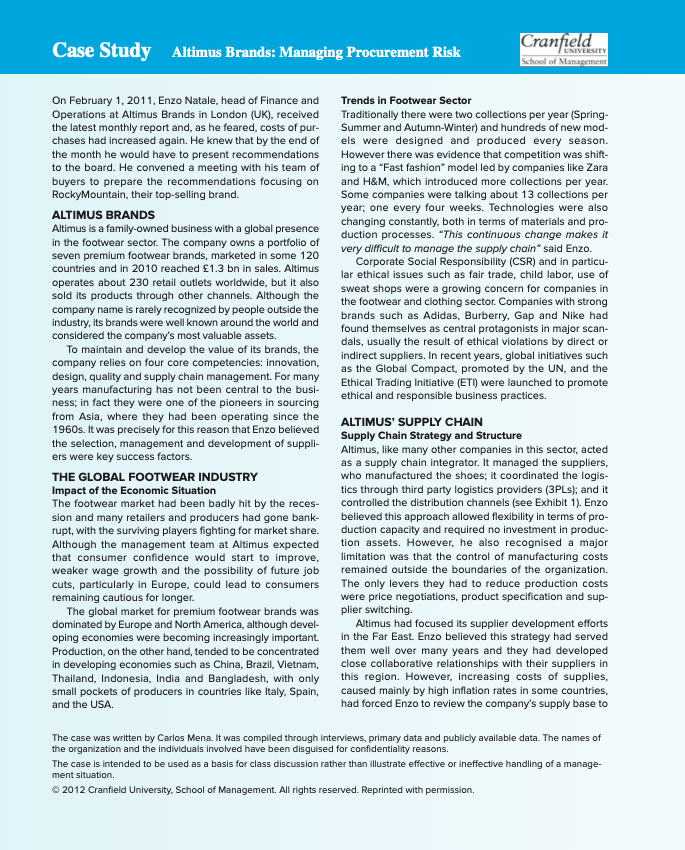
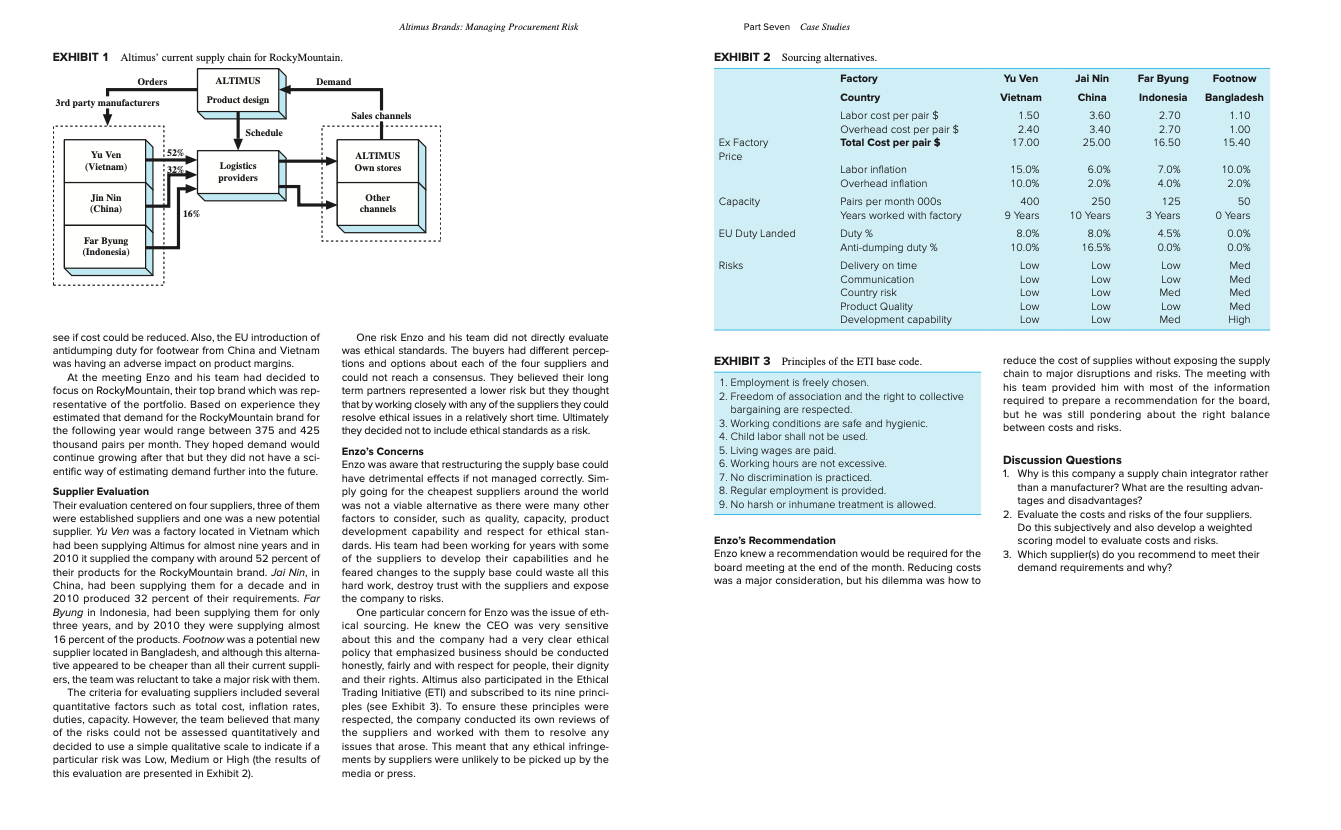
Case Study Altimus Brands: Managing Procurement Risk Cranfield School of Management UNIVERSITY On February 1, 2011, Enzo Natale, head of Finance and Operations at Altimus Brands in London (UK), received the latest monthly report and, as he feared, costs of pur- chases had increased again. He knew that by the end of the month he would have to present recommendations to the board. He convened a meeting with his team of buyers to prepare the recommendations focusing on Rocky Mountain, their top-selling brand. ALTIMUS BRANDS Altimus is a family-owned business with a global presence in the footwear sector. The company owns a portfolio of seven premium footwear brands, marketed in some 120 countries and in 2010 reached 1.3 bn in sales. Altimus operates about 230 retail outlets worldwide, but it also sold its products through other channels. Although the company name is rarely recognized by people outside the industry, its brands were well known around the world and considered the company's most valuable assets. To maintain and develop the value of its brands, the company relies on four core competencies: innovation, design, quality and supply chain management. For many years manufacturing has not been central to the busi- ness; in fact they were one of the pioneers in sourcing from Asia, where they had been operating since the 1960s. It was precisely for this reason that Enzo believed the selection, management and development of suppli- ers were key success factors. THE GLOBAL FOOTWEAR INDUSTRY Impact of the Economic Situation The footwear market had been badly hit by the reces- sion and many retailers and producers had gone bank- rupt, with the surviving players fighting for market share. Although the management team at Altimus expected that consumer confidence would start to improve, weaker wage growth and the possibility of future job cuts, particularly in Europe, could lead to consumers remaining cautious for longer. The global market for premium footwear brands was dominated by Europe and North America, although devel- oping economies were becoming increasingly important. Production, on the other hand, tended to be concentrated in developing economies such as China, Brazil, Vietnam, Thailand, Indonesia, India and Bangladesh, with only small pockets of producers in countries like Italy, Spain, and the USA Trends in Footwear Sector Traditionally there were two collections per year (Spring- Summer and Autumn-Winter) and hundreds of new mod- els were designed and produced every season. However there was evidence that competition was shift- ing to a "Fast fashion modelled by companies like Zara and H&M, which introduced more collections per year. Some companies were talking about 13 collections per year, one every four weeks. Technologies were also changing constantly, both in terms of materials and pro- duction processes. This continuous change makes it very difficult to manage the supply chain" said Enzo. Corporate Social Responsibility (CSR) and in particu- lar ethical issues such as fair trade, child labor, use of sweat shops were a growing concern for companies in the footwear and clothing sector. Companies with strong brands such as Adidas, Burberry, Gap and Nike had found themselves as central protagonists in major scan- dals, usually the result of ethical violations by director indirect suppliers. In recent years, global initiatives such as the Global Compact, promoted by the UN, and the Ethical Trading Initiative (ETI) were launched to promote ethical and responsible business practices. ALTIMUS' SUPPLY CHAIN Supply Chain Strategy and Structure Altimus, like many other companies in this sector, acted as a supply chain integrator. It managed the suppliers, who manufactured the shoes; it coordinated the logis- ties through third party logistics providers (3PLs); and it controlled the distribution channels (see Exhibit 1). Enzo believed this approach allowed flexibility in terms of pro- duction capacity and required no investment in produc- tion assets. However, he also recognised a major limitation was that the control of manufacturing costs remained outside the boundaries of the organization. The only levers they had to reduce production costs were price negotiations, product specification and sup- plier switching. Altimus had focused its supplier development efforts in the Far East. Enzo believed this strategy had served them well over many years and they had developed close collaborative relationships with their suppliers in this region. However, increasing costs of supplies, caused mainly by high inflation rates in some countries, had forced Enzo to review the company's supply base to The case was written by Carlos Mena. It was compiled through interviews, primary data and publicly available data. The names of the organization and the individuals involved have been disguised for confidentiality reasons. The case is intended to be used as a basis for class discussion rather than illustrate effective or ineffective handling of a manage- ment situation, 2012 Cranfield University, School of Management. All rights reserved. Reprinted with permission. Demand 3 Alrimus Brands: Managing Procurement Risk Part Seven Case Studies EXHIBIT 1 Altimus' current supply chain for Rocky Mountain. EXHIBIT 2 Sourcing alternatives. Orders ALTIMUS Factory Yu Ven Jai Nin Far Byung Footnow 3rd party manufacturers Product design Country Vietnam China Indonesia Bangladesh Sales channels Labor cost per pair $ 1.50 3.60 2.70 1.10 Schedule Overhead cost per pair $ 2.40 3.40 2.70 1.00 Ex Factory Total Cost per pair $ 17.00 25.00 16.50 15.40 Yu Ven ALTIMUS Price (Vietnam) Logistics Own stores Labor inflation 15.0% 6.0% 7.0% % 10.0% % providers Overhead inflation 10.0% 2.0% 4.0% 2.0% Jin Nin Other Capacity Pairs per month OOOS 400 250 125 50 (China) 16% channels Years worked with factory 9 Years 10 Years 0 Years Tears EU Duty Landed Far Byung Duty % 8.0% 8.0% 4.5% 0.0% (Indonesia) Anti-dumping duty % 10.0% 16.5% 0.0% 0.0% Risks Delivery on time Low Low Low Med Communication Low Low Low Med Country risk Low Low Med Med Product Quality Low Low Low Med Development capability Low Low Med High see if cost could be reduced. Also, the EU introduction of One risk Enzo and his team did not directly evaluate antidumping duty for footwear from China and Vietnam was ethical standards. The buyers had different percep- was having an adverse impact on product margins. tions and options about each of the four suppliers and EXHIBIT 3 Principles of the ETI base code. reduce the cost of supplies without exposing the supply At the meeting Enzo and his team had decided to could not reach a consensus. They believed their long chain to major disruptions and risks. The meeting with focus on Rocky Mountain, their top brand which was rep- 1. Employment is freely chosen term partners represented a lower risk but they thought his team provided him with most of the information 2. Freedom of association and the right to collective resentative of the portfolio. Based on experience they that by working closely with any of the suppliers they could required to prepare a recommendation for the board, estimated that demand for the Rocky Mountain brand for resolve ethical issues in a relatively short time. Ultimately bargaining are respected. but he was still pondering about the right balance the following year would range between 375 and 425 they decided not to include ethical standards as a risk. 3. Working conditions are safe and hygienic. between costs and risks. thousand pairs per month. They hoped demand would 4. Child labor shall not be used. Enzo's Concerns continue growing after that but they did not have a sci- 5. Living wages are paid. Enzo was aware that restructuring the supply base could Working hours are not excessive. Discussion Questions entific way of estimating demand further into the future, have detrimental effects if not managed correctly. Sim- 7. No discrimination is practiced. 1. Why is this company a supply chain integrator rather Supplier Evaluation ply going for the cheapest suppliers around the world 8. Regular employment is provided. than a manufacturer? What are the resulting advan- Their evaluation centered on four suppliers, three of them was not a viable alternative as there were many other 9. No harsh or inhumane treatment is allowed. tages and disadvantages? were established suppliers and one was a new potential factors to consider, such as quality, capacity, product 2. Evaluate the costs and risks of the four suppliers. supplier. Yu Ven was a factory located in Vietnam which development capability and respect for ethical stan- Do this subjectively and also develop a weighted had been supplying Altimus for almost nine years and in dards. His team had been working for years with some Enzo's Recommendation scoring model to evaluate costs and risks. 2010 it supplied the company with around 52 percent of of the suppliers to develop their capabilities and he Enzo knew a recommendation would be required for the 3. Which supplier(s) do you recommend to meet their their products for the Rocky Mountain brand. Jai Nin, in feared changes to the supply base could waste all this board meeting at the end of the month. Reducing costs demand requirements and why? China, had been supplying them for a decade and in hard work, destroy trust with the suppliers and expose was a major consideration, but his dilemma was how to 2010 produced 32 percent of their requirements. Far the company to risks. Byung in Indonesia, had been supplying them for only One particular concern for Enzo was the issue of eth- three years, and by 2010 they were supplying almost ical sourcing. He knew the CEO was very sensitive 16 percent of the products. Footnow was a potential new about this and the company had a very clear ethical supplier located in Bangladesh, and although this alterna policy that emphasized business should be conducted tive appeared to be cheaper than all their current suppli honestly, fairly and with respect for people, their dignity ers, the team was reluctant to take a major risk with them. and their rights. Altimus also participated in the Ethical The criteria for evaluating suppliers included several Trading Initiative (ETI) and subscribed to its nine princi- quantitative factors such as total cost, inflation rates, ples (see Exhibit 3). To ensure these principles were duties, capacity. However, the team believed that many respected, the company conducted its own reviews of of the risks could not be assessed quantitatively and the suppliers and worked with them to resolve any decided to use a simple qualitative scale to indicate if a issues that arose. This meant that any ethical infringe- particular risk was Low, Medium or High (the results of ments by suppliers were unlikely to be picked up by the this evaluation are presented in Exhibit 2). media or press




