







Question: Please answer questions e, f, g, h. David Lyons, CEO of Lyons Solar Technologies, is con- cerned about his firm's level of debt financing. The
Please answer questions e, f, g, h.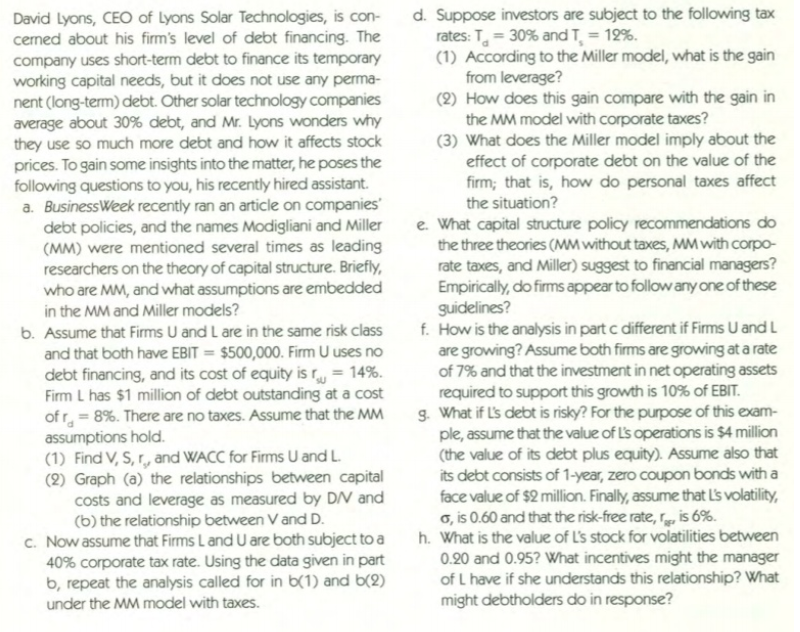
David Lyons, CEO of Lyons Solar Technologies, is con- cerned about his firm's level of debt financing. The company uses short-term debt to finance its temporary working capital needs, but it does not use any perma- nent (long-tem) debt. Other solar technology companies average about 30% debt, and Mr. Lyons wonders why they use so much more debt and how it affects stock prices. To gain some insights into the matter, he poses the following questions to you, his recently hired assistant. a. Business Week recently ran an article on companies' debt policies, and the names Modigliani and Miller (MM) were mentioned several times as leading researchers on the theory of capital structure. Briefly, who are MM, and what assumptions are embedded in the MM and Miller models? b. Assume that Firms U and l are in the same risk class and that both have EBIT = $500,000. Fim U uses no debt financing, and its cost of equity is = 14%. FirmL has $1 million of debt outstanding at a cost of r = 8%. There are no taxes. Assume that the MM assumptions hold. (1) Find V, S, I, and WACC for Firms U and L. (2) Graph (a) the relationships between capital costs and leverage as measured by DN and (b) the relationship between V and D. c. Now assume that Firms Land U are both subject to a 40% corporate tax rate. Using the data given in part b, repeat the analysis called for in b(1) and (2) under the MM model with taxes. d. Suppose investors are subject to the following tax rates: T. = 30% and T = 12%. (1) According to the Miller model, what is the gain from leverage? (2) How does this gain compare with the gain in the MM model with corporate taxes? (3) What does the Miller model imply about the effect of corporate debt on the value of the firm; that is, how do personal taxes affect the situation? e. What capital structure policy recommendations do the three theories (MM without taxes, MM with corpo- rate taxes, and Miller) suggest to financial managers? Empirically, do firms appear to follow any one of these guidelines? f. How is the analysis in partc different if Fims U and L are growing? Assume both firms are growing at a rate of 7% and that the investment in net operating assets required to support this growth is 10% of EBIT. 9. What ifl's debt is risky? For the purpose of this exam- ple, assume that the value of L's operations is $4 million (the value of its debt plus equity). Assume also that its debt consists of 1-year, zero coupon bonds with a face value of $2 million. Finally, assume that is volatility, o, is 0.60 and that the risk-free rate, is 6%. h. What is the value of L's stock for volatilities between 0.20 and 0.95? What incentives might the manager of L have if she understands this relationship? What might debtholders do in response
Step by Step Solution
There are 3 Steps involved in it

Get step-by-step solutions from verified subject matter experts
 Study Help