







Question: Please answer questions e) f) g) h). Thank you and thumbs up Problem 1: Isoquant, Isocost Cost Minimizing Approach to Factor Selection: Suppose Mr Once-ler
Please answer questions e) f) g) h). Thank you and thumbs up
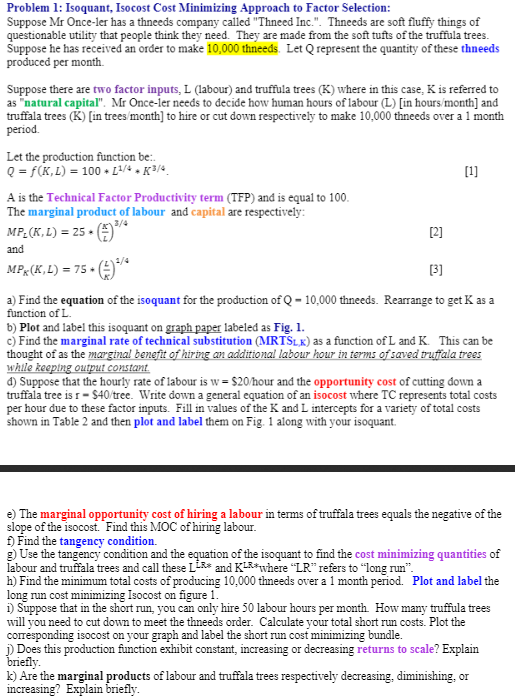
Problem 1: Isoquant, Isocost Cost Minimizing Approach to Factor Selection: Suppose Mr Once-ler has a thneeds company called "Thneed Inc.". Thneeds are soft fluffy things of questionable utility that people think they need. They are made from the soft tufts of the truffula trees. Suppose he has received an order to make 10,000 thneeds. Let Q represent the quantity of these thneeds produced per month Suppose there are two factor inputs, L (labour) and truffula trees (K) where in this case. K is referred to as "natural capital". Mr Once-ler needs to decide how human hours of labour (L) [in hours/month] and truffala trees (K) [in trees month] to hire or cut down respectively to make 10.000 thneeds over a 1 month period. Let the production function be: Q = f(K,L) = 100+ [1/4 K3/4 [1] A is the Technical Factor Productivity term (TFP) and is equal to 100. The marginal product of labour and capital are respectively: MP_(K, L) = 25.99 [2] MPx(K,L) = 75.0" [3] a) Find the equation of the isoquant for the production of Q-10,000 thneeds. Rearrange to get K as a function of L b) Plot and label this isoquant on graph paper labeled as Fig. 1. c) Find the marginal rate of technical substitution (MRTSLK) as a function of L and K. This can be thought of as the marginal benefit of hiring an additional labour hour in terms of saved truffala trees while keeping output constant. d) Suppose that the hourly rate of labour is w = $20/hour and the opportunity cost of cutting down a truffala tree is r - $40/tree. Write down a general equation of an isocost where TC represents total costs per hour due to these factor inputs. Fill in values of the K and L intercepts for a variety of total costs shown in Table 2 and then plot and label them on Fig. 1 along with your isoquant and e) The marginal opportunity cost of hiring a labour in terms of truffala trees equals the negative of the slope of the isocost. Find this MOC of hiring labour. 1) Find the tangency condition. Use the tangency condition and the equation of the isoquant to find the cost minimizing quantities of labour and truffala trees and call these Li** and K **where "LR" refers to "long run". h) Find the minimum total costs of producing 10.000 thneeds over a 1 month period. Plot and label the long run cost minimizing Isocost on figure 1. 1) Suppose that in the short run, you can only hire 50 labour hours per month How many truffula trees will you need to cut down to meet the thneeds order. Calculate your total short run costs. Plot the corresponding isocost on your graph and label the short run cost minimizing bundle. 1. Does this production function exhibit constant, increasing or decreasing returns to scale? Explain briefly k) Are the marginal products of labour and truffala trees respectively decreasing, diminishing, or increasing? Explain briefly. Problem 1: Isoquant, Isocost Cost Minimizing Approach to Factor Selection: Suppose Mr Once-ler has a thneeds company called "Thneed Inc.". Thneeds are soft fluffy things of questionable utility that people think they need. They are made from the soft tufts of the truffula trees. Suppose he has received an order to make 10,000 thneeds. Let Q represent the quantity of these thneeds produced per month Suppose there are two factor inputs, L (labour) and truffula trees (K) where in this case. K is referred to as "natural capital". Mr Once-ler needs to decide how human hours of labour (L) [in hours/month] and truffala trees (K) [in trees month] to hire or cut down respectively to make 10.000 thneeds over a 1 month period. Let the production function be: Q = f(K,L) = 100+ [1/4 K3/4 [1] A is the Technical Factor Productivity term (TFP) and is equal to 100. The marginal product of labour and capital are respectively: MP_(K, L) = 25.99 [2] MPx(K,L) = 75.0" [3] a) Find the equation of the isoquant for the production of Q-10,000 thneeds. Rearrange to get K as a function of L b) Plot and label this isoquant on graph paper labeled as Fig. 1. c) Find the marginal rate of technical substitution (MRTSLK) as a function of L and K. This can be thought of as the marginal benefit of hiring an additional labour hour in terms of saved truffala trees while keeping output constant. d) Suppose that the hourly rate of labour is w = $20/hour and the opportunity cost of cutting down a truffala tree is r - $40/tree. Write down a general equation of an isocost where TC represents total costs per hour due to these factor inputs. Fill in values of the K and L intercepts for a variety of total costs shown in Table 2 and then plot and label them on Fig. 1 along with your isoquant and e) The marginal opportunity cost of hiring a labour in terms of truffala trees equals the negative of the slope of the isocost. Find this MOC of hiring labour. 1) Find the tangency condition. Use the tangency condition and the equation of the isoquant to find the cost minimizing quantities of labour and truffala trees and call these Li** and K **where "LR" refers to "long run". h) Find the minimum total costs of producing 10.000 thneeds over a 1 month period. Plot and label the long run cost minimizing Isocost on figure 1. 1) Suppose that in the short run, you can only hire 50 labour hours per month How many truffula trees will you need to cut down to meet the thneeds order. Calculate your total short run costs. Plot the corresponding isocost on your graph and label the short run cost minimizing bundle. 1. Does this production function exhibit constant, increasing or decreasing returns to scale? Explain briefly k) Are the marginal products of labour and truffala trees respectively decreasing, diminishing, or increasing? Explain briefly
Step by Step Solution
There are 3 Steps involved in it

Get step-by-step solutions from verified subject matter experts
 Study Help