Question: PLEASE ANSWER QUESTIONS G AND H ASAP !! 1. Consider the following scenario: Christina is a college student majoring in Information Science, which she decided
PLEASE ANSWER QUESTIONS G AND H ASAP !!
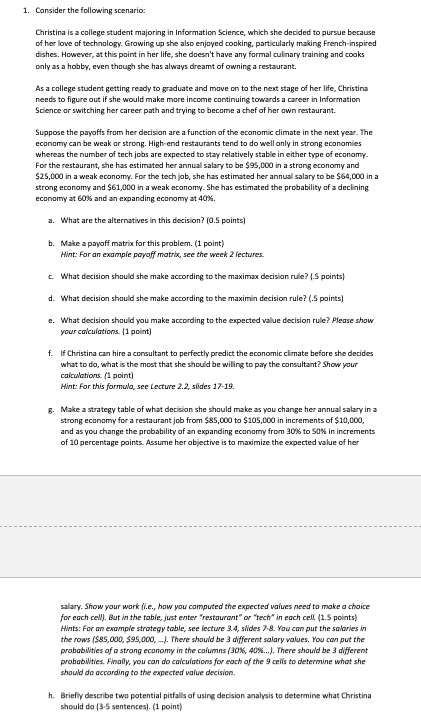
1. Consider the following scenario: Christina is a college student majoring in Information Science, which she decided to pursue because of her love of technology. Growing up she also enjoyed cooking, particularly making French-inspired dishes. However, at this point in her life, she doesn't have any formal culinary training and cooks only as a hobby, even though she has always dreamt of owning a restaurant As a college student getting ready to graduate and move on to the next stage of her life, Christina needs to figure out if she would make more income continuing towards a career in Information Science or switching her career path and trying to become a chef of her own restaurant. Suppose the payoffs from her decision are a function of the economic climate in the next year. The economy can be weak or strong. High-end restaurants tend to do well only in strong economies whereas the number of tech jobs are expected to stay relatively stable in either type of economy. For the restaurant, she has estimated her annual salary to be $95,000 in a strong economy and $25,000 in a weak economy. For the tech job, she has estimated her annual salary to be $64,000 in a strong economy and $61,000 in a weak economy. She has estimated the probability of a declining economy at 60% and an expanding economy at 40%. a. What are the alternatives in this decision? (0.5 points) b. Make a payoff matrix for this problem. (1 point) Hint: For an example payoff matrix, see the week 2 lectures. What decision should she make according to the maximax decision rule? (5 points) d. What decision should she make according to the maximin decision rule? (-5 points) c. What decision should you make according to the expected value decision rule? Please show your calculations. (1 point) f. If Christina can hire a consultant to perfectly predict the economic climate before she decides what to do, what is the most that she should be willing to pay the consultant? Show your calculations (1 point) Hint: For this formula, see Lecture 2.2 slides 17-19. 8. Make a strategy table of what decision she should make as you change her annual salary in a strong economy for a restaurant job from $85,000 to $105,000 in increments of $10,000, and as you change the probability of an expanding economy from 30% to Sox in increments of 10 percentage points. Assume her objective is to maximize the expected value of her salary. Show your work fi.e., how you computed the expected values need to make a choice for each cell). But in the table, just enter "restaurant" or "tech" in each cell (1.5 points) Hints: For an example strategy table, see lecture 2.4, slides 7-8. You can put the salaries in the rows ($85,000, $95.000,-... There should be 3 different salary values. You can put the probabilities of a strong economy in the columns (30%, 40%...). There should be 3 different probabilities. Finally, you can do calculations for each of the 9 cells to determine what she should do according to the expected value decision. h. Briefly describe two potential pitfalls of using decision analysis to determine what Christina should do 3-5 sentences) (1 point) 1. Consider the following scenario: Christina is a college student majoring in Information Science, which she decided to pursue because of her love of technology. Growing up she also enjoyed cooking, particularly making French-inspired dishes. However, at this point in her life, she doesn't have any formal culinary training and cooks only as a hobby, even though she has always dreamt of owning a restaurant As a college student getting ready to graduate and move on to the next stage of her life, Christina needs to figure out if she would make more income continuing towards a career in Information Science or switching her career path and trying to become a chef of her own restaurant. Suppose the payoffs from her decision are a function of the economic climate in the next year. The economy can be weak or strong. High-end restaurants tend to do well only in strong economies whereas the number of tech jobs are expected to stay relatively stable in either type of economy. For the restaurant, she has estimated her annual salary to be $95,000 in a strong economy and $25,000 in a weak economy. For the tech job, she has estimated her annual salary to be $64,000 in a strong economy and $61,000 in a weak economy. She has estimated the probability of a declining economy at 60% and an expanding economy at 40%. a. What are the alternatives in this decision? (0.5 points) b. Make a payoff matrix for this problem. (1 point) Hint: For an example payoff matrix, see the week 2 lectures. What decision should she make according to the maximax decision rule? (5 points) d. What decision should she make according to the maximin decision rule? (-5 points) c. What decision should you make according to the expected value decision rule? Please show your calculations. (1 point) f. If Christina can hire a consultant to perfectly predict the economic climate before she decides what to do, what is the most that she should be willing to pay the consultant? Show your calculations (1 point) Hint: For this formula, see Lecture 2.2 slides 17-19. 8. Make a strategy table of what decision she should make as you change her annual salary in a strong economy for a restaurant job from $85,000 to $105,000 in increments of $10,000, and as you change the probability of an expanding economy from 30% to Sox in increments of 10 percentage points. Assume her objective is to maximize the expected value of her salary. Show your work fi.e., how you computed the expected values need to make a choice for each cell). But in the table, just enter "restaurant" or "tech" in each cell (1.5 points) Hints: For an example strategy table, see lecture 2.4, slides 7-8. You can put the salaries in the rows ($85,000, $95.000,-... There should be 3 different salary values. You can put the probabilities of a strong economy in the columns (30%, 40%...). There should be 3 different probabilities. Finally, you can do calculations for each of the 9 cells to determine what she should do according to the expected value decision. h. Briefly describe two potential pitfalls of using decision analysis to determine what Christina should do 3-5 sentences) (1 point)









 Study Help