Question: please answer questions in simple form . question by question not long paragraphs Group 1 Wells Fargo Case Analysis Questions: Page Do you agree with
please answer questions in simple form . question by question not long paragraphs
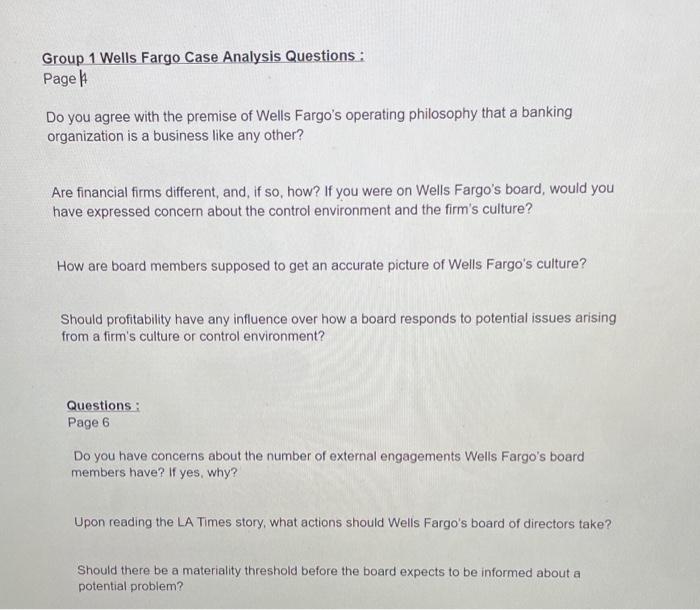
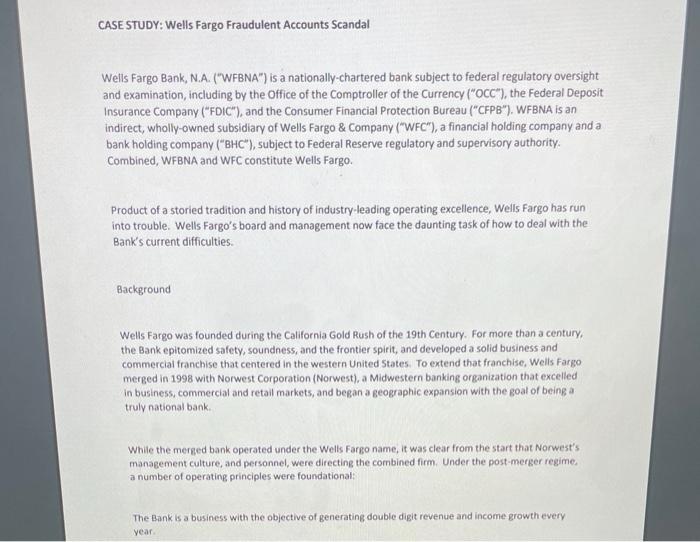
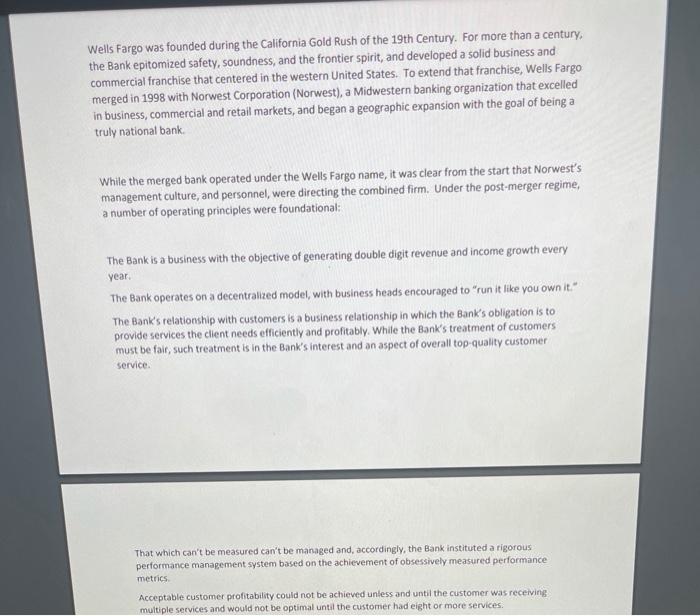
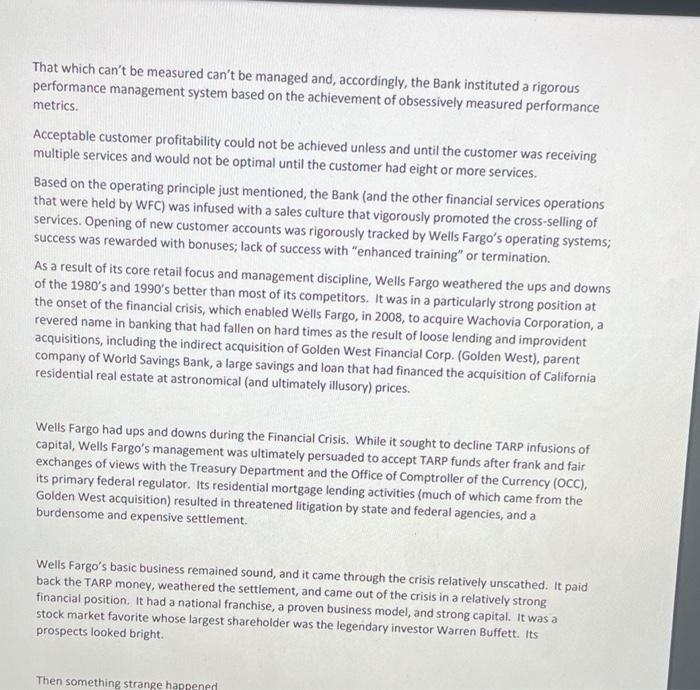
Group 1 Wells Fargo Case Analysis Questions: Page Do you agree with the premise of Wells Fargo's operating philosophy that a banking organization is a business like any other? Are financial firms different, and, if so, how? If you were on Wells Fargo's board, would you have expressed concern about the control environment and the firm's culture? How are board members supposed to get an accurate picture of Wells Fargo's culture? Should profitability have any influence over how a board responds to potential issues arising from a firm's culture or control environment? Questions : Page 6 Do you have concerns about the number of external engagements Wells Fargo's board members have? If yes, why? Upon reading the LA Times story, what actions should Wells Fargo's board of directors take? Should there be a materiality threshold before the board expects to be informed about a potential problem? CASE STUDY: Wells Fargo Fraudulent Accounts Scandal Wells Fargo Bank, N.A. ("WFBNA") is a nationally-chartered bank subject to federal regulatory oversight and examination, including by the Office of the Comptroller of the Currency ("OCC"), the Federal Deposit Insurance Company ("FDIC"), and the Consumer Financial Protection Bureau ("CFPB"). WFBNA is an indirect, wholly-owned subsidiary of Wells Fargo & Company ("WFC"), a financial holding company and a bank holding company ("BHC"), subject to Federal Reserve regulatory and supervisory authority Combined, WFBNA and WFC constitute Wells Fargo. Product of a storled tradition and history of industry-leading operating excellence, Wells Fargo has run into trouble. Wells Fargo's board and management now face the daunting task of how to deal with the Bank's current difficulties Background Wells Fargo was founded during the California Gold Rush of the 19th Century. For more than a century, the Bank epitomized safety, soundness, and the frontier spirit, and developed a solid business and commercial franchise that centered in the western United States. To extend that franchise, Wells Fargo merged in 1998 with Norwest Corporation (Norwest), a Midwestern banking organization that excelled in business, commercial and retail markets and began a geographic expansion with the goal of being a truly national bank While the merged bank operated under the Wells Fargo name, it was clear from the start that Norwest's management culture, and personnel, were directing the combined firm. Under the post-merger regime, a number of operating principles were foundational The Bank is a business with the objective of generating double digit revenue and income growth every year Wells Fargo was founded during the California Gold Rush of the 19th Century. For more than a century, the Bank epitomized safety, soundness, and the frontier spirit, and developed a solid business and commercial franchise that centered in the western United States. To extend that franchise, Wells Fargo merged in 1998 with Norwest Corporation (Norwest), a Midwestern banking organization that excelled in business, commercial and retail markets, and began a geographic expansion with the goal of being a truly national bank While the merged bank operated under the Wells Fargo name, it was clear from the start that Norwest's management culture, and personnel, were directing the combined firm. Under the post-merger regime, a number of operating principles were foundational: The Bank is a business with the objective of generating double digit revenue and income growth every year The Bank operates on a decentralized model with business heads encouraged to run it like you own it." The Bank's relationship with customers is a business relationship in which the Bank's obligation is to provide services the client needs efficiently and profitably. While the Bank's treatment of customers must be fair, such treatment is in the Bank's interest and an aspect of overall top quality customer service That which can't be measured can't be managed and, accordingly, the Bank instituted a rigorous performance management system based on the achievement of obsessively measured performance metrics Acceptable customer profitability could not be achieved unless and until the customer was receiving multiple services and would not be optimal until the customer had eight or more services That which can't be measured can't be managed and, accordingly, the Bank instituted a rigorous performance management system based on the achievement of obsessively measured performance metrics. Acceptable customer profitability could not be achieved unless and until the customer was receiving multiple services and would not be optimal until the customer had eight or more services. Based on the operating principle just mentioned, the Bank (and the other financial services operations that were held by WFC) was infused with a sales culture that vigorously promoted the cross-selling of services. Opening of new customer accounts was rigorously tracked by Wells Fargo's operating systems; success was rewarded with bonuses; lack of success with "enhanced training" or termination. As a result of its core retail focus and management discipline, Wells Fargo weathered the ups and downs of the 1980's and 1990's better than most of its competitors. It was in a particularly strong position at the onset of the financial crisis, which enabled Wells Fargo, in 2008, to acquire Wachovia Corporation, a revered name in banking that had fallen on hard times as the result of loose lending and improvident acquisitions, including the indirect acquisition of Golden West Financial Corp. (Golden West), parent company of World Savings Bank, a large savings and loan that had financed the acquisition of California residential real estate at astronomical (and ultimately illusory) prices. Wells Fargo had ups and downs during the Financial Crisis. While it sought to decline TARP infusions of capital, Wells Fargo's management was ultimately persuaded to accept TARP funds after frank and fair exchanges of views with the Treasury Department and the Office of Comptroller of the Currency (OCC), its primary federal regulator. Its residential mortgage lending activities (much of which came from the Golden West acquisition) resulted in threatened litigation by state and federal agencies, and a burdensome and expensive settlement. Wells Fargo's basic business remained sound, and it came through the crisis relatively unscathed. It paid back the TARP money, weathered the settlement, and came out of the crisis in a relatively strong financial position. It had a national franchise, a proven business model, and strong capital. It was a stock market favorite whose largest shareholder was the legendary investor Warren Buffett. Its prospects looked bright. Then something strange happened Then something strange happened. Wells Fargo's Identity Crisis The core of Wells Fargo's operating strategy was its large retail distribution network, operating out of the Community Bank Division, and comprised of physical branches (called "stores"), and alternative delivery channels such as telephone, free-standing ATMs, and the internet. As noted above, the objective of this system was to generate new customer relationships and to expand, to the maximum extent possible, the number of products and services sold to existing customers. The scale of the system had grown by acquisition, but Wells Fargo's management had insured that its IT systems expanded to cover this growth effectively. While the community Bank's management had also grown, it was well trained in the Bank's management philosophy and in the use of the Bank's systems. This cohesion was buttressed by the fact that the top leadership had worked together for years at Norwest and, as a result, had implicit trust and confidence in each other. Wells Fargo's financial success reinforced its commitment to a decentralized organizational structure, and enhanced the status and authority of division heads, particularly the head of the Community Bank, which was the Bank's main profit engine. The decentralized model also influenced the design and execution of the firm's control functions. Many of the Bank's centralized control functions had parallel units in the lines of business, with dual lines of reporting. For instance, each line of business had its own chief risk officer who reported directly to the head of the business line, and had a secondary (dotted line) reporting line to the head of Corporate Risk - the Chief Risk Officer. A similar decentralized structure existed for Human Resources. The Bank's decentralized structure gave the head of the Community Bank near unlimited discretion in establishing sales goals, and management at all levels were remorseless and relentless in pursuit of these goals. The Community Bank's leadership acknowledged the improbability of reaching these goals, referring to them at times as 50/50 plans, meaning that they expected only half the regions would be able to meet them. Nonetheless, at each level in the hierarchy, employees were measured on how they performed relative to these goals. They were ranked against one another on their performance relative to goals, and their incentive compensation and promotional opportunities were determined relative to those goals. In some cases, employees were dismissed for failing to meet sales goals. Turnover in the Community Bank was high relative to peers, but because of the sales culture, management considered this turnover to be in line with that of non-bank retailers, and therefore acceptable. Over the years, signs did emerge that aggressive sales goals were having some deleterious effects: In 2002, the Community Bank, noticing an uptick in sales practice violations, established a sales integrity task force which lead to additional employee training and a modification of incentive plans to reduce the promotion of bad behavior In the summer of 2002, Wells Fargo's Internal Investigations unit determined that almost an entire branch in Colorado engaged in a form of "gaming" in connection with a promotional campaign in the second quarter of 2002. In some instances, such "gaming" Involved employees issuing debit cards without customer consent. In 2004, Wells Fargo's Internal Investigations group drafted a memorandum noting an increase in annual sales gaming cases - defined as the manipulation and/or misrepresentation of sales to receive compensation or meet sales goals - from 63 in 2000 to a projected 680 in 2004. The memorandum noted a similar increase in terminations, from 21 in 2000 to a projected 223 in 2004. Beginning in 2005, the Wells Fargo board of director's Audit & Examination Committee began receiving regular Audit & Security Reports indicating that the highest level of complaints to the firm's internal EthicsLine were related to sales integrity violations. In 2010, Wells Fargo's primary regulator, the OCC, issued a Matter Requiring Attention (MRA) requiring an enterprise-wide system for complaint management. This MRA was addressed to the firm's management and not to the board. Also in 2010, OCC examiners asked the head of the Community Bank about the 700 cases of whistleblower complaints related to the gaming of employee incentive plans. The head of the Community Bank responded that the primary reason for the high number of complaints is that the culture encourages valid complaints which are then investigated and appropriately addressed. In 2011, Wells Fargo terminated 13 bankers and tellers in a branch in California for engaging in the manipulation of teller referral credits Despite these warning signs, the incentive compensation structure within the Community Bank remained largely unchanged. In fact, the Division doubled down on the program in 2010 by aligning performance management and recognition with sales goals, so that incentive compensation and performance rating were both associated with sales. This effectively meant that bankers, branch managers and district managers who did not meet sales goals not only could miss out on opportunities to earn incentive compensation, but were also at risk of poor performance reviews. Questions Do you agree with the premise of Wells Fargo's operating philosophy that a banking organization is a business like any other? Are financial firms different, and, if so, how? If you were on Wells Fargo's board, would you have expressed concern about the control environment and the firm's culture? How are board members supposed to get an accurate picture of Wells Fargo's culture? Should profitability have any influence over how a board responds to potential issues arising from a firm's culture or control environment









 Study Help