







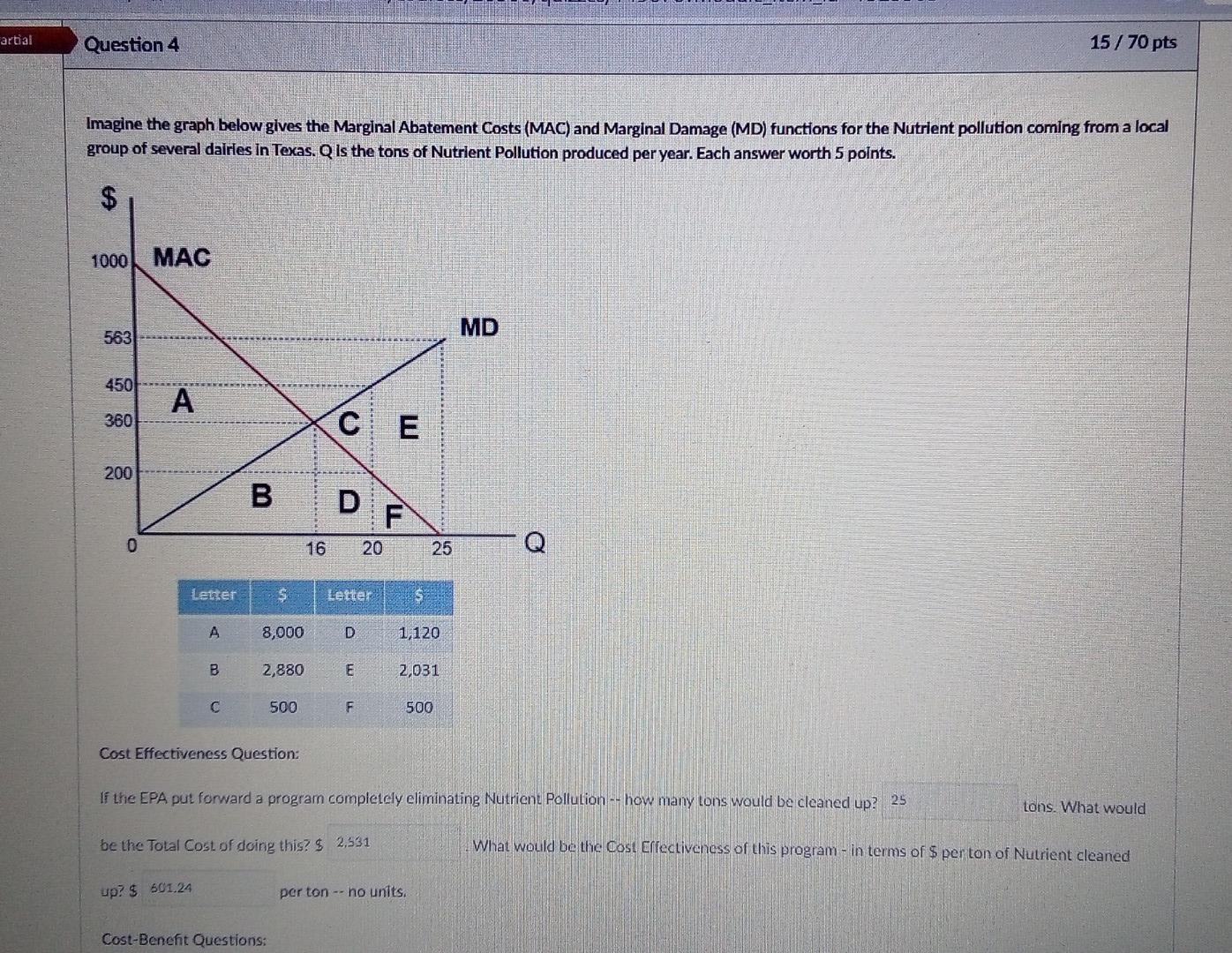
Question: please answer, thanks artial Question 4 15 / 70 pts Imagine the graph below gives the Marginal Abatement Costs (MAC) and Marginal Damage (MD) functions
please answer, thanks
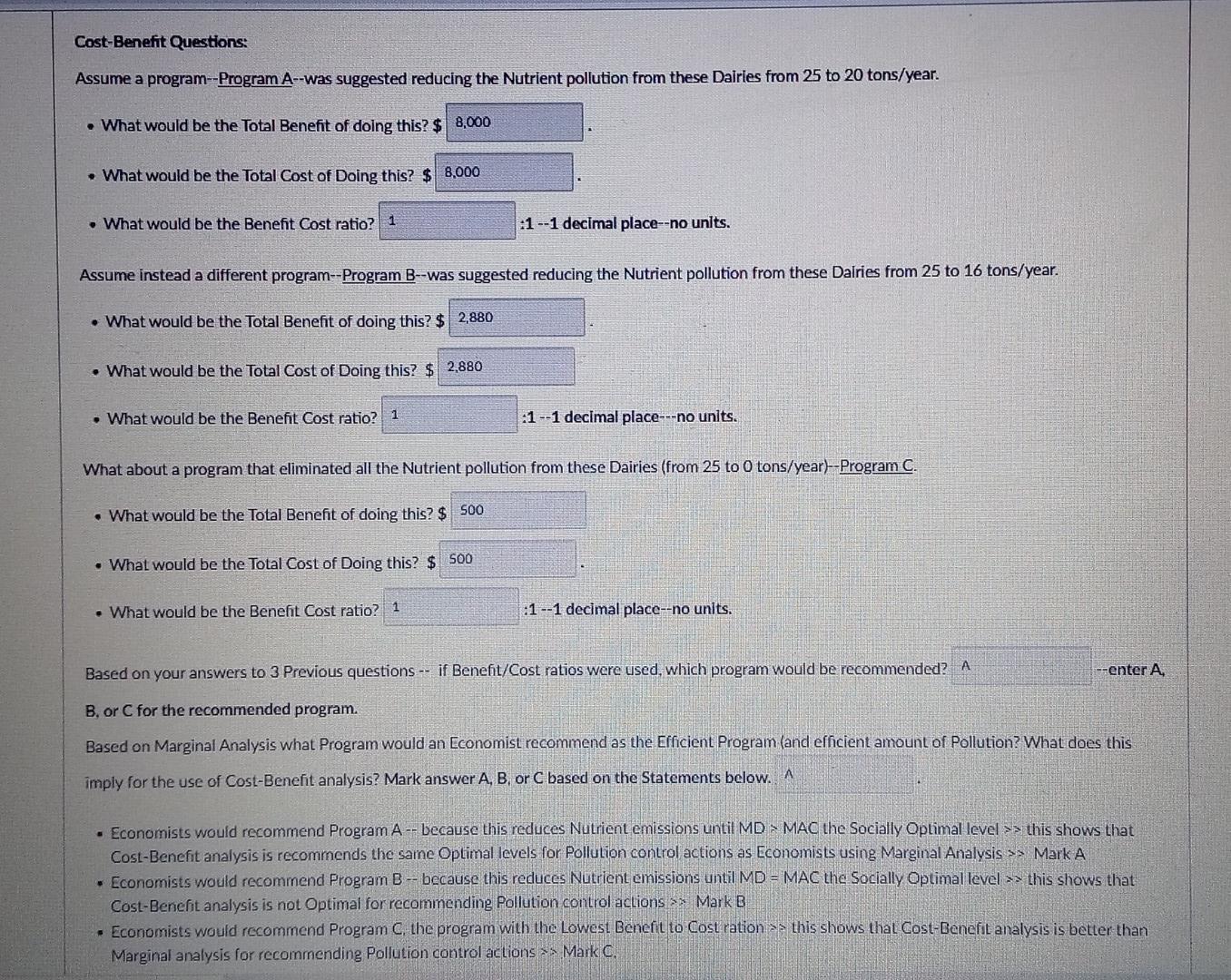
artial Question 4 15 / 70 pts Imagine the graph below gives the Marginal Abatement Costs (MAC) and Marginal Damage (MD) functions for the Nutrient pollution coming from a local group of several dairies In Texas. Q is the tons of Nutrient Pollution produced per year. Each answer worth 5 points. $ 1000 MAC MD 563 450 A 360 200 B D F 20 0 16 25 Letter $ Letter $ A 8,000 D 1,120 B 2,880 E 2,031 C 500 F 500 Cost Effectiveness Question: If the EPA put forward a program completely eliminating Nutrient Pollution -- how many tons would be cleaned up? 25 tons. What would be the Total Cost of doing this? $ 2,531 What would be the Cost Crrectiveness of this program - in terms of $ per ton of Nutrient cleaned up? $ 601.24 per ton -- no units. Cost-Benent Questions: Cost-Benefit Questions: Assume a program--Program A--was suggested reducing the Nutrient pollution from these Dairies from 25 to 20 tons/year. What would be the Total Benefit of doing this? $ 8,000 What would be the Total Cost of Doing this? $ 8,000 . What would be the Benefit Cost ratio? 1 :1 -1 decimal place--no units. Assume instead a different program--Program B--was suggested reducing the Nutrient pollution from these Dalries from 25 to 16 tons/year. What would be the Total Benefit of doing this? $ 2,880 What would be the Total Cost of Doing this? $ 2,880 . What would be the Benefit Cost ratio? 1 :1 --1 decimal place---no units. What about a program that eliminated all the Nutrient pollution from these Dairies (from 25 to 0 tons/year)--Program C. What would be the Total Benefit of doing this? $ 500 What would be the Total Cost of Doing this? $ 500 What would be the Beneht Cost ratio? 1 :1 --1 decimal place--no units. Based on your answers to 3 Previous questions -- if Benefit/Cost ratios were used, which program would be recommended? A --enter A B, or C for the recommended program. Based on Marginal Analysis what Program would an Economist recommend as the Efficient Program (and efficient amount of Pollution? What does this imply for the use of Cost-Benefit analysis? Mark answer A, B, or C based on the Statements below. A Economists would recommend Program A -- because this reduces Nutrient emissions until MD MAC the Socially Optimal level >> this shows that Cost-Benefit analysis is recommends the samne Optimal levels for Pollution control actions as Economists using Marginal Analysis >> Mark A Economists would recommend Program B -- because this reduces Nutrient emissions until MD = MAC the Socially Optimal level >> this shows that Cost-Beneht analysis is not Optimal for recommending Pollution control actions >> Mark B Economists would recommend Program C, the program with the Lowest Benefit to Cost ration >> this shows that Cost-Benefit analysis is better than Marginal analysis for recommending Pollution control actions Mark C. artial Question 4 15 / 70 pts Imagine the graph below gives the Marginal Abatement Costs (MAC) and Marginal Damage (MD) functions for the Nutrient pollution coming from a local group of several dairies In Texas. Q is the tons of Nutrient Pollution produced per year. Each answer worth 5 points. $ 1000 MAC MD 563 450 A 360 200 B D F 20 0 16 25 Letter $ Letter $ A 8,000 D 1,120 B 2,880 E 2,031 C 500 F 500 Cost Effectiveness Question: If the EPA put forward a program completely eliminating Nutrient Pollution -- how many tons would be cleaned up? 25 tons. What would be the Total Cost of doing this? $ 2,531 What would be the Cost Crrectiveness of this program - in terms of $ per ton of Nutrient cleaned up? $ 601.24 per ton -- no units. Cost-Benent Questions: Cost-Benefit Questions: Assume a program--Program A--was suggested reducing the Nutrient pollution from these Dairies from 25 to 20 tons/year. What would be the Total Benefit of doing this? $ 8,000 What would be the Total Cost of Doing this? $ 8,000 . What would be the Benefit Cost ratio? 1 :1 -1 decimal place--no units. Assume instead a different program--Program B--was suggested reducing the Nutrient pollution from these Dalries from 25 to 16 tons/year. What would be the Total Benefit of doing this? $ 2,880 What would be the Total Cost of Doing this? $ 2,880 . What would be the Benefit Cost ratio? 1 :1 --1 decimal place---no units. What about a program that eliminated all the Nutrient pollution from these Dairies (from 25 to 0 tons/year)--Program C. What would be the Total Benefit of doing this? $ 500 What would be the Total Cost of Doing this? $ 500 What would be the Beneht Cost ratio? 1 :1 --1 decimal place--no units. Based on your answers to 3 Previous questions -- if Benefit/Cost ratios were used, which program would be recommended? A --enter A B, or C for the recommended program. Based on Marginal Analysis what Program would an Economist recommend as the Efficient Program (and efficient amount of Pollution? What does this imply for the use of Cost-Benefit analysis? Mark answer A, B, or C based on the Statements below. A Economists would recommend Program A -- because this reduces Nutrient emissions until MD MAC the Socially Optimal level >> this shows that Cost-Benefit analysis is recommends the samne Optimal levels for Pollution control actions as Economists using Marginal Analysis >> Mark A Economists would recommend Program B -- because this reduces Nutrient emissions until MD = MAC the Socially Optimal level >> this shows that Cost-Beneht analysis is not Optimal for recommending Pollution control actions >> Mark B Economists would recommend Program C, the program with the Lowest Benefit to Cost ration >> this shows that Cost-Benefit analysis is better than Marginal analysis for recommending Pollution control actions Mark C
Step by Step Solution
There are 3 Steps involved in it

Get step-by-step solutions from verified subject matter experts
 Study Help