







Question: Please answer the # 21-27 multiple choice questions: 21. In a transaction qualifying as a type C reorganization, the acquiring corporation receives the transferors property:
Please answer the # 21-27 multiple choice questions:
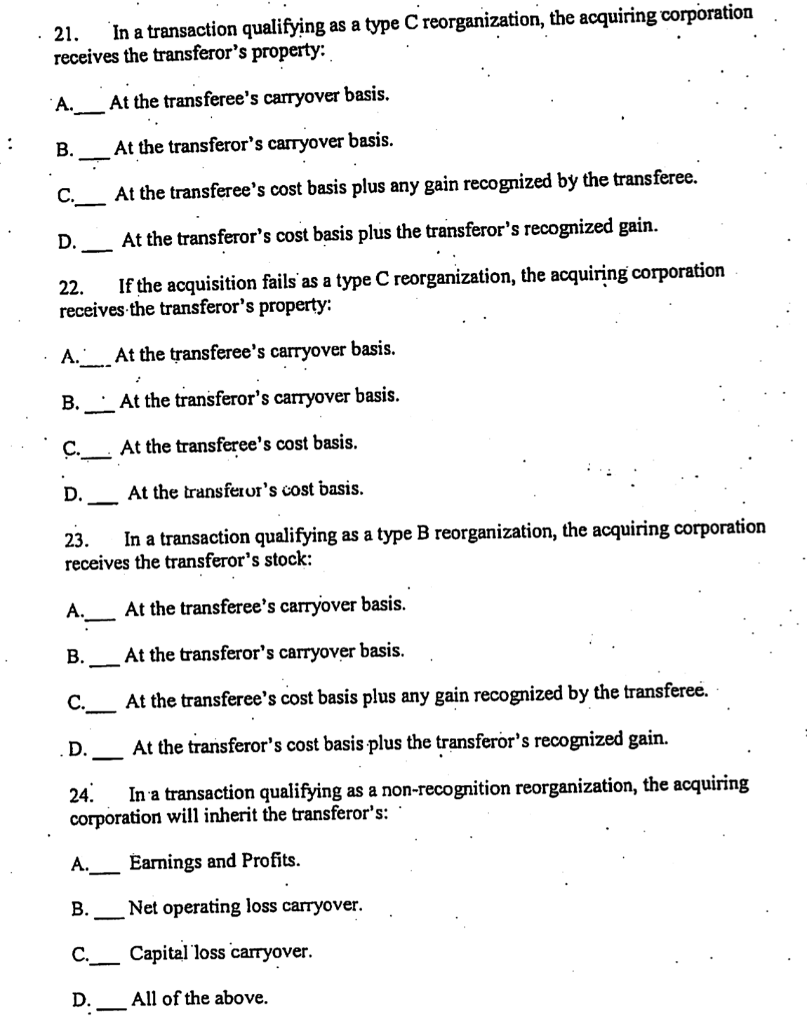
21. In a transaction qualifying as a type C reorganization, the acquiring corporation receives the transferors property:
-
At the transferees carryover basis.
-
At the transferors carryover basis.
-
At the transferees cost basis plus any gain recognized by the transferee.
-
At the transferors cost basis plus the transferors recognized gain.
22. If the acquisition fails as a type C reorganization, the acquiring corporation receives the transferors property:
-
At the transferees carryover basis.
-
At the transferors carryover basis.
-
At the transferees cost basis
-
At the transferors cost basis.
23. In a transaction qualifying as a type B reorganization, the acquiring corporation receives the transferors stock:
-
At the transferees carryover basis.
-
At the transferors carryover basis.
-
At the transferees cost basis plus any again recognized by the transferee.
-
At the transferors cost basis plus the transferors recognized gain.
24. In a transaction qualifying as a non-recognition reorganization, the acquiring corporation will inherit the transferors:
-
Earnings and profits.
-
Net operating loss carryover.
-
Capital loss carryover.
-
All of the above.
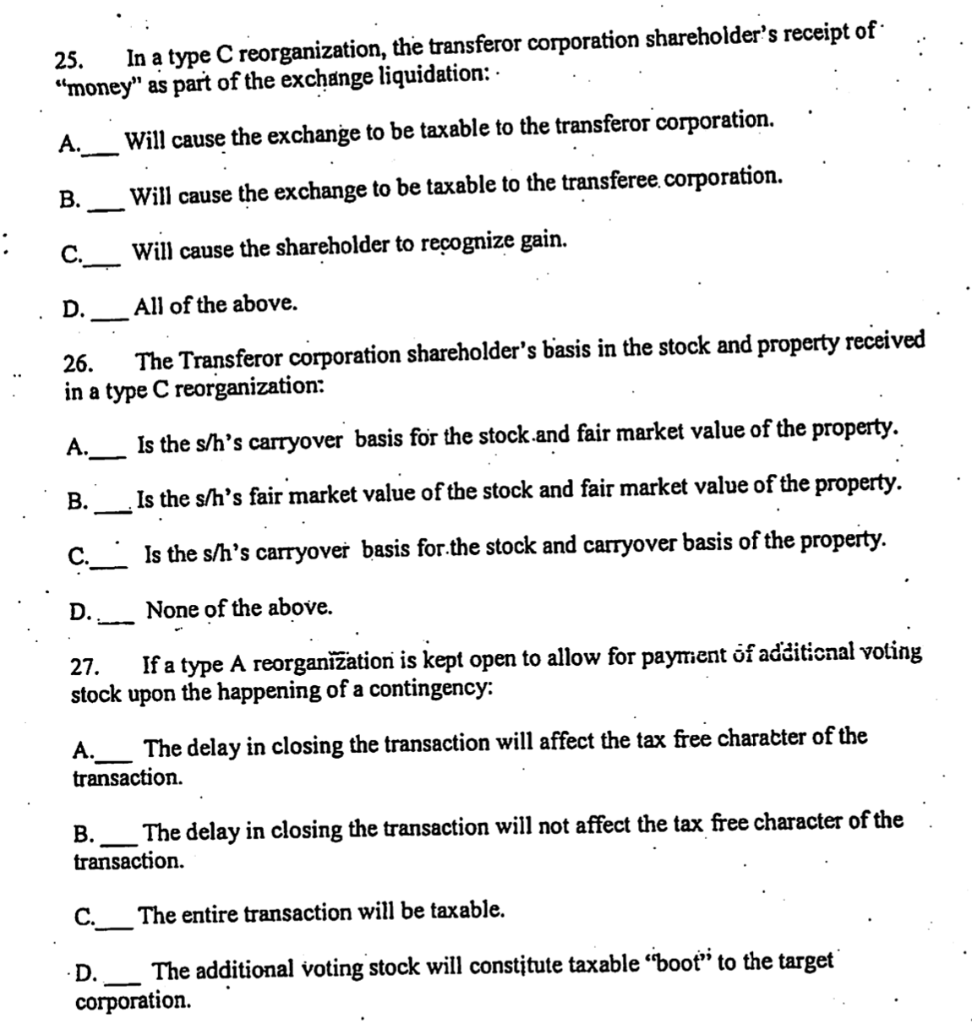
25. In a type C reorganization, the transferor corporation shareholders receipt of money as part of the exchange liquidation:
-
Will cause the exchange to be taxable to the transferor corporation
-
Will cause the exchange to be taxable to the transferee corporation.
-
Will cause the shareholder to recognize gain.
-
All of the above.
26. The transferor corporation shareholders basis in the stock and property received in a type C reorganization:
-
Is the shareholders carryover basis for the stock and fair market value of the property.
-
Is the shareholders fair market value of the stock and fair market value of the property.
-
Is the shareholders carryover basis for the stock and carryover basis of the property.
-
None of the above.
27. If a type A reorganization is kept open to allow for payment of additional voting stock upon the happening of a contingency:
-
The delay in closing the transaction will affect the tax free character of the transaction.
-
The delay in closing the transaction will not affect the tax free character of the transaction.
-
The entire transaction will be taxable.
-
The additional voting stock will constitute taxable boot to the target Corporation.
Textbook: Federal Income Taxation of Corporations and Shareholders, 7th Edition
Course: Taxation of Reorganizations & Liquidations
21. In a transaction qualifying as a type C reorganization, the acquiring corporation receives the transferor's property: A. _ At the transferee's carryover basis. y At the transferor's carryover basis. At the transferee's cost basis plus any gain recognized by the transferee. D. _ At the transferor's cost basis plus the transferor's recognized gain. 22. If the acquisition fails as a type C reorganization, the acquiring corporation receives the transferor's property: A. At the transferee's carryover basis. B.. At the transferor's carryover basis. At the transferee's cost basis. D._At the transferur's cost basis. 23. In a transaction qualifying as a type B reorganization, the acquiring corporation receives the transferor's stock: A._ At the transferee's carryover basis. At the transferor's carryover basis. At the transferee's cost basis plus any gain recognized by the transferee. - At the transferor's cost basis plus the transferor's recognized gain. 24. In a transaction qualifying as a non-recognition reorganization, the acquiring corporation will inherit the transferor's: A. __ Earnings and Profits. Net operating loss carryover. C. _ Capital loss carryover. All of the above. 25. In a type C reorganization, the transferor corporation shareholder's receipt of money" as part of the exchange liquidation: .. . A. __ Will cause the exchange to be taxable to the transferor corporation... B. __ Will cause the exchange to be taxable to the transferee.corporation. c. __ Will cause the shareholder to recognize gain. D. All of the above. 26. The Transferor corporation shareholder's basis in the stock and property received in a type C reorganization: A.__ Is the s/h's carryover basis for the stock.and fair market value of the property. B. _ Is the s/h's fair market value of the stock and fair market value of the property. c.__ Is the s/h's carryover basis for the stock and carryover basis of the property. D. None of the above. 27. If a type A reorganization is kept open to allow for paymient of additional voting stock upon the happening of a contingency: A. __ The delay in closing the transaction will affect the tax free character of the transaction. B. ___ The delay in closing the transaction will not affect the tax free character of the transaction. c. The entire transaction will be taxable. D. _ The additional voting stock will constitute taxable boot to the target corporation. 21. In a transaction qualifying as a type C reorganization, the acquiring corporation receives the transferor's property: A. _ At the transferee's carryover basis. y At the transferor's carryover basis. At the transferee's cost basis plus any gain recognized by the transferee. D. _ At the transferor's cost basis plus the transferor's recognized gain. 22. If the acquisition fails as a type C reorganization, the acquiring corporation receives the transferor's property: A. At the transferee's carryover basis. B.. At the transferor's carryover basis. At the transferee's cost basis. D._At the transferur's cost basis. 23. In a transaction qualifying as a type B reorganization, the acquiring corporation receives the transferor's stock: A._ At the transferee's carryover basis. At the transferor's carryover basis. At the transferee's cost basis plus any gain recognized by the transferee. - At the transferor's cost basis plus the transferor's recognized gain. 24. In a transaction qualifying as a non-recognition reorganization, the acquiring corporation will inherit the transferor's: A. __ Earnings and Profits. Net operating loss carryover. C. _ Capital loss carryover. All of the above. 25. In a type C reorganization, the transferor corporation shareholder's receipt of money" as part of the exchange liquidation: .. . A. __ Will cause the exchange to be taxable to the transferor corporation... B. __ Will cause the exchange to be taxable to the transferee.corporation. c. __ Will cause the shareholder to recognize gain. D. All of the above. 26. The Transferor corporation shareholder's basis in the stock and property received in a type C reorganization: A.__ Is the s/h's carryover basis for the stock.and fair market value of the property. B. _ Is the s/h's fair market value of the stock and fair market value of the property. c.__ Is the s/h's carryover basis for the stock and carryover basis of the property. D. None of the above. 27. If a type A reorganization is kept open to allow for paymient of additional voting stock upon the happening of a contingency: A. __ The delay in closing the transaction will affect the tax free character of the transaction. B. ___ The delay in closing the transaction will not affect the tax free character of the transaction. c. The entire transaction will be taxable. D. _ The additional voting stock will constitute taxable boot to the target corporation
Step by Step Solution
There are 3 Steps involved in it

Get step-by-step solutions from verified subject matter experts
 Study Help