







Question: Please answer the 4 multiple choice questions below: A process address space must have a minimum of 3 memory objects in order for its owning
Please answer the 4 multiple choice questions below:
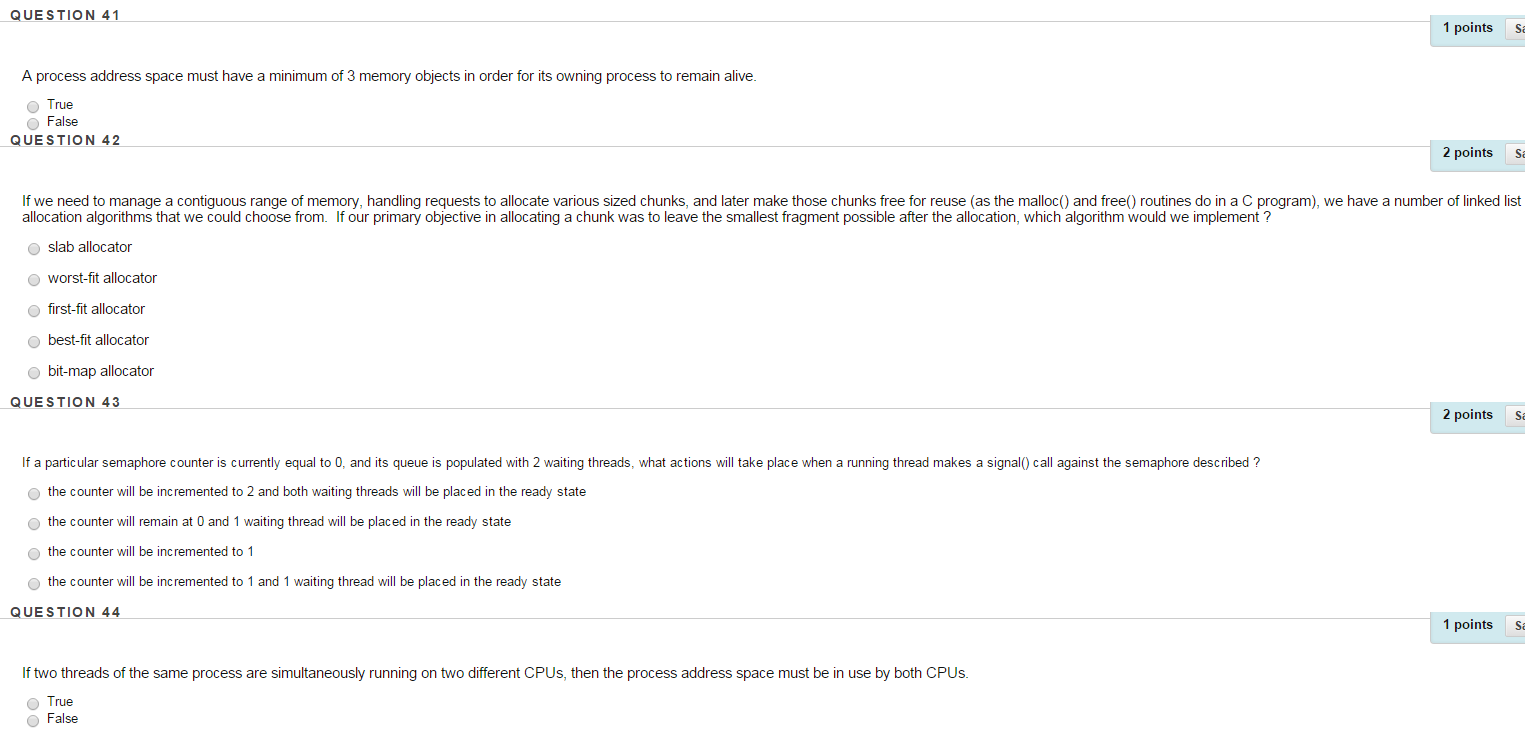
A process address space must have a minimum of 3 memory objects in order for its owning process to remain alive. True flase If we need to manage a contiguous range of memory, handling requests to allocate various sized chunks, and later make those chunks free for reuse (as the malloc() and free() routines do in a C program), we have a number of linked list allocation algorithms that we could choose from. If our primary objective in allocating a chunk was to leave the smallest fragment possible after the allocation, which algorithm would we implement ? slab allocator worst-fit allocator first-fit allocator best-fit allocator bit-map allocator If a particular semaphore counter is currently equal to 0. and its queue is populated with 2 waiting threads, what actions will take place when a running thread makes a signal() call against the semaphore described ? the counter will be incremented to 2 and both waiting threads will be placed in the ready state the counter will remain at 0 and 1 waiting thread will be placed in the ready state the counter will be incremented to 1 the counter will be incremented to 1 and 1 waiting thread will be placed in the ready state If two threads of the same process are simultaneously running on two different CPUs, then the process address space must be in use by both CPUs. True False A process address space must have a minimum of 3 memory objects in order for its owning process to remain alive. True flase If we need to manage a contiguous range of memory, handling requests to allocate various sized chunks, and later make those chunks free for reuse (as the malloc() and free() routines do in a C program), we have a number of linked list allocation algorithms that we could choose from. If our primary objective in allocating a chunk was to leave the smallest fragment possible after the allocation, which algorithm would we implement ? slab allocator worst-fit allocator first-fit allocator best-fit allocator bit-map allocator If a particular semaphore counter is currently equal to 0. and its queue is populated with 2 waiting threads, what actions will take place when a running thread makes a signal() call against the semaphore described ? the counter will be incremented to 2 and both waiting threads will be placed in the ready state the counter will remain at 0 and 1 waiting thread will be placed in the ready state the counter will be incremented to 1 the counter will be incremented to 1 and 1 waiting thread will be placed in the ready state If two threads of the same process are simultaneously running on two different CPUs, then the process address space must be in use by both CPUs. True False
Step by Step Solution
There are 3 Steps involved in it

Get step-by-step solutions from verified subject matter experts
 Study Help