







Question: PLEASE ANSWER THE A,B, AND C AND ALSO CHECK THEN ANSWER FOR THE UPPER BLANK THANK YOU risk-free rate The interest rate on debt, r,
 PLEASE ANSWER THE A,B, AND C AND ALSO CHECK THEN ANSWER FOR THE UPPER BLANK THANK YOU
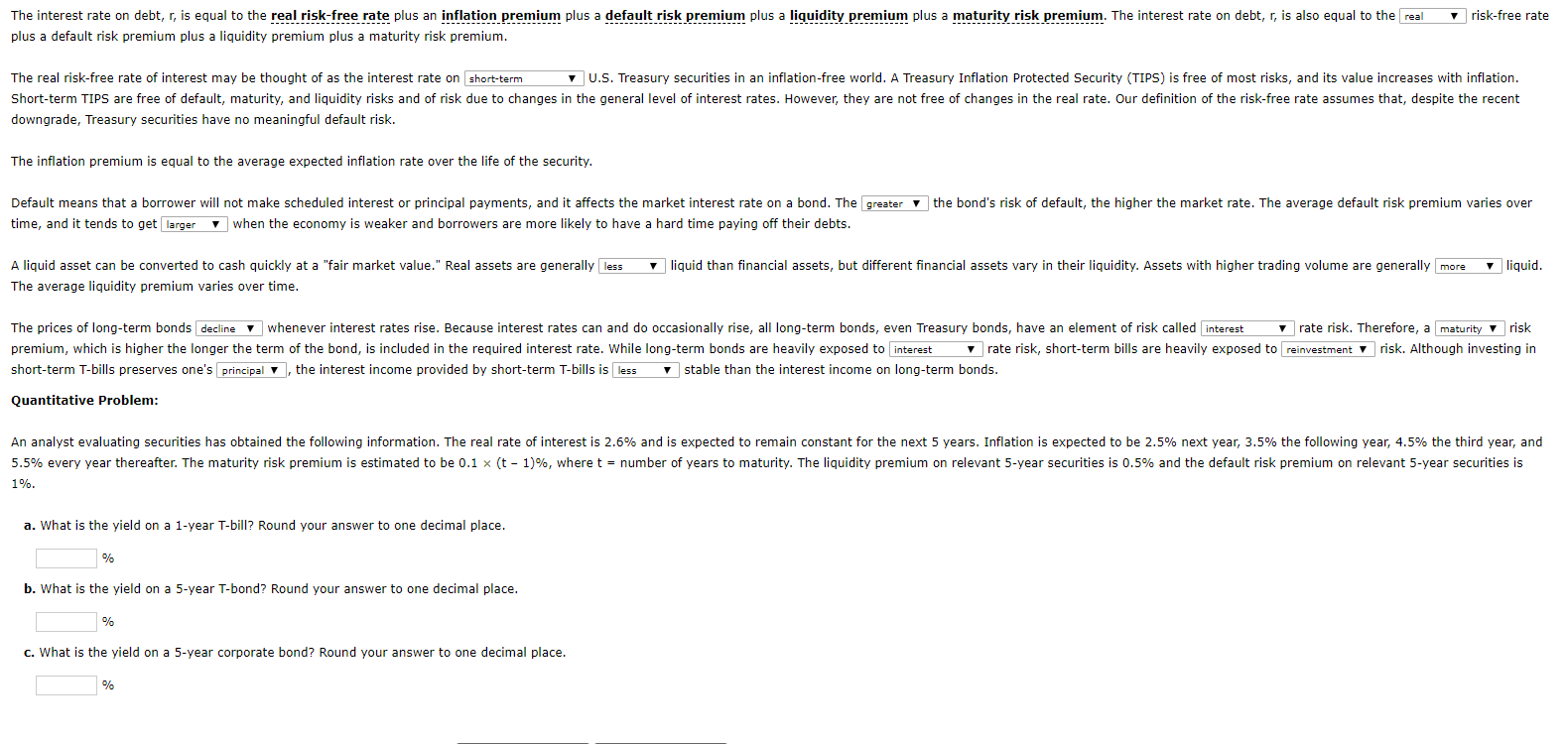
risk-free rate The interest rate on debt, r, is equal to the real risk-free rate plus an inflation premium plus a default risk premium plus a liquidity premium plus a maturity risk premium. The interest rate on debt, r, is also equal to the real plus a default risk premium plus a liquidity premium plus a maturity risk premium. The real risk-free rate of interest may be thought of as the interest rate on short-term U.S. Treasury securities in an inflation-free world. A Treasury Inflation Protected Security (TIPS) is free of most risks, and its value increases with inflation. Short-term TIPS are free of default, maturity, and liquidity risks and of risk due to changes in the general level of interest rates. However, they are not free of changes in the real rate. Our definition of the risk-free rate assumes that, despite the recent downgrade, Treasury securities have no meaningful default risk. The inflation premium is equal to the average expected inflation rate over the life of the security. the bond's risk of default, the higher the market rate. The average default risk premium varies over Default means that a borrower will not make scheduled interest or principal payments, and it affects the market interest rate on a bond. The greater time, and it tends to get larger when the economy is weaker and borrowers are more likely to have a hard time paying off their debts. liquid than financial assets, but different financial assets vary in their liquidity. Assets with higher trading volume are generally more liquid. A liquid asset can be converted to cash quickly at a "fair market value." Real assets are generally less The average liquidity premium varies over time. The prices of long-term bonds decline whenever interest rates rise. Because interest rates can and do occasionally rise, all long-term bonds, even Treasury bonds, have an element of risk called interest rate risk. Therefore, a maturity risk premium, which is higher the longer the term of the bond, is included in the required interest rate. While long-term bonds are heavily exposed to interest rate risk, short-term bills are heavily exposed to reinvestment risk. Although investing in short-term T-bills preserves one's principal , the interest income provided by short-term T-bills is less stable than the interest income on long-term bonds. Quantitative Problem: An analyst evaluating securities has obtained the following information. The real rate of interest is 2.6% and is expected to remain constant for the next 5 years. Inflation is expected to be 2.5% next year, 3.5% the following year, 4.5% the third year, and 5.5% every year thereafter. The maturity risk premium is estimated to be 0.1 x (t-1)%, where t = number of years to maturity. The liquidity premium on relevant 5-year securities is 0.5% and the default risk premium on relevant 5-year securities is 1%. a. What is the yield on a 1-year T-bill? Round your answer to one decimal place. b. What is the yield on a 5-year T-bond? Round your answer to one decimal place. c. What is the yield on a 5-year corporate bond? Round your answer to one decimal place
Step by Step Solution
There are 3 Steps involved in it

Get step-by-step solutions from verified subject matter experts
 Study Help