Question: please answer the case stidy as soon as possible U In 1997, the Turkish Ministry of Health (MoH) began work on the Core Health Resource
please answer the case stidy as soon as possible
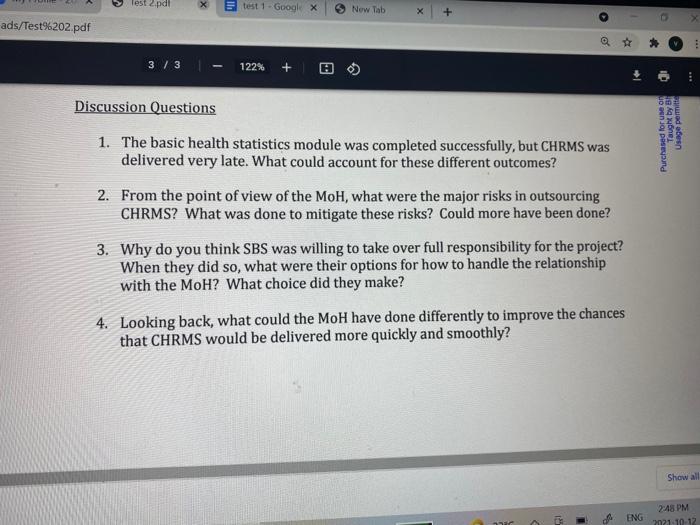
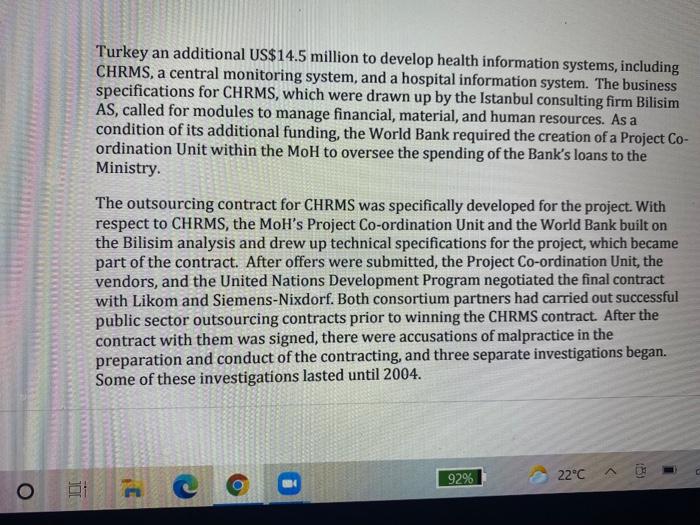
U In 1997, the Turkish Ministry of Health (MoH) began work on the Core Health Resource Management System (CHRMS) project. The MoH contracted with Siemens-Nixdorf and the Turkish software firm Likom to carry out the project. Likom was to be responsible for applications software, training, and on-site support, while Siemens-Nixdorf would do software and hardware installation. The project was scheduled to be completed in 1999. By 2002, CHRMS was still not complete, and Likom quit the project. The MoH considered cancelling the project, but the remaining partner agreed to take overall responsibility for CHRMS, and the project continued. Over the five year period since starting work on CHRMS, Siemens-Nixdorf had reorganised, handing responsibility for CHRMS to Siemens Business Services (SBS), the leading firm in the Turkish outsourcing sector. In turn, SBS had subcontracted portions of the project to seven other vendors. The MoH had no contact with these vendors; once Likom left, SBS was the single point of communication between the project and the Moh. nagement at Canadore College of Applied And Technology on the Project Man590 2021 to 20 och inbothacasecentre.org The World Bank and the Turkish Ministry of Health The MoH was the largest provider of hospital and primary care in Turkey, controlling half of the country's hospital beds in its 751 hospitals, and was the sole provider of preventative care. In the early 1990s, the Mol received loans of US$225 million from the World Bank to carry out a comprehensive reform program that would improve public health, advance the health services available in Turkey, and develop the MoH as an organisation. A basic health statistics module was contracted out to two private vendors in 1995 and was completed successfully by 1997. In 1997 the Bank loaned 92% 22C O Turkey an additional US$14.5 million to develop health information systems, including CHRMS, a central monitoring system, and a hospital information system. The business specifications for CHRMS, which were drawn up by the Istanbul consulting firm Bilisim AS, called for modules to manage financial, material, and human resources. As a condition of its additional funding, the World Bank required the creation of a Project Co- ordination Unit within the Mol to oversee the spending of the Bank's loans to the Ministry The outsourcing contract for CHRMS was specifically developed for the project. With respect to CHRMS, the MoH's Project Co-ordination Unit and the World Bank built on the Bilisim analysis and drew up technical specifications for the project, which became part of the contract. After offers were submitted, the Project Co-ordination Unit, the vendors, and the United Nations Development Program negotiated the final contract with Likom and Siemens-Nixdorf. Both consortium partners had carried out successful public sector outsourcing contracts prior to winning the CHRMS contract. After the contract with them was signed, there were accusations of malpractice in the preparation and conduct of the contracting, and three separate investigations began. Some of these investigations lasted until 2004. 92% 22C 2 / 3 122% + Disagreements and cultural differences There were disagreements throughout the early stages of the project about the quality of the systems analysis done before the contract was signed. The Ministry's Project Co- ordination Unit believed that the analysis was adequate and said that the Human Resources Department was simply reluctant to give approval, because CHRMS would reduce the department's ability to make appointments outside of normal channels. For its part, the Human Resources Department pointed out that the analysis completely omitted 19 regional warehouses and therefore was not sufficient; the Project Co- ordination Unit and SBS agreed that the warehouses were missing from the analysis but argued that overall, the analysis was good enough. The Human Resources Department was the largest and most powerful department the MoH. Early in the project it claimed that its needs were not being adequately recognised by the Project Co-ordination Unit, and threatened to stop CHRMS. The MoH solved this problem by expanding the small Human Resources IT section into a full department, responsible for the IT operations of the entire ministry, including the technical aspects of CHRMS. The Project Co-ordination Unit retained responsibility for the financial aspects of the project. ENG 91% 22C AD 20 2 / 3 122% + A Throughout the project there were cultural differences between the outsourcers and the MoH. As part of their bid, the outsourcers had prepared a plan and budget for their work, including gaining approvals from MoH departments as the project progressed. They found, though, that some MoH staff did not understand the need for CHRMS and did not see any benefit to them for giving approval. Moreover, some departments wanted to change the requirements for the parts of the project that affected them. In the view of some people at the World Bank, the guaranteed jobs offered by the Turkish public sector had made its employees lazy and risk-averse. 22C ING 24 202 91% C ul/Downloads/Test%202.pdf 3 / 3 122% . SBS and Likom staff reported that overall, MoH employees did not understand why private sector employees got higher salaries, and generally resisted helping them. MoH staff seemed to be unfamiliar with the concept of outsourcing and with the role of the World Bank. Since the MoH had already successfully completed the basic health statistics module using outsourcers, the reason for these attitudes was thought to be the frequent turnover among MoH staff. After one and a half years of discussion about issues with the pre-contract systems analysis, the MoH presented Likom and SBS with a contract amendment and gave them 12 days to sign it. It was at that point that Likom withdrew from the project. Once SBS took full responsibility, it discovered that extra work outside the contract was required. For example, the MoH did not have standard codes for the materials it used, making data entry into the materials resource management system impossible. Normally the client would be responsible for developing such codes, but when the MoH made no progress on this task, two SBS employees took it on. The outcomes By mid 2004, CHRMS had been installed and was in use by the central Ministry of Health 18 ENG 919 22C Test 2.pdl X E test 1 - Google X New Tab X ads/Test%202.pdf 3 / 3 122% E Discussion Questions Purchased for use on Usage permite 1. The basic health statistics module was completed successfully, but CHRMS was delivered very late. What could account for these different outcomes? 2. From the point of view of the MoH, what were the major risks in outsourcing CHRMS? What was done to mitigate these risks? Could more have been done? 3. Why do you think SBS was willing to take over full responsibility for the project? When they did so, what were their options for how to handle the relationship with the MoH? What choice did they make? 4. Looking back, what could the MoH have done differently to improve the chances that CHRMS would be delivered more quickly and smoothly? Show all 3 ENG 2:48 PM 2021-10-12









 Study Help