







Question: Please answer the circled question 1 at the bottom using the data in the table above Sa + 0.57% $ 0.43% $0.43% +0.78% collision 1
Please answer the circled question 1 at the bottom using the data in the table above
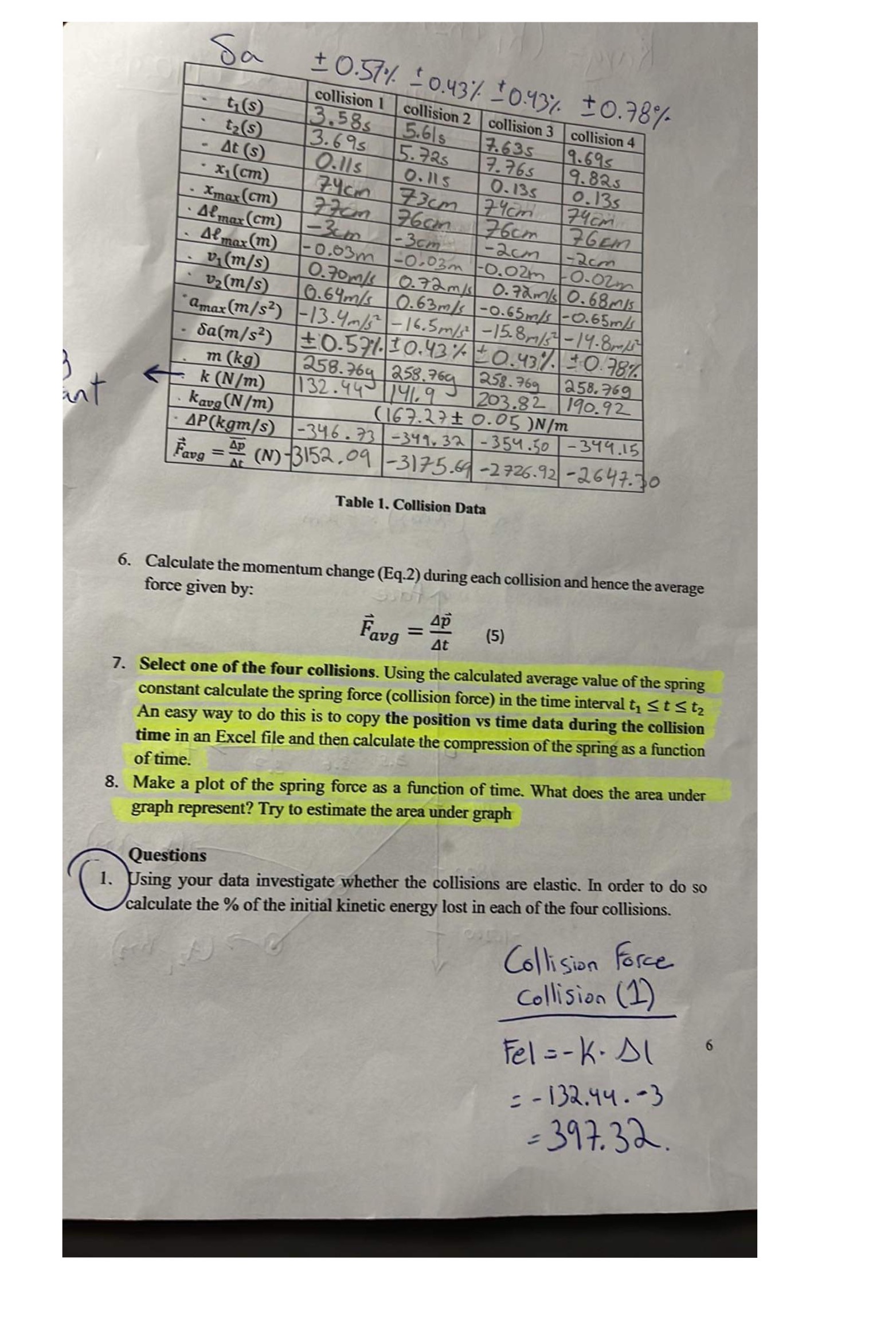
Sa + 0.57% $ 0.43% $0.43% +0.78% collision 1 collision 2 ti (s) 3.58s collision 3 collision 4 5.6/ s t2 (s ) 3. 69s 7.635 9. 69s 5. 725 At (s) 7. 765 9.825 OilIs O. 115 0. 135 0. 135 x1 (cm) 7.4cm 7:3 cm 74 cm 79 CM Xmax (cm) 76an 76cm 76EM Almax (cm) - 3 cm - 3 cm - 2 cm - 2cm Al max (m) - 0.63m -0103m - 0.02 m 10.02m v1 (m/s) 0.70m/1 0.72 m/s| 0. 72m/s|0. 68m/s U2 (m/s) 6.64m /5 0.63 m/s - 0.65 m/s - 0. 65 m/s . amax (m/s2) -13.4m/52 - 16.5 m/s -15.8m/57- 14.8 r/ Sa(m/s2) +0.57%- 10.43% + 0.43% +0.78% m (kg) 258. 769 258.769 258. 769 258.769 k (N/m) 132. 94 141.9 203.82 190. 92 kava (N /m) ( 167 . 2 7 + 0.05 ) N/m . AP (kgm/s) 1-346. 73 - 349. 32 -359.50 -349.15 Favg = AP (N) -3152. 09 -3175.69-2726.92 -2647.30 Table 1. Collision Data 6. Calculate the momentum change (Eq.2) during each collision and hence the average force given by: Favg = 7 ( 5 ) 7. Select one of the four collisions. Using the calculated average value of the spring constant calculate the spring force (collision force) in the time interval t, S t S t2 An easy way to do this is to copy the position vs time data during the collision time in an Excel file and then calculate the compression of the spring as a function of time. 8. Make a plot of the spring force as a function of time. What does the area under graph represent? Try to estimate the area under graph Questions Using your data investigate whether the collisions are elastic. In order to do so calculate the % of the initial kinetic energy lost in each of the four collisions. Collision Force collision ( 1) Fel = - K- DI = - 132.44. - 3 =397.32
Step by Step Solution
There are 3 Steps involved in it

Get step-by-step solutions from verified subject matter experts
 Study Help