Question: Please answer the coming three questions based on the provided Code of Ethics for Engineers which is below the questions. Based on the provided Code
Please answer the coming three questions based on the provided Code of Ethics for Engineers which is below the questions.
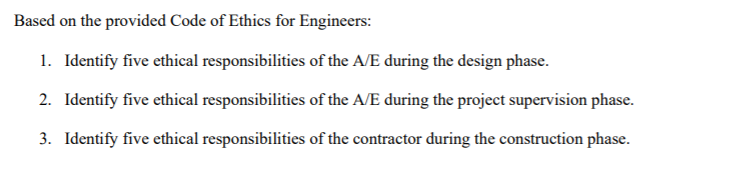
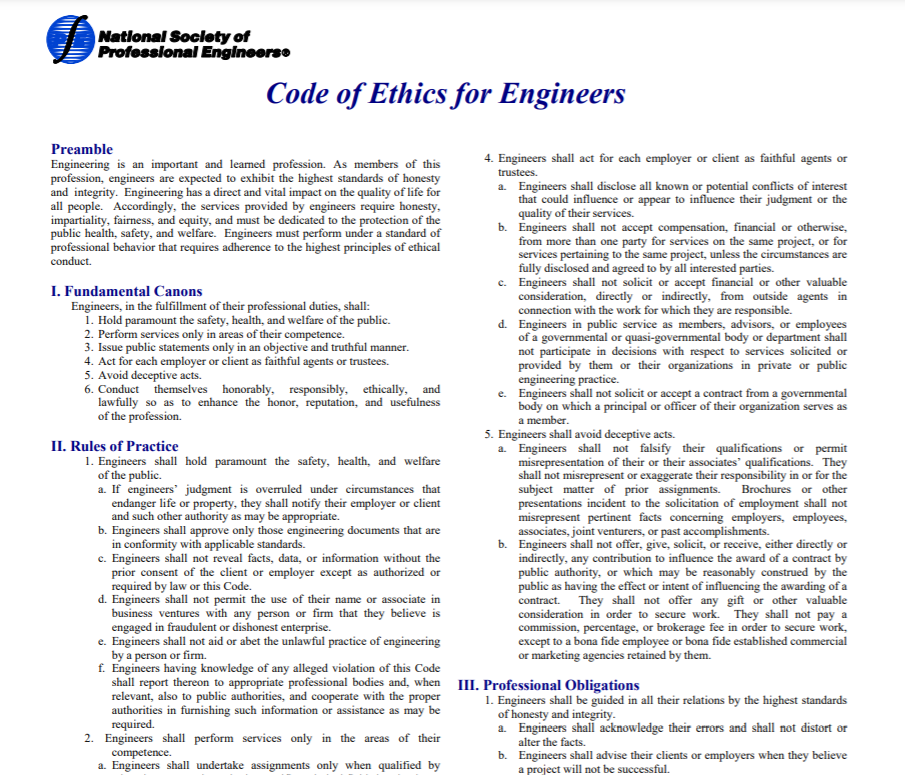
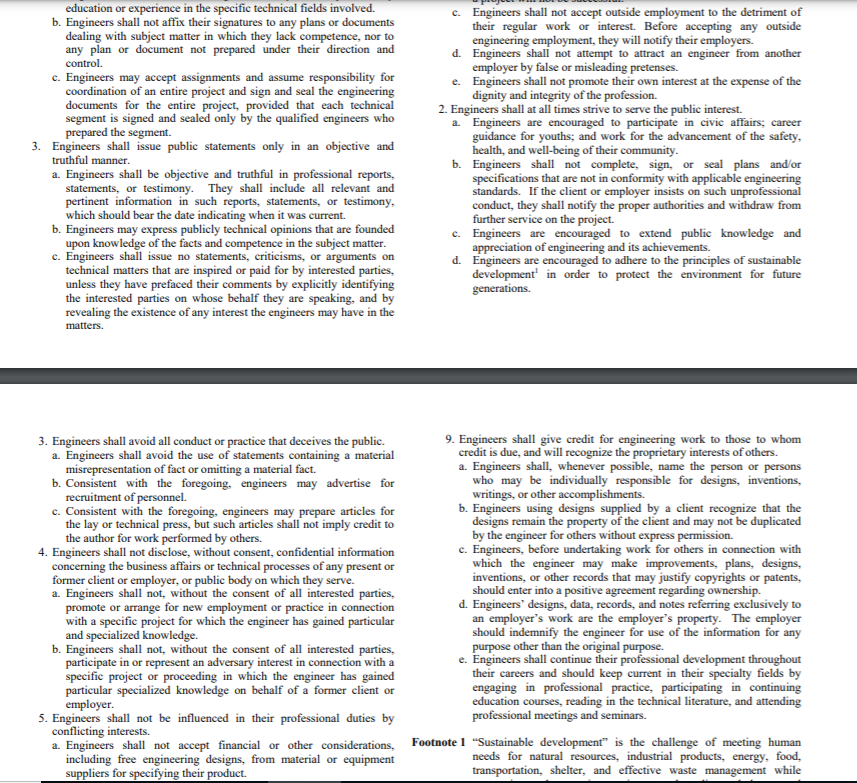
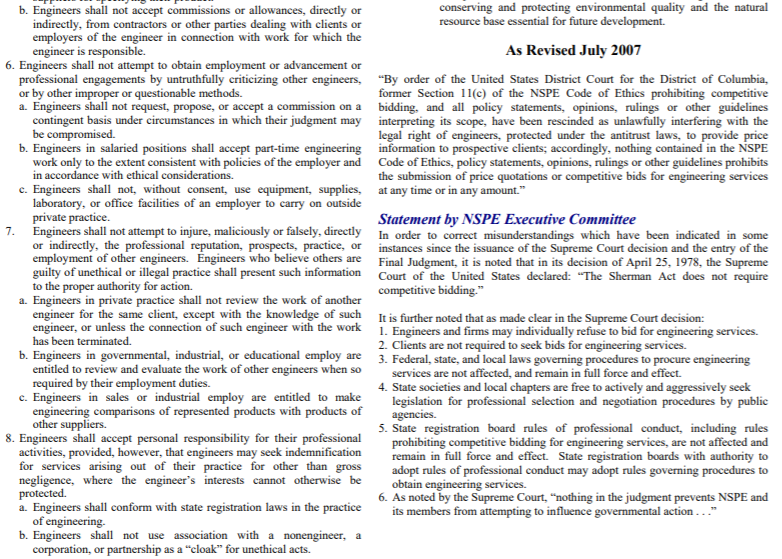
Based on the provided Code of Ethics for Engineers: 1. Identify five ethical responsibilities of the A/E during the design phase. 2. Identify five ethical responsibilities of the A/E during the project supervision phase. 3. Identify five ethical responsibilities of the contractor during the construction phase. National Society of Professional Engineers Code of Ethics for Engineers Preamble Engineering is an important and learned profession. As members of this 4. Engineers shall act for each employer or client as faithful agents or profession, engineers are expected to exhibit the highest standards of honesty trustees. and integrity. Engineering has a direct and vital impact on the quality of life for a Engineers shall disclose all known or potential conflicts of interest all people. Accordingly, the services provided by engineers require honesty, that could influence or appear to influence their judgment or the impartiality, fairness, and equity, and must be dedicated to the protection of the quality of their services. public health, safety, and welfare. Engineers must perform under a standard of b. Engineers shall not accept compensation, financial or otherwise, professional behavior that requires adherence to the highest principles of ethical from more than one party for services on the same project, or for conduct. services pertaining to the same project, unless the circumstances are fully disclosed and agreed to by all interested parties. I. Fundamental Canons c. Engineers shall not solicit or accept financial or other valuable Engineers, in the fulfillment of their professional duties, shall: consideration, directly or indirectly, from outside agents in connection with the work for which they are responsible. 1. Hold paramount the safety, health, and welfare of the public. d. Engineers in public service as members, advisors, or employees 2. Perform services only in areas of their competence. of a governmental or quasi-governmental body or department shall 3. Issue public statements only in an objective and truthful manner. not participate in decisions with respect to services solicited or 4. Act for each employer or client as faithful agents or trustees. provided by them or their organizations in private or public 5. Avoid deceptive acts. engineering practice. 6. Conduct themselves honorably, responsibly, ethically, and e Engineers shall not solicit or accept a contract from a governmental lawfully so as to enhance the honor, reputation, and usefulness body on which a principal or officer of their organization serves as of the profession a member 5. Engineers shall avoid deceptive acts. II. Rules of Practice a Engineers shall not falsify their qualifications or permit 1. Engineers shall hold paramount the safety, health, and welfare misrepresentation of their or their associates' qualifications. They of the public. shall not misrepresent or exaggerate their responsibility in or for the a. If engineers' judgment is overruled under circumstances that subject matter of prior assignments. Brochures or other endanger life or property, they shall notify their employer or client presentations incident to the solicitation of employment shall not and such other authority as may be appropriate. misrepresent pertinent facts concerning employers, employees, b. Engineers shall approve only those engineering documents that are associates, joint venturers, or past accomplishments. in conformity with applicable standards. b. Engineers shall not offer, give, solicit, or receive, either directly or c. Engineers shall not reveal facts, data, or information without the indirectly, any contribution to influence the award of a contract by prior consent of the client or employer except as authorized or public authority, or which may be reasonably construed by the required by law or this Code. public as having the effect or intent of influencing the awarding of a d. Engineers shall not permit the use of their name or associate in contract. They shall not offer any gift or other valuable business ventures with any person or firm that they believe is consideration in order to secure work. They shall not pay a engaged in fraudulent or dishonest enterprise. commission, percentage, or brokerage fee in order to secure work, e. Engineers shall not aid or abet the unlawful practice of engineering except to a bona fide employee or bona fide established commercial by a person or firm. or marketing agencies retained by them. f. Engineers having knowledge of any alleged violation of this Code shall report thereon to appropriate professional bodies and, when III. Professional Obligations relevant, also to public authorities, and cooperate with the proper 1. Engineers shall be guided in all their relations by the highest standards authorities in furnishing such information or assistance as may be of honesty and integrity. required. a. Engineers shall acknowledge their errors and shall not distort or 2. Engineers shall perform services only in the areas of their alter the facts. competence. b. Engineers shall advise their clients or employers when they believe a. Engineers shall undertake assignments only when qualified by a project will not be successful. education or experience in the specific technical fields involved. b. Engineers shall not affix their signatures to any plans or documents dealing with subject matter in which they lack competence, nor to any plan or document not prepared under their direction and control. c. Engineers may accept assignments and assume responsibility for coordination of an entire project and sign and seal the engineering documents for the entire project, provided that each technical segment is signed and sealed only by the qualified engineers who prepared the segment. 3. Engineers shall issue public statements only in an objective and truthful manner. a. Engineers shall be objective and truthful in professional reports, statements, or testimony. They shall include all relevant and pertinent information in such reports, statements, or testimony, which should bear the date indicating when it was current. b. Engineers may express publicly technical opinions that are founded upon knowledge of the facts and competence in the subject matter. c. Engineers shall issue no statements, criticisms, or arguments on technical matters that are inspired or paid for by interested parties, unless they have prefaced their comments by explicitly identifying the interested parties on whose behalf they are speaking, and by revealing the existence of any interest the engineers may have in the matters. c. Engineers shall not accept outside employment to the detriment of their regular work or interest. Before accepting any outside engineering employment, they will notify their employers. d. Engineers shall not attempt to attract an engineer from another employer by false or misleading pretenses. e. Engineers shall not promote their own interest at the expense of the dignity and integrity of the profession. 2. Engineers shall at all times strive to serve the public interest. a Engineers are encouraged to participate in civic affairs; career guidance for youths; and work for the advancement of the safety, health, and well-being of their community. b. Engineers shall not complete, sign, or seal plans and/or specifications that are not in conformity with applicable engineering standards. If the client or employer insists on such unprofessional conduct, they shall notify the proper authorities and withdraw from further service on the project. c. Engineers are encouraged to extend public knowledge and appreciation of engineering and its achievements. d. Engineers are encouraged to adhere to the principles of sustainable development in order to protect the environment for future generations. 3. Engineers shall avoid all conduct or practice that deceives the public. 9. Engineers shall give credit for engineering work to those to whom a. Engineers shall avoid the use of statements containing a material credit is due, and will recognize the proprietary interests of others. misrepresentation of fact or omitting a material fact. a. Engineers shall, whenever possible, name the person or persons b. Consistent with the foregoing, engineers may advertise for who may be individually responsible for designs, inventions, recruitment of personnel. writings, or other accomplishments. c. Consistent with the foregoing, engineers may prepare articles for b. Engineers using designs supplied by a client recognize that the the lay or technical press, but such articles shall not imply credit to designs remain the property of the client and may not be duplicated the author for work performed by others. by the engineer for others without express permission. 4. Engineers shall not disclose, without consent, confidential information c. Engineers, before undertaking work for others in connection with concerning the business affairs or technical processes of any present or which the engineer may make improvements, plans, designs, former client or employer, or public body on which they serve. inventions, or other records that may justify copyrights or patents, a. Engineers shall not, without the consent of all interested parties, should enter into a positive agreement regarding ownership promote or arrange for new employment or practice in connection d. Engineers' designs, data, records, and notes referring exclusively to with a specific project for which the engineer has gained particular an employer's work are the employer's property. The employer and specialized knowledge. should indemnify the engineer for use of the information for any b. Engineers shall not, without the consent of all interested parties, purpose other than the original purpose. participate in or represent an adversary interest in connection with a e. Engineers shall continue their professional development throughout specific project or proceeding in which the engineer has gained their careers and should keep current in their specialty fields by particular specialized knowledge on behalf of a former client or engaging in professional practice, participating in continuing employer. education courses, reading in the technical literature, and attending 5. Engineers shall not be influenced in their professional duties by professional meetings and seminars. conflicting interests. a. Engineers shall not accept financial or other considerationsFootnote 1 "Sustainable development" is the challenge of meeting human including free engineering designs, from material or equipment needs for natural resources, industrial products, energy, food, suppliers for specifying their product. transportation, shelter, and effective waste management while 7. b. Engineers shall not accept commissions or allowances, directly or conserving and protecting environmental quality and the natural indirectly, from contractors or other parties dealing with clients or resource base essential for future development. employers of the engineer in connection with work for which the engineer is responsible As Revised July 2007 6. Engineers shall not attempt to obtain employment or advancement or professional engagements by untruthfully criticizing other engineers, "By order of the United States District Court for the District of Columbia, or by other improper or questionable methods. former Section 11(e) of the NSPE Code of Ethics prohibiting competitive a. Engineers shall not request, propose, or accept a commission on a bidding, and all policy statements, opinions, rulings or other guidelines contingent basis under circumstances in which their judgment may interpreting its scope, have been rescinded as unlawfully interfering with the be compromised. legal right of engineers, protected under the antitrust laws, to provide price b. Engineers in salaried positions shall accept part-time engineering information to prospective clients, accordingly, nothing contained in the NSPE work only to the extent consistent with policies of the employer and Code of Ethics, policy statements, opinions, rulings or other guidelines prohibits in accordance with ethical considerations. the submission of price quotations or competitive bids for engineering services c. Engineers shall not, without consent, use equipment, supplies, at any time or in any amount." laboratory, or office facilities of an employer to carry on outside private practice. Statement by NSPE Executive Committee Engineers shall not attempt to injure, maliciously or falsely, directly in order to correct misunderstandings which have been indicated in some or indirectly, the professional reputation, prospects, practice, or instances since the issuance of the Supreme Court decision and the entry of the employment of other engineers. Engineers who believe others are Final Judgment, it is noted that in its decision of April 25, 1978, the Supreme guilty of unethical or illegal practice shall present such information Court of the United States declared: "The Sherman Act does not require to the proper authority for action. competitive bidding." a. Engineers in private practice shall not review the work of another engineer for the same client, except with the knowledge of such It is further noted that as made clear in the Supreme Court decision: engineer, or unless the connection of such engineer with the work 1. Engineers and firms may individually refuse to bid for engineering services. has been terminated b. Engineers in governmental, industrial, or educational employ are 3. Federal, state, and local laws governing procedures to procure engineering 2. Clients are not required to seek bids for engineering services. entitled to review and evaluate the work of other engineers when so services are not affected, and remain in full force and effect. required by their employment duties. 4. State societies and local chapters are free to actively and aggressively seek c. Engineers in sales or industrial employ are entitled to make legislation for professional selection and negotiation procedures by public engineering comparisons of represented products with products of agencies. other suppliers. 5. State registration board rules of professional conduct, including rules 8. Engineers shall accept personal responsibility for their professional prohibiting competitive bidding for engineering services, are not affected and activities, provided, however, that engineers may seek indemnification remain in full force and effect. State registration boards with authority to for services arising out of their practice for other than gross adopt rules of professional conduct may adopt rules governing procedures to negligence, where the engineer's interests cannot otherwise be obtain engineering services. protected 6. As noted by the Supreme Court, "nothing in the judgment prevents NSPE and a. Engineers shall conform with state registration laws in the practice its members from attempting to influence governmental action..." of engineering. b. Engineers shall not use association with a nonengineer, a corporation, or partnership as a "cloak for unethical acts









 Study Help