







Question: Please answer the discussion items at the end of this case study. Thank you!! If you're having trouble seeing the words, right click on the
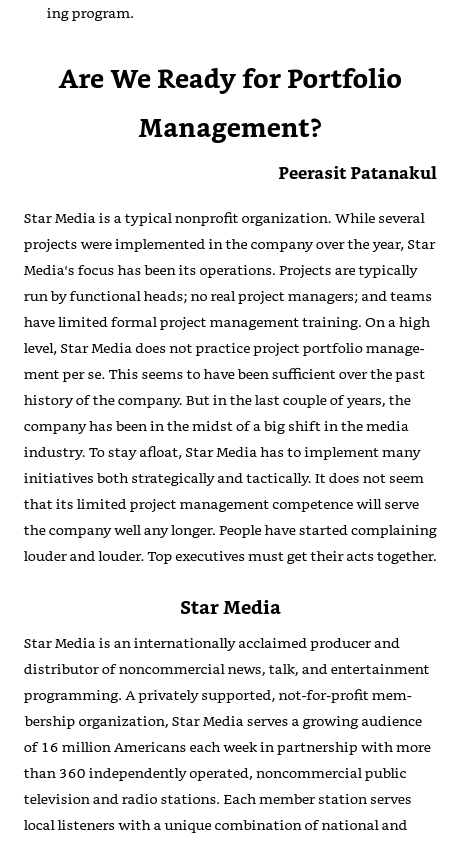
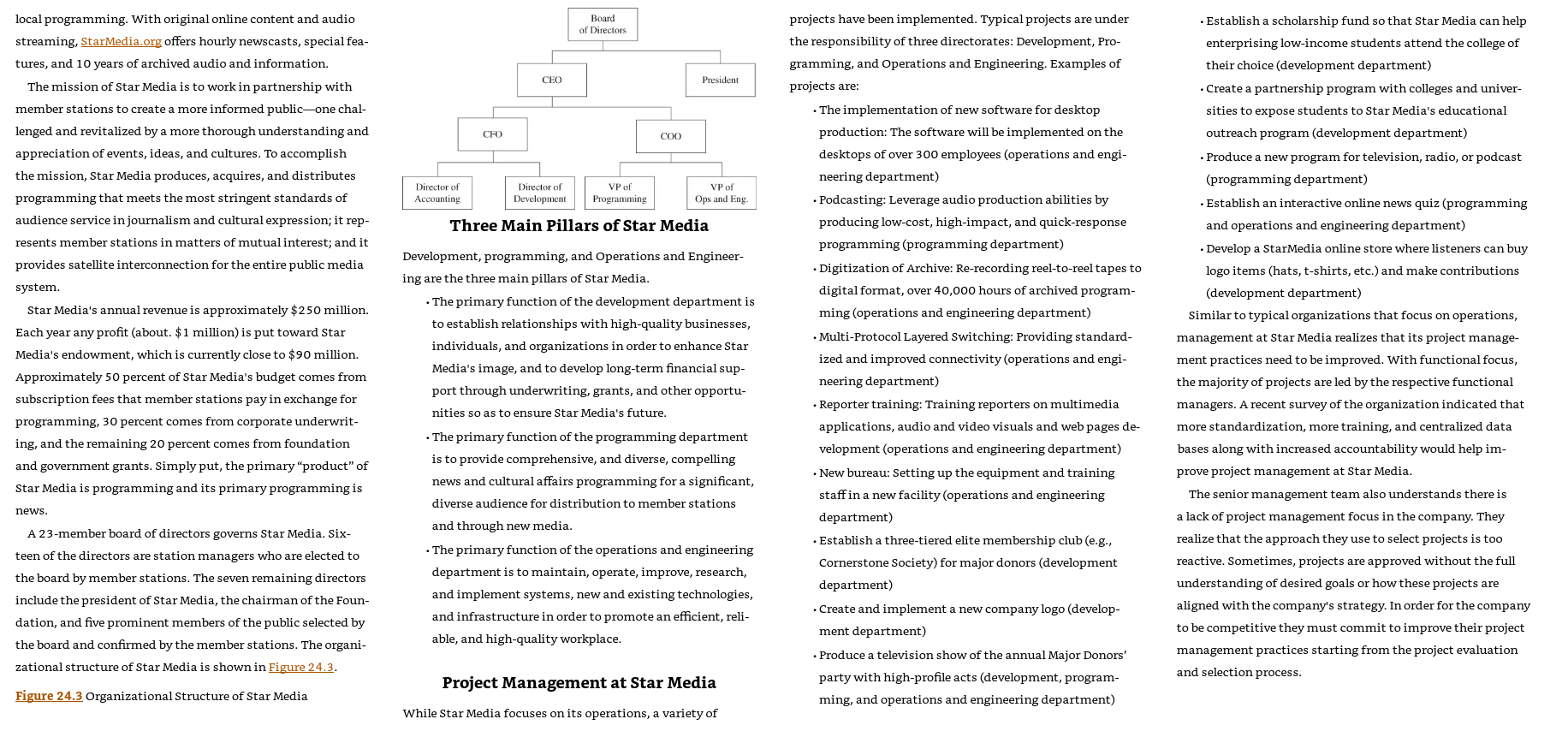
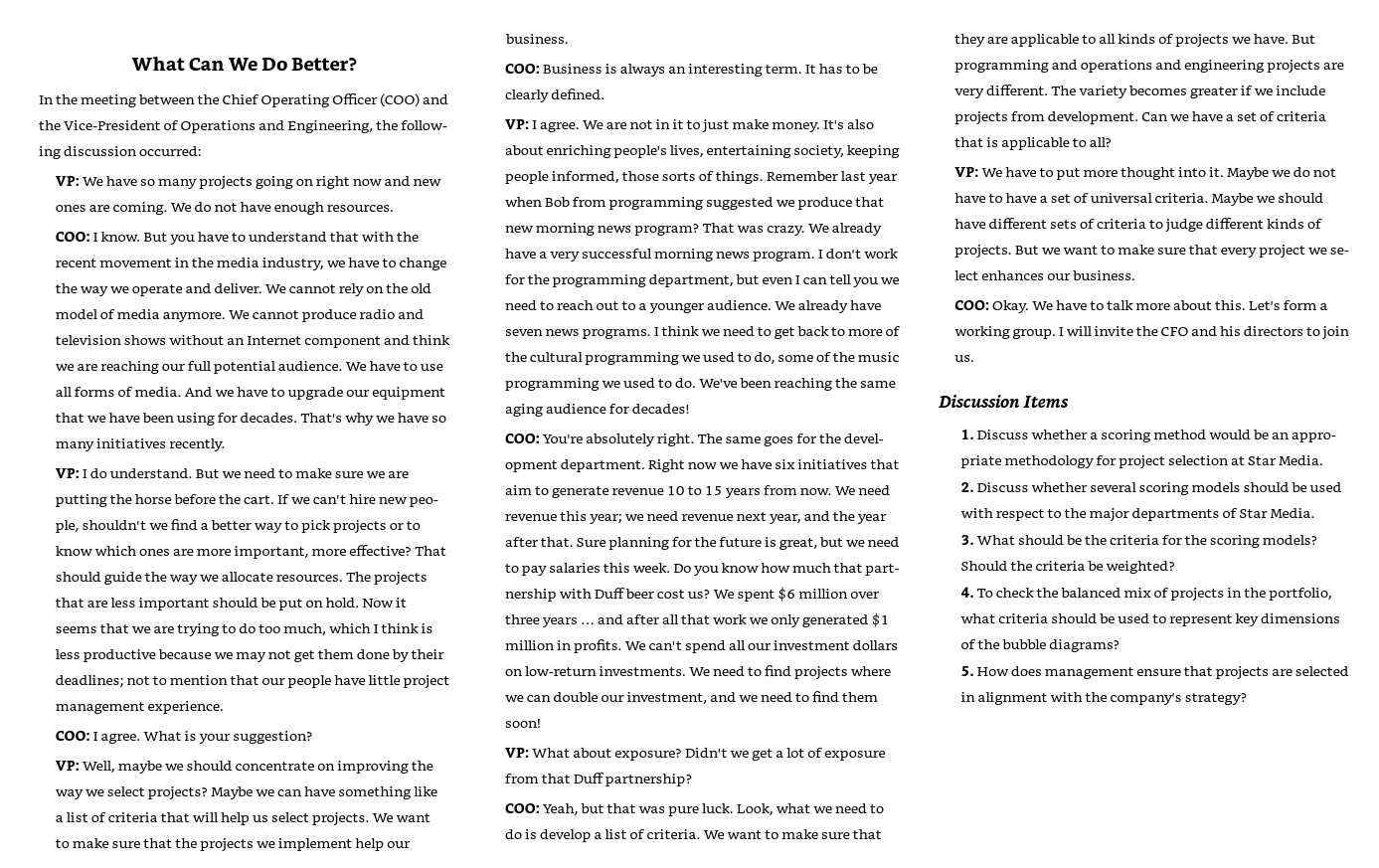
Please answer the discussion items at the end of this case study. Thank you!!
If you're having trouble seeing the words, right click on the image and open it in a separate page. This will make it much easier to read.
ing program. Are We Ready for Portfolio Management? Peerasit Patanakul Star Media is a typical nonprofit organization. While several projects were implemented in the company over the year, Star Media's focus has been its operations. Projects are typically run by functional heads; no real project managers; and teams have limited formal project management training. On a high level, Star Media does not practice project portfolio manage- ment per se. This seems to have been sufficient over the past history of the company. But in the last couple of years, the company has been in the midst of a big shift in the media industry. To stay afloat, Star Media has to implement many initiatives both strategically and tactically. It does not seem that its limited project management competence will serve the company well any longer. People have started complaining louder and louder. Top executives must get their acts together. Star Media Star Media is an internationally acclaimed producer and distributor of noncommercial news, talk, and entertainment programming. A privately supported, not-for-profit mem- bership organization, Star Media serves a growing audience of 16 million Americans each week in partnership with more than 360 independently operated, noncommercial public television and radio stations. Each member station serves local listeners with a unique combination of national and Board of Directors CEO President CFO COO Director of Accounting Director of Development VP of Programming VP of Ops and Eng. Three Main Pillars of Star Media local programming. With original online content and audio streaming, StarMedia.org offers hourly newscasts, special fea- tures, and 10 years of archived audio and information. The mission of Star Media is to work in partnership with member stations to create a more informed public-one chal- lenged and revitalized by a more thorough understanding and appreciation of events, ideas, and cultures. To accomplish the mission, Star Media produces, acquires, and distributes programming that meets the most stringent standards of audience service in journalism and cultural expression; it rep- resents member stations in matters of mutual interest; and it provides satellite interconnection for the entire public media system. Star Media's annual revenue is approximately $250 million. Each year any profit (about. $1 million) is put toward Star Media's endowment, which is currently close to $90 million. Approximately 50 percent of Star Media's budget comes from subscription fees that member stations pay in exchange for programming, 30 percent comes from corporate underwrit- ing, and the remaining 20 percent comes from foundation and government grants. Simply put, the primary "product" of Star Media is programming and its primary programming is Development, programming, and Operations and Engineer- ing are the three main pillars of Star Media. The primary function of the development department is to establish relationships with high-quality businesses, individuals, and organizations in order to enhance Star Media's image, and to develop long-term financial sup- port through underwriting, grants, and other opportu- nities so as to ensure Star Media's future. The primary function of the programming department is to provide comprehensive, and diverse, compelling news and cultural affairs programming for a significant, diverse audience for distribution to member stations and through new media. The primary function of the operations and engineering department is to maintain, operate, improve, research, and implement systems, new and existing technologies, and infrastructure in order to promote an efficient, reli- able, and high-quality workplace. projects have been implemented. Typical projects are under the responsibility of three directorates: Development, Pro- gramming, and Operations and Engineering. Examples of projects are: The implementation of new software for desktop production: The software will be implemented on the desktops of over 300 employees (operations and engi- neering department) Podcasting: Leverage audio production abilities producing low-cost, high-impact, and quick-response programming (programming department) Digitization of Archive: Re-recording reel-to-reel tapes to digital format, over 40,000 hours of archived program- ming (operations and engineering department) Multi-Protocol Layered Switching: Providing standard- ized and improved connectivity (operations and engi- neering department) Reporter training: Training reporters on multimedia applications, audio and video visuals and web pages de velopment (operations and engineering department) New bureau: Setting up the equipment and training staff in a new facility (operations and engineering department) Establish a three-tiered elite membership club (e.g., Cornerstone Society) for major donors (development department) Create and implement a new company logo (develop- ment department) Produce a television show of the annual Major Donors' party with high-profile acts (development, program- ming, and operations and engineering department) Establish a scholarship fund so that Star Media can help enterprising low-income students attend the college of their choice (development department) Create a partnership program with colleges and univer- sities to expose students to Star Media's educational outreach program (development department) Produce a new program for television, radio, or podcast (programming department) Establish an interactive online news quiz (programming and operations and engineering department) Develop a StarMedia online store where listeners can buy logo items (hats, t-shirts, etc.) and make contributions (development department) Similar to typical organizations that focus on operations, management at Star Media realizes that its project manage- ment practices need to be improved. With functional focus, the majority of projects are led by the respective functional managers. A recent survey of the organization indicated that more standardization, more training, and centralized data bases along with increased accountability would help im- prove project management at Star Media. The senior management team also understands there is a lack of project management focus in the company. They realize that the approach they use to select projects is too reactive. Sometimes, projects are approved without the full understanding of desired goals or how these projects are aligned with the company's strategy. In order for the company to be competitive they must commit to improve their project management practices starting from the project evaluation and selection process. news. A 23-member board of directors governs Star Media. Six- teen of the directors are station managers who are elected to the board by member stations. The seven remaining directors include the president of Star Media, the chairman of the Foun- dation, and five prominent members of the public selected by the board and confirmed by the member stations. The organi- zational structure of Star Media is shown in Figure 24.3. Project Management at Star Media Figure 24.3 Organizational Structure of Star Media While Star Media focuses on its operations, a variety of business. What Can We Do Better? COO: Business is always an interesting term. It has to be clearly defined. they are applicable to all kinds of projects we have. But programming and operations and engineering projects are very different. The variety becomes greater if we include projects from development. Can we have a set of criteria that is applicable to all? VP: We have to put more thought into it. Maybe we do not have to have a set of universal criteria. Maybe we should have different sets of criteria to judge different kinds of projects. But we want to make sure that every project we se- lect enhances our business. Coo: Okay. We have to talk more about this. Let's form a working group. I will invite the CFO and his directors to join us. Discussion Items In the meeting between the Chief Operating Officer (COO) and the Vice-President of Operations and Engineering, the follow- ing discussion occurred: VP: We have so many projects going on right now and new ones are coming. We do not have enough resources. COO: I know. But you have to understand that with the recent movement in the media industry, we have to change the way we operate and deliver. We cannot rely on the old model of media anymore. We cannot produce radio and television shows without an Internet component and think we are reaching our full potential audience. We have to use all forms of media. And we have to upgrade our equipment that we have been using for decades. That's why we have so many initiatives recently. VP: I do understand. But we need to make sure we are putting the horse before the cart. If we can't hire new peo- ple, shouldn't we find a better way to pick projects or to know which ones are more important, more effective? That should guide the way we allocate resources. The projects that are less important should be put on hold. Now it seems that we are trying to do too much, which I think is less productive because we may not get them done by their deadlines; not to mention that our people have little project management experience. COO: I agree. What is your suggestion? VP: Well, maybe we should concentrate on improving the way we select projects? Maybe we can have something like a list of criteria that will help us select projects. We want to make sure that the projects we implement help our VP: I agree. We are not in it to just make money. It's also about enriching people's lives, entertaining society, keeping people informed, those sorts of things. Remember last year when Bob from programming suggested we produce that new morning news program? That was crazy. We already have a very successful morning news program. I don't work for the programming department, but even I can tell you we need to reach out to a younger audience. We already have seven news programs. I think we need to get back to more of the cultural programming we used to do, some of the music programming we used to do. We've been reaching the same aging audience for decades! COO: You're absolutely right. The same goes for the devel- opment department. Right now we have six initiatives that aim to generate revenue 10 to 15 years from now. We need revenue this year; we need revenue next year, and the year after that. Sure planning for the future is great, but we need to pay salaries this week. Do you know how much that part- nership with Duff beer cost us? We spent $6 million over three years ... and after all that work we only generated $1 million in profits. We can't spend all our investment dollars on low-return investments. We need to find projects where we can double our investment, and we need to find them 1. Discuss whether a scoring method would be an appro- priate methodology for project sele at Star Media 2. Discuss whether several scoring models should be used with respect to the major departments of Star Media. 3. What should be the criteria for the scoring models? Should the criteria be weighted? 4. To check the balanced mix of projects in the portfolio, what criteria should be used to represent key dimensions of the bubble diagrams? 5. How does management ensure that projects are selected in alignment with the company's strategy? soon! VP: What about exposure? Didn't we get a lot of exposure from that Duff partnership? COO: Yeah, but that was pure luck. Look, what we need to do is develop a list of criteria. We want to make sure that ing program. Are We Ready for Portfolio Management? Peerasit Patanakul Star Media is a typical nonprofit organization. While several projects were implemented in the company over the year, Star Media's focus has been its operations. Projects are typically run by functional heads; no real project managers; and teams have limited formal project management training. On a high level, Star Media does not practice project portfolio manage- ment per se. This seems to have been sufficient over the past history of the company. But in the last couple of years, the company has been in the midst of a big shift in the media industry. To stay afloat, Star Media has to implement many initiatives both strategically and tactically. It does not seem that its limited project management competence will serve the company well any longer. People have started complaining louder and louder. Top executives must get their acts together. Star Media Star Media is an internationally acclaimed producer and distributor of noncommercial news, talk, and entertainment programming. A privately supported, not-for-profit mem- bership organization, Star Media serves a growing audience of 16 million Americans each week in partnership with more than 360 independently operated, noncommercial public television and radio stations. Each member station serves local listeners with a unique combination of national and Board of Directors CEO President CFO COO Director of Accounting Director of Development VP of Programming VP of Ops and Eng. Three Main Pillars of Star Media local programming. With original online content and audio streaming, StarMedia.org offers hourly newscasts, special fea- tures, and 10 years of archived audio and information. The mission of Star Media is to work in partnership with member stations to create a more informed public-one chal- lenged and revitalized by a more thorough understanding and appreciation of events, ideas, and cultures. To accomplish the mission, Star Media produces, acquires, and distributes programming that meets the most stringent standards of audience service in journalism and cultural expression; it rep- resents member stations in matters of mutual interest; and it provides satellite interconnection for the entire public media system. Star Media's annual revenue is approximately $250 million. Each year any profit (about. $1 million) is put toward Star Media's endowment, which is currently close to $90 million. Approximately 50 percent of Star Media's budget comes from subscription fees that member stations pay in exchange for programming, 30 percent comes from corporate underwrit- ing, and the remaining 20 percent comes from foundation and government grants. Simply put, the primary "product" of Star Media is programming and its primary programming is Development, programming, and Operations and Engineer- ing are the three main pillars of Star Media. The primary function of the development department is to establish relationships with high-quality businesses, individuals, and organizations in order to enhance Star Media's image, and to develop long-term financial sup- port through underwriting, grants, and other opportu- nities so as to ensure Star Media's future. The primary function of the programming department is to provide comprehensive, and diverse, compelling news and cultural affairs programming for a significant, diverse audience for distribution to member stations and through new media. The primary function of the operations and engineering department is to maintain, operate, improve, research, and implement systems, new and existing technologies, and infrastructure in order to promote an efficient, reli- able, and high-quality workplace. projects have been implemented. Typical projects are under the responsibility of three directorates: Development, Pro- gramming, and Operations and Engineering. Examples of projects are: The implementation of new software for desktop production: The software will be implemented on the desktops of over 300 employees (operations and engi- neering department) Podcasting: Leverage audio production abilities producing low-cost, high-impact, and quick-response programming (programming department) Digitization of Archive: Re-recording reel-to-reel tapes to digital format, over 40,000 hours of archived program- ming (operations and engineering department) Multi-Protocol Layered Switching: Providing standard- ized and improved connectivity (operations and engi- neering department) Reporter training: Training reporters on multimedia applications, audio and video visuals and web pages de velopment (operations and engineering department) New bureau: Setting up the equipment and training staff in a new facility (operations and engineering department) Establish a three-tiered elite membership club (e.g., Cornerstone Society) for major donors (development department) Create and implement a new company logo (develop- ment department) Produce a television show of the annual Major Donors' party with high-profile acts (development, program- ming, and operations and engineering department) Establish a scholarship fund so that Star Media can help enterprising low-income students attend the college of their choice (development department) Create a partnership program with colleges and univer- sities to expose students to Star Media's educational outreach program (development department) Produce a new program for television, radio, or podcast (programming department) Establish an interactive online news quiz (programming and operations and engineering department) Develop a StarMedia online store where listeners can buy logo items (hats, t-shirts, etc.) and make contributions (development department) Similar to typical organizations that focus on operations, management at Star Media realizes that its project manage- ment practices need to be improved. With functional focus, the majority of projects are led by the respective functional managers. A recent survey of the organization indicated that more standardization, more training, and centralized data bases along with increased accountability would help im- prove project management at Star Media. The senior management team also understands there is a lack of project management focus in the company. They realize that the approach they use to select projects is too reactive. Sometimes, projects are approved without the full understanding of desired goals or how these projects are aligned with the company's strategy. In order for the company to be competitive they must commit to improve their project management practices starting from the project evaluation and selection process. news. A 23-member board of directors governs Star Media. Six- teen of the directors are station managers who are elected to the board by member stations. The seven remaining directors include the president of Star Media, the chairman of the Foun- dation, and five prominent members of the public selected by the board and confirmed by the member stations. The organi- zational structure of Star Media is shown in Figure 24.3. Project Management at Star Media Figure 24.3 Organizational Structure of Star Media While Star Media focuses on its operations, a variety of business. What Can We Do Better? COO: Business is always an interesting term. It has to be clearly defined. they are applicable to all kinds of projects we have. But programming and operations and engineering projects are very different. The variety becomes greater if we include projects from development. Can we have a set of criteria that is applicable to all? VP: We have to put more thought into it. Maybe we do not have to have a set of universal criteria. Maybe we should have different sets of criteria to judge different kinds of projects. But we want to make sure that every project we se- lect enhances our business. Coo: Okay. We have to talk more about this. Let's form a working group. I will invite the CFO and his directors to join us. Discussion Items In the meeting between the Chief Operating Officer (COO) and the Vice-President of Operations and Engineering, the follow- ing discussion occurred: VP: We have so many projects going on right now and new ones are coming. We do not have enough resources. COO: I know. But you have to understand that with the recent movement in the media industry, we have to change the way we operate and deliver. We cannot rely on the old model of media anymore. We cannot produce radio and television shows without an Internet component and think we are reaching our full potential audience. We have to use all forms of media. And we have to upgrade our equipment that we have been using for decades. That's why we have so many initiatives recently. VP: I do understand. But we need to make sure we are putting the horse before the cart. If we can't hire new peo- ple, shouldn't we find a better way to pick projects or to know which ones are more important, more effective? That should guide the way we allocate resources. The projects that are less important should be put on hold. Now it seems that we are trying to do too much, which I think is less productive because we may not get them done by their deadlines; not to mention that our people have little project management experience. COO: I agree. What is your suggestion? VP: Well, maybe we should concentrate on improving the way we select projects? Maybe we can have something like a list of criteria that will help us select projects. We want to make sure that the projects we implement help our VP: I agree. We are not in it to just make money. It's also about enriching people's lives, entertaining society, keeping people informed, those sorts of things. Remember last year when Bob from programming suggested we produce that new morning news program? That was crazy. We already have a very successful morning news program. I don't work for the programming department, but even I can tell you we need to reach out to a younger audience. We already have seven news programs. I think we need to get back to more of the cultural programming we used to do, some of the music programming we used to do. We've been reaching the same aging audience for decades! COO: You're absolutely right. The same goes for the devel- opment department. Right now we have six initiatives that aim to generate revenue 10 to 15 years from now. We need revenue this year; we need revenue next year, and the year after that. Sure planning for the future is great, but we need to pay salaries this week. Do you know how much that part- nership with Duff beer cost us? We spent $6 million over three years ... and after all that work we only generated $1 million in profits. We can't spend all our investment dollars on low-return investments. We need to find projects where we can double our investment, and we need to find them 1. Discuss whether a scoring method would be an appro- priate methodology for project sele at Star Media 2. Discuss whether several scoring models should be used with respect to the major departments of Star Media. 3. What should be the criteria for the scoring models? Should the criteria be weighted? 4. To check the balanced mix of projects in the portfolio, what criteria should be used to represent key dimensions of the bubble diagrams? 5. How does management ensure that projects are selected in alignment with the company's strategy? soon! VP: What about exposure? Didn't we get a lot of exposure from that Duff partnership? COO: Yeah, but that was pure luck. Look, what we need to do is develop a list of criteria. We want to make sure thatStep by Step Solution
There are 3 Steps involved in it
1 Expert Approved Answer
Step: 1 Unlock

Question Has Been Solved by an Expert!
Get step-by-step solutions from verified subject matter experts
Step: 2 Unlock
Step: 3 Unlock
 Study Help