







Question: Please answer the final question based upon an excerpt on 1 dollar slices of pizza from a recent wall street journal article Gray's Papaya, which
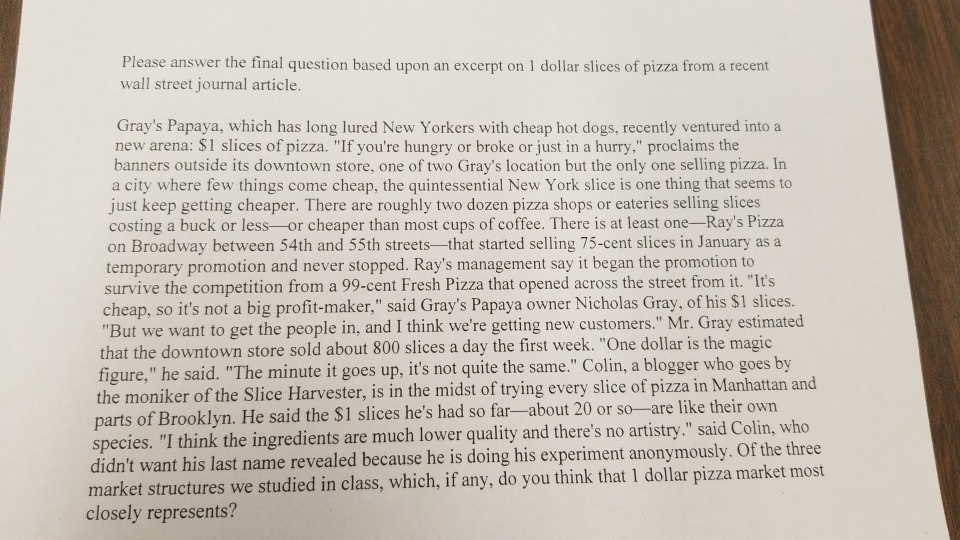
Please answer the final question based upon an excerpt on 1 dollar slices of pizza from a recent wall street journal article Gray's Papaya, which has long lured New Yorkers with cheap hot dogs, recently ventured into a new arena: S1 slices of pizza. "If you're hungry or broke or just in a hurry," proclaims the banners outside its downtown store, one of two Gray's location but the only one selling pizza. In a city where few things come cheap, the quintessential New York slice is one thing that seems to just keep getting cheaper. There are roughly two dozen pizza shops or eateries selling slices costing a buck or less-or cheaper than most cups of coffee. There is at least one-Ray's Pizza on Broadway between 54th and 55th streets-that started selling 75-cent slices in January as a temporary promotion and never stopped. Ray's management say it began the promotion to survive the competition from a 99-cent Fresh Pizza that opened across the street from it. "It's cheap, so it's not a big profit-maker," said Gray's Papaya owner Nicholas Gray, of his $1 slices "But we want to get the people in, and I think we're getting new customers." Mr. Gray estimated that the downtown store sold about 800 slices a day the first week. "One dollar is the magic figure," he said. "The minute it goes up, it's not quite the same." Colin, a blogger who goes by the moniker of the Slice Harvester, is in the midst of trying every slice of pizza in Manhattan and parts of Brooklyn. He said the $1 slices he's had so far-about 20 or so-are like their own species. "I think the ingredients are much lower quality and there's no artistry, " said Colin, who didn't want his last name revealed because he is doing his experiment anonymously. Of the three market structures we studied in class, which, if any, do you think that 1 dollar pizza market most closely represents? Please answer the final question based upon an excerpt on 1 dollar slices of pizza from a recent wall street journal article Gray's Papaya, which has long lured New Yorkers with cheap hot dogs, recently ventured into a new arena: S1 slices of pizza. "If you're hungry or broke or just in a hurry," proclaims the banners outside its downtown store, one of two Gray's location but the only one selling pizza. In a city where few things come cheap, the quintessential New York slice is one thing that seems to just keep getting cheaper. There are roughly two dozen pizza shops or eateries selling slices costing a buck or less-or cheaper than most cups of coffee. There is at least one-Ray's Pizza on Broadway between 54th and 55th streets-that started selling 75-cent slices in January as a temporary promotion and never stopped. Ray's management say it began the promotion to survive the competition from a 99-cent Fresh Pizza that opened across the street from it. "It's cheap, so it's not a big profit-maker," said Gray's Papaya owner Nicholas Gray, of his $1 slices "But we want to get the people in, and I think we're getting new customers." Mr. Gray estimated that the downtown store sold about 800 slices a day the first week. "One dollar is the magic figure," he said. "The minute it goes up, it's not quite the same." Colin, a blogger who goes by the moniker of the Slice Harvester, is in the midst of trying every slice of pizza in Manhattan and parts of Brooklyn. He said the $1 slices he's had so far-about 20 or so-are like their own species. "I think the ingredients are much lower quality and there's no artistry, " said Colin, who didn't want his last name revealed because he is doing his experiment anonymously. Of the three market structures we studied in class, which, if any, do you think that 1 dollar pizza market most closely represents
Step by Step Solution
There are 3 Steps involved in it

Get step-by-step solutions from verified subject matter experts
 Study Help