Question: PLEASE ANSWER THE FOLLOWING GIVEN PROBLEMS IN THE CASE: THE ABSOLUTE ZERO CASE General Absolute Zero (AZ) is a frozen food processor. It buys fruits
PLEASE ANSWER THE FOLLOWING GIVEN PROBLEMS IN THE CASE:
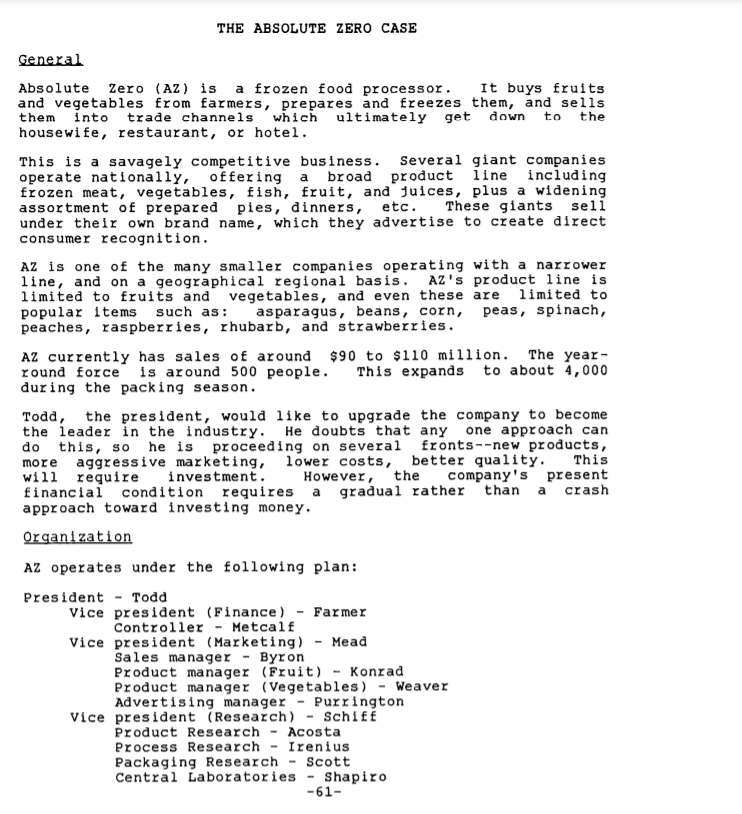
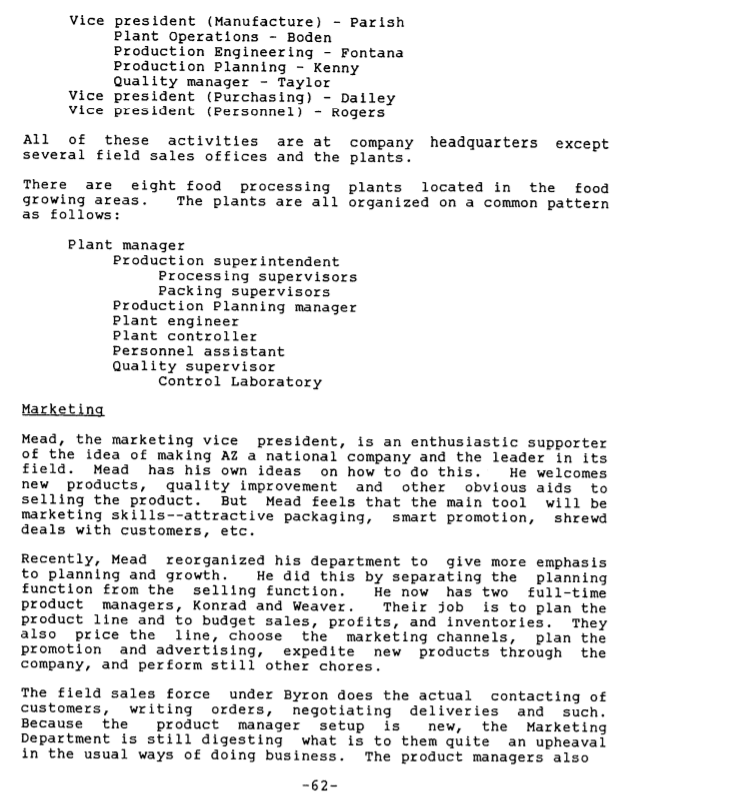
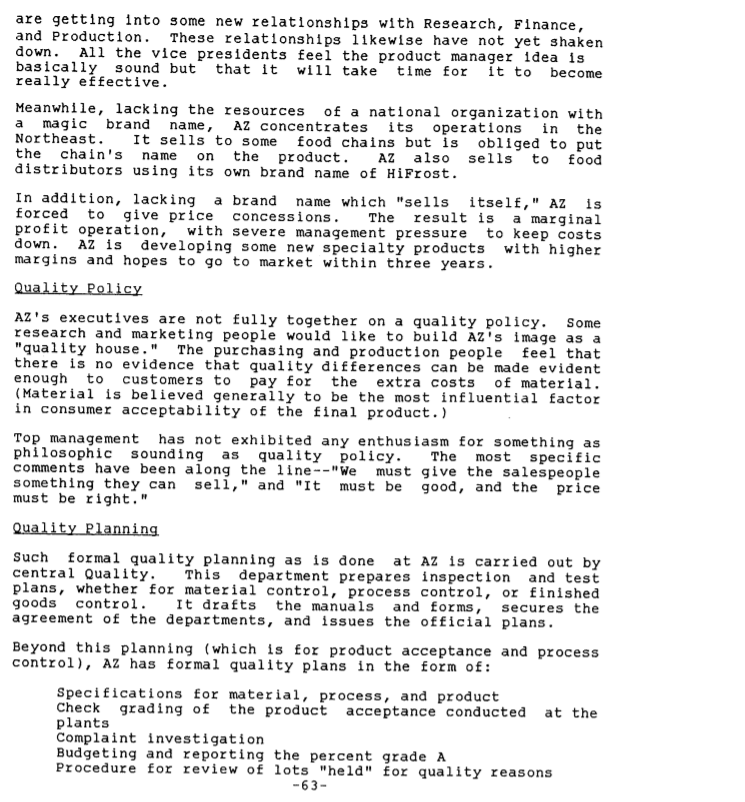
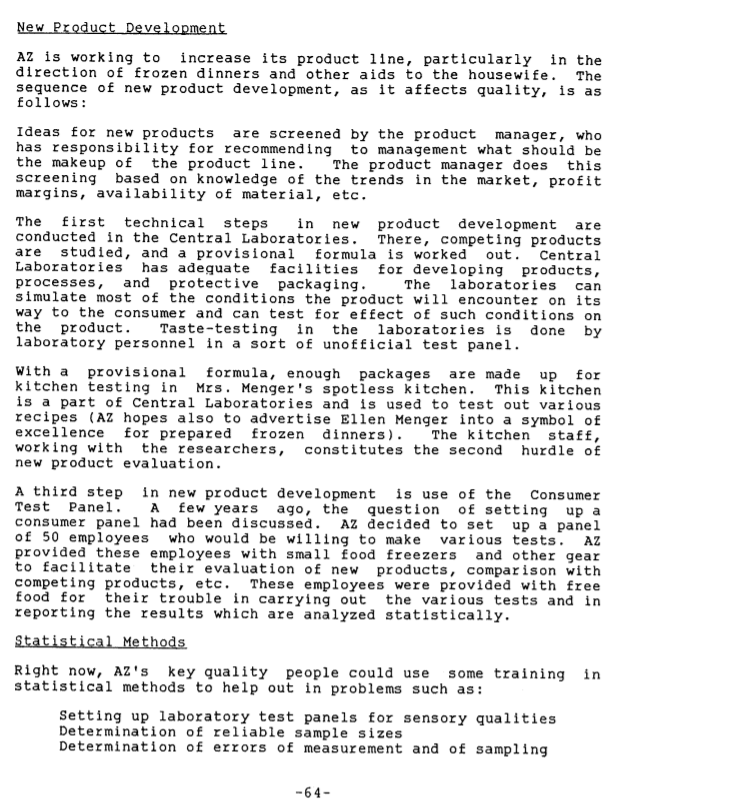
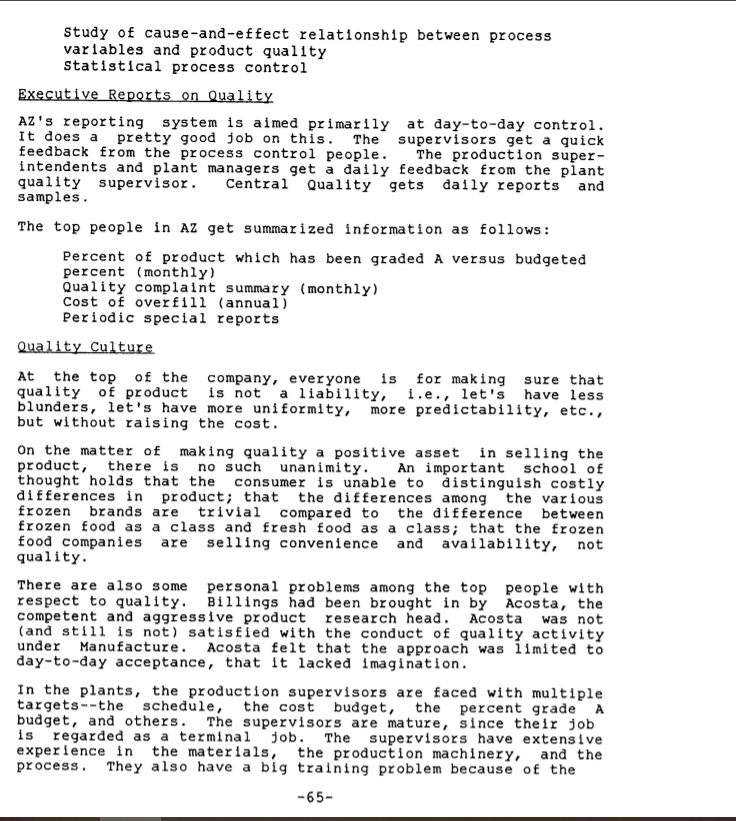
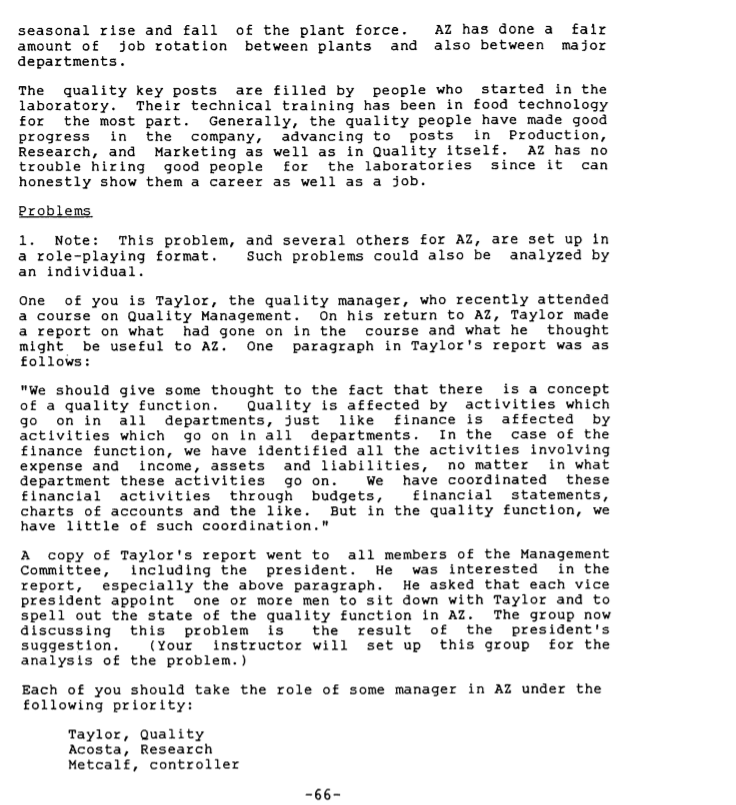
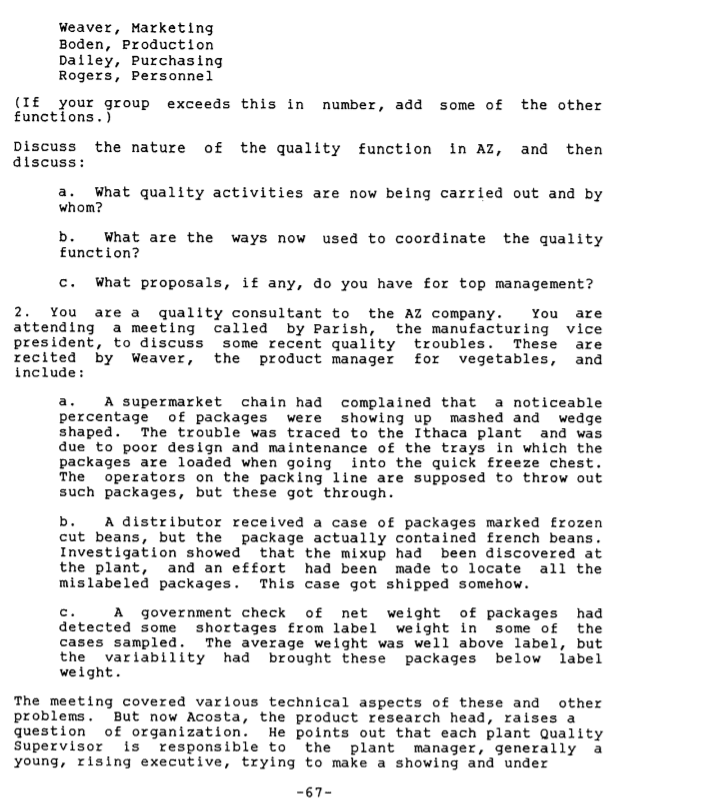
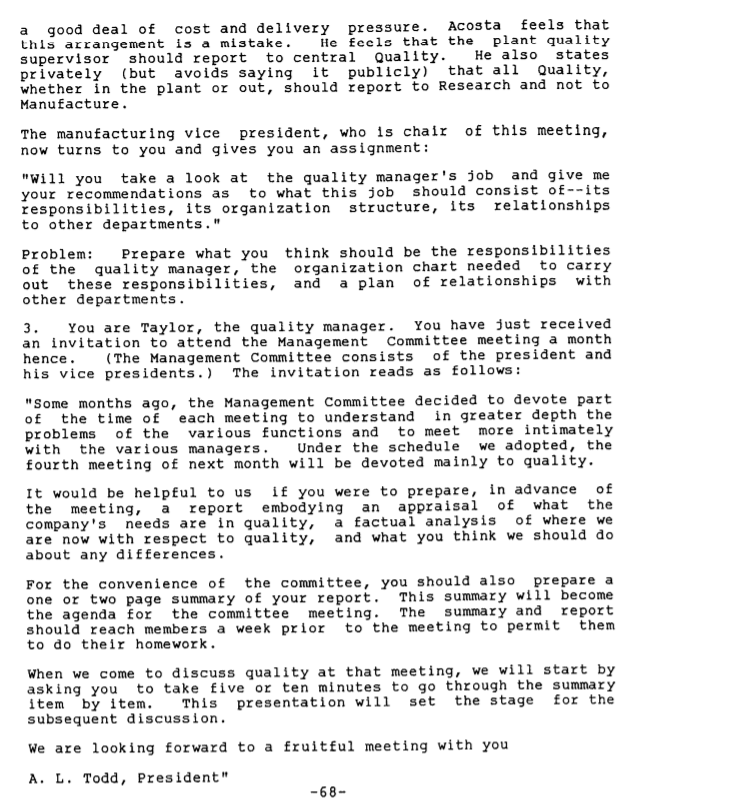
THE ABSOLUTE ZERO CASE General Absolute Zero (AZ) is a frozen food processor. It buys fruits and vegetables from farmers, prepares and freezes them, and sells them into trade channels which ultimately get down to the housewife, restaurant, or hotel. This is a savagely competitive business. Several giant companies operate nationally, offering a broad product line including frozen meat, vegetables, fish, fruit, and juices, plus a widening assortment of prepared pies, dinners, etc. These giants sell under their own brand name, which they advertise to create direct consumer recognition. Az is one of the many smaller companies operating with a narrower line, and on a geographical regional basis. AZ's product line is limited to fruits and vegetables, and even these are limited to popular items such as: asparagus, beans, corn, peas, spinach, peaches, raspberries, rhubarb, and strawberries. AZ currently has sales of around $90 to $110 million. The year- round force is around 500 people. This expands to about 4,000 during the packing season. Todd, the president, would like to upgrade the company to become the leader in the industry. He doubts that any one approach can do this, so he is proceeding on several fronts--new products, more aggressive marketing, lower costs, better quality. This will require investment. However, the company's present financial condition requires a gradual rather than a crash approach toward investing money. Organization AZ operates under the following plan: President - Todd Vice president (Finance) - Farmer Controller - Metcalf Vice president Marketing) - Mead Sales manager - Byron Product manager (Fruit) - Konrad Product manager (Vegetables) - Weaver Advertising manager - Purrington Vice president Research) - Schiff Product Research - Acosta Process Research - Irenius Packaging Research - Scott Central Laboratories - Shapiro -61- Vice president (Manufacture) - Parish Plant Operations - Boden Production Engineering - Fontana Production Planning - Kenny Quality manager - Taylor Vice president (Purchasing) - Dailey Vice president (Personnel) - Rogers All of these activities are at company headquarters except several field sales offices and the plants. There are eight food processing plants located in the food growing areas. The plants are all organized on a common pattern as follows: Plant manager Production superintendent Processing supervisors Packing supervisors Production Planning manager Plant engineer Plant controller Personnel assistant Quality supervisor Control Laboratory Marketing Mead, the marketing vice president, is an enthusiastic supporter of the idea of making Az a national company and the leader in its field. Mead has his own ideas on how to do this. He welcomes new products, quality improvement and other obvious aids to selling the product. But Mead feels that the main tool will be marketing skills--attractive packaging, smart promotion, shrewd deals with customers, etc. Recently, Mead reorganized his department to give more emphasis to planning and growth. He did this by separating the planning function from the selling function. He now has two full-time product managers, Konrad and Weaver. Their job is to plan the product line and to budget sales, profits, and inventories. They also price the line, choose the marketing channels, plan the promotion and advertising, expedite new products through the company, and perform still other chores. The field sales force under Byron does the actual contacting of customers, writing orders, negotiating deliveries and such. Because the product manager setup is new, the Marketing Department is still digesting what is to them quite an upheaval in the usual ways of doing business. The product managers also -62- a on are getting into some new relationships with Research, Finance, and Production. These relationships 11kewise have not yet shaken down. All the vice presidents feel the product manager idea is basically sound but that it will take time for it to become really effective. Meanwhile, lacking the resources of a national organization with magic brand name, AZ concentrates its operations in the Northeast. It sells to some food chains but is obliged to put the chain's name the product. AZ also sells to food distributors using its own brand name of HiFrost. In addition, lacking a brand name which "sells itself," AZ is forced to give price concessions. The result is a marginal profit operation, with severe management pressure to keep costs down. AZ is developing some new specialty products with higher margins and hopes to go to market within three years. Quality Policy AZ's executives are not fully together on a quality policy. Some research and marketing people would like to build AZ's image as a "quality house." The purchasing and production people feel that there is no evidence that quality differences can be made evident enough to customers to pay for the extra costs of material. (Material is believed generally to be the most influential factor in consumer acceptability of the final product.) Top management has not exhibited any enthusiasm for something as philosophic sounding as quality policy. The most specific comments have been along the line--"We must give the salespeople something they can sell," and "It must be good, and the price must be right." Quality Planning Such formal quality planning as is done at az is carried out by central Quality. This department prepares inspection and test plans, whether for material control, process control, or finished goods control. It drafts the manuals and forms, secures the agreement of the departments, and issues the official plans. Beyond this planning (which is for product acceptance and process control), AZ has formal quality plans in the form of: Specifications for material, process, and product Check grading of the product acceptance conducted at the plants Complaint investigation Budgeting and reporting the percent grade A Procedure for review of lots "held" for quality reasons -63- New Product Development AZ is working to increase its product line, particularly in the direction of frozen dinners and other aids to the housewife. The sequence of new product development, as it affects quality, is as follows: Ideas for new products are screened by the product manager, who has responsibility for recommending to management what should be the makeup of the product line. The product manager does this screening based on knowledge of the trends in the market, profit margins, availability of material, etc. The first technical steps in new product development are conducted in the Central Laboratories. There, competing products are studied, and a provisional formula is worked out. Central Laboratories has adequate facilities for developing products, processes, and protective packaging. The laboratories can simulate most of the conditions the product will encounter on its way to the consumer and can test for effect of such conditions on the product. Taste-testing in the laboratories is done by laboratory personnel in a sort of unofficial test panel. With a provisional formula, enough packages are made up for kitchen testing in Mrs. Menger's spotless kitchen. This kitchen is a part of Central Laboratories and is used to test out various recipes (AZ hopes also to advertise Ellen Menger into a symbol of excellence for prepared frozen dinners). The kitchen staff, working with the researchers, constitutes the second hurdle of new product evaluation. A third step in new product development is use of the consumer Test Panel. A few years ago, the question of setting up a consumer panel had been discussed. AZ decided to set up a panel of 50 employees who would be willing to make various tests. AZ provided these employees with small food freezers and other gear to facilitate their evaluation of new products, comparison with competing products, etc. These employees were provided with free food for their trouble in carrying out the various tests and in reporting the results which are analyzed statistically. Statistical Methods Right now, AZ's key quality people could use some training in statistical methods to help out in problems such as: Setting up laboratory test panels for sensory qualities Determination of reliable sample sizes Determination of errors of measurement and of sampling -64- Study of cause-and-effect relationship between process variables and product quality Statistical process control Executive Reports on Quality AZ's reporting system is aimed primarily at day-to-day control. It does a pretty good job on this. The supervisors get a quick feedback from the process control people. The production super- intendents and plant managers get a daily feedback from the plant quality supervisor. Central Quality gets daily reports and samples. The top people in Az get summarized information as follows: Percent of product which has been graded A versus budgeted percent (monthly) Quality complaint summary (monthly) Cost of overfill (annual) Periodic special reports Quality Culture At the top of the company, everyone is for making sure that quality of product is not a liability, i.e., let's have less blunders, let's have more uniformity, more predictability, etc., but without raising the cost. On the matter of making quality a positive asset in selling the product, there is no such unanimity. An important school of thought holds that the consumer is unable to distinguish costly differences in product; that the differences among the various frozen brands are trivial compared to the difference between frozen food as a class and fresh food as a class; that the frozen food companies are selling convenience and availability, not quality There are also some personal problems among the top people with respect to quality. Billings had been brought in by Acosta, the competent and aggressive product research head. Acosta was not (and still is not) satisfied with the conduct of quality activity under Manufacture. Acosta felt that the approach was limited to day-to-day acceptance, that it lacked Imagination. In the plants, the production supervisors are faced with multiple targets--the schedule, the cost budget, the percent grade A budget, and others. The supervisors are mature, since their job is regarded as a terminal job. The supervisors have extensive experience in the materials, the production machinery, and the process. They also have a big training problem because of the -65- seasonal rise and fall of the plant force. AZ has done a fair amount of job rotation between plants and also between major departments. The quality key posts are filled by people who started in the laboratory. Their technical training has been in food technology for the most part. Generally, the quality people have made good progress in the company, advancing to posts in Production, Research, and Marketing as well as in Quality itself. AZ has no trouble hiring good people for the laboratories since it can honestly show them a career as well as a job. Problems 1. Note: This problem, and several others for Az, are set up in a role-playing format. Such problems could also be analyzed by an individual. One of you is Taylor, the quality manager, who recently attended a course on Quality Management. On his return to AZ, Taylor made a report on what had gone on in the course and what he thought might be useful to Az. One paragraph in Taylor's report was as follows: "We should give some thought to the fact that there is a concept of a quality function. Quality is affected by activities which go on in all departments, just like finance is affected by activities which go on in all departments. In the case of the finance function, we have identified all the activities involving expense and income, assets and liabilities, no matter in what department these activities go on. We have coordinated these financial activities through budgets, financial statements, charts of accounts and the like. But in the quality function, we have little of such coordination." A copy of Taylor's report went to all members of the Management Committee, including the president. He was interested in the report, especially the above paragraph. He asked that each vice president appoint one or more men to sit down with Taylor and to spell out the state of the quality function in Az. The group now discussing this problem is the result of the president's suggestion. (Your instructor will set up this group for the analysis of the problem.) Each of you should take the role of some manager in Az under the following priority: Taylor, Quality Acosta, Research Metcalf, controller -66- Weaver, Marketing Boden, Production Dailey, Purchasing Rogers, Personnel (If your group exceeds this in number, ada some of the other functions.) Discuss the nature of the quality function in Az, and then discuss: a. What quality activities are now being carried out and by whom? b. What are the ways now used to coordinate the quality function? c. What proposals, if any, do you have for top management? 2. You are a quality consultant to the AZ company. You are attending a meeting called by Parish, the manufacturing vice president, to discuss some recent quality troubles. These are recited by Weaver, the product manager for vegetables, and include: a. A supermarket chain had complained that a noticeable percentage of packages were showing up mashed and wedge shaped. The trouble was traced to the Ithaca plant and was due to poor design and maintenance of the trays in which the packages are loaded when going into the quick freeze chest. The operators on the packing line are supposed to throw out such packages, but these got through. A distributor received a case of packages marked frozen cut beans, but the package actually contained french beans. Investigation showed that the mixup had been discovered at the plant, and an effort had been made to locate all the mislabeled packages. This case got shipped somehow. A government check of net weight of packages had detected some shortages from label weight in some of the cases sampled. The average weight was well above label, but the variability had brought these packages below label weight. The meeting covered various technical aspects of these and other problems. But now Acosta, the product research head, raises a question of organization. He points out that each plant Quality Supervisor is responsible to the plant manager, generally a young, rising executive, trying to make a showing and under b. c. -67- a good deal of cost and delivery pressure. Acosta feels that this arrangement is a mistake. He feels that the plant quality supervisor should report to central Quality. He also states privately (but avoids saying it publicly) that all Quality, whether in the plant or out, should report to Research and not to Manufacture. The manufacturing vice president, who is chair of this meeting, now turns to you and gives you an assignment: "Will you take a look at the quality manager's job and give me your recommendations as to what this job should consist of its responsibilities, its organization structure, its relationships to other departments." Problem: Prepare what you think should be the responsibilities of the quality manager, the organization chart needed to carry out these responsibilities, and a plan of relationships with other departments. 3. You are Taylor, the quality manager. You have just received an invitation to attend the Management Committee meeting a month hence. (The Management Committee consists of the president and his vice presidents. The invitation reads as follows: "Some months ago, the Management Committee decided to devote part of the time of each meeting to understand in greater depth the problems of the various functions and to meet more intimately with the various managers. Under the schedule we adopted, the fourth meeting of next month will be devoted mainly to quality. It would be helpful to us if you were to prepare, in advance of the meeting, a report embodying an appraisal of what the company's needs are in quality, a factual analysis of where we are now with respect to quality, and what you think we should do about any differences. For the convenience of the committee, you should also prepare a one or two page summary of your report. This summary will become the agenda for the committee meeting. The summary and report should reach members a week prior to the meeting to permit them to do their homework. When we come to discuss quality at that meeting, we will start by asking you to take five or ten minutes to go through the summary item by item. This presentation will set the stage for the subsequent discussion. We are looking forward to a fruitful meeting with you A. L. Todd, President" -68- The problem for the group is now to prepare an outline for a "one or two page summary" which will be presented before the entire meeting when it reconvenes. 4. You are Taylor, the quality manager at AZ You have just come from a long discussion with Mr. Parish, who is the manufacturing vice president, and also your boss. Parish had called you in and closed the door. (This has always meant that something important is up. ) Then he posed a problem somewhat along this line: "For years, we have been telling ourselves that quality of product is important. We put the message in the house organ, on the factory walls, in the annual report, and on every other blank space we can find. But look at how we handle it in relation to sales, profits, costs, inventories, productivity and such. We say these other issues are important too. But we handle them as though we meant it. We set budgets, quotas, targets, or objectives for them, by total and by subtotal. We set up to measure how well we are doing, month by month, against objective. We hold people responsible for meeting the objective for their subtotal. Their job, their bonus, or their peace of mind depends on whether they get a passing grade or not. Sure, we budget percent grade A. But in relation to all that quality means, is that adequate? I want you to take a month or two to think about it. Look at the problem of objectives for quality. What should we set objectives on? What kind of objectives should we set? I certainly don't know. All I know is that, in relation to some of these other subjects, quality gets mighty short shrift as far as objectives are concerned. But you're the expert, so you tell me. If we do nothing, the time is coming when Research, or the boss, or someone else will take this out of our hands, and we'll have another consultant or someone else who may turn out bad rather than good. So, see me in a couple of months with your proposal." Problem: Prepare the proposal for the vice president AZ has no direct connection with the ultimate consumer; AZ sells only to chains or distributors. They, in turn, move the product to lower levels of distribution and finally to the store, hotel, or restaurant which deals with the consuming public. These intermediate distribution steps perform no tests on the product and provide little feedback on qualityComplaints on 5. -69- handling or identification do arise. So do complaints relayed back from the ultimate consumer. Also, since some products carry AZ's own name, there is some complaint feedback direct from the ultimate consumer back to Az. You are Taylor, the quality manager, and you have been wondering about this. You feel uncomfortable over the fact that AZ has so little contact with the ultimate consumer. You are not sure that the approximations (Mrs. Menger's Kitchen, the Consumer Test Panel, etc.) are good enough to bridge the gap. But you also wonder whether you ought to get involved. Some people point out that Marketing has the general responsibility for finding out what the consumer needs are and that Research has the general responsibility of coming up with specifications which reflect these needs. Hence, you should concern yourself with seeing to it that the specifications are met. Anything else (they say) is not only beyond the call of duty; it may be an invasion of the responsibilities of other departments. Your readings in the literature and your attendance at seminars have made you aware there have been cases in which insuring conformance to specification was just a wooden way of doing the quality job. The specification writers weren't that good. You already know of weaknesses in AZ. Some material specifications are too rigid, and this is offset by continued lax enforcement. This is even more extensive in the process specifications. It is not clear whether the consumer knows the difference between high and medium grades of material. Your worrying about this problem has caused you to talk to your boss, Mr Parish. He has been pretty sympathetic but has generally defended the status quo. However, he also told you: "Why don't you put your ideas down on paper--it sort of forces you to think it through. Then, if your conclusions are that we should make a change of some sort, come on in and we'll talk about it." Problem: What are the views for the vice president? 6. You are Taylor, the quality manager. You have just come out of a meeting in which you and everyone else connected with quality took a lot of abuse because of a tie-up in one of the plants. A cooking tank was operating at the wrong temperature for part of the day and produced some substandard goods. You know that this is a pretty rare event, but that didn't stop the proceedings. You have now made up your mind that the real reason for so much attention being devoted to an isolated instance is yourself; you - 70- have failed to provide to the company executives a panoramic picture of how the company is doing on quality. Lacking a picture in perspective, the executives get overexcited by sporadic instances. Now you are faced with determining what kind of quality information to present to the company executives. You decide to prepare a draft proposal and obtain comments from everyone. Based on these comments, you expect to design the final report package. Problem: Prepare the draft proposal. Prepare this in tabular form, showing for each proposed report: The unit of measure The standard of comparison, whether historical (H), engineered (E), derived from the market (M), or based on a plan (P) Source of your information, whether based on formal reports (F), verbal reports (V), or personal observation (0) Frequency of reports, whether daily (D), weekly (W), monthly (M), quarterly (o), annual (A), or irregular (I) 7. You are Taylor, the quality manager. You have been having a lot of trouble getting people to listen to your proposals. The response is often along the line, "That sounds pretty good, but how do you know it will pay for itself?" You have been frustrated by this so often that it has set you thinking, "I can't prove that these findings will pay for themselves because I don't really know it myself. I should find out a lot more about our quality costs, not just for all those other guys--I should know all this myself." You have already discussed the problem with Metcalf, the controller. Metcalf is not sure that anything useful would be accomplished. "We have standards on about everything, and the executives now get pretty complete variance reports. It sounds to me like you would just be rearranging information which the executives already get in one way or another." But Metcalf is also cooperative. "If you can spell out just what it is you want, we'll get it for you if our accounts are set up that way. If it means new accounts, then I may have to consult the boss." You already know that some of what you are looking for is not readily available from the accounts. But you decide you will put down what you think are the needs for a fairly complete knowledge of quality costs and will argue afterwards how to get the information. Problem: List what you feel are the categories of quality costs which you need to have in order to understand the comparative economics of quality problems at Az. -71- 8. You are Taylor, the quality manager. Your boss, Mr. Parish, has just returned from attending the weekly meeting of the Management Committee. He calls you in and tells you about one event in the meeting. During a discussion on cost reduction, Mr. Farmer, the finance vice president, brought up the matter of over fill. "Every year, regular as clockwork, we give away close to $900,000 of material we never get paid for. I understand it isn't possible to eliminate this. But surely it doesn't have to be so much. If we piled that much stuff into trucks, it would be quite a few loads." Farmer made his point, because the president, Mr. Todd, turned to Mr. Parish with this comment: "This has really been going on for quite a while without any improvement. It seems to me everyone is pointing at everyone else. Can you take a look, and see if you can get us off dead center?" Now Parish puts it up to you. "Both Farmer and the boss are right. We've been sitting on this one long enough. Either we blast it loose, or it will make a lot of trouble for us. Suppose you get into it and give me a plan of action." You already know quite a bit about overfill. The procedure is generally as follows: Filling is done either by machine or by hand. Machine filling is done for a mass such as spinach or for small stuff such as peas. The machine measures the fill volumetrically. Right after the machine fill, an operator checks every tenth box or so and can make a simple adjustment to raise or lower fill. At the end of the line, a quality checker weighs a sample every half hour. The sample consists of ten consecutive packages on the line. Based on the weight tallies, the checker provides feedback to the mechanic. A statistician had once set up charts at these checking stations. These charts are not being maintained, but the total overf111 of the ten samples is added up. This total and the range of the samples are used to give an alarm signal to the mechanic. The remaining packs are hand filled by operators on the line. These hand filled packages are weighed individually by the operators at the time of fill and again by a checker at the end of the line There are plenty of unexplored variables. Some machines are multihead; others are single-head but multi-nozzle. These nozzles may be unlike. The density of the fill undoubtedly varies. The scales have a measurement variation. The ten samples are consecutive on the conveyor, but not from the filling heads. The responses of the mechanics to the feedback are not fully known -72- In the case of the hand fill, control is really in the hands of operators, but it is not known whether they are equally good. There are "tolerances" on the overfill of individual boxes. These are used for box-by-box control. In a way, you have been hoping for a showdown on this problem. Now that a showdown may be at hand, you are not so sure. There are a lot of facts you don't know and that no one else really knows. That doesn't prevent them from having some pretty positive views You don't have the time to get answers to all these questions, and you know that, if you just bring the boss a bunch of opinions, you will get both of you into trouble. Problem: Prepare your plan of action. 9. You are a committee which top management has designated to look at Az's approach to launching new products from "the cradle to the grave." The assignment of the committee has been spelled out in a frame of reference as follows: "Review AZ's procedures for launching new products from every pertinent viewpoint--marketing, research, cost, production, quality, packaging, storage, and shipping, clear to the customer and ultimate consumer. Consider the adequacy of these procedures as to the problems we expect to face in the years ahead. Prepare recommendations to management on what to do to improve our launching of new products." The committee is now in session on the quality aspects of this assignment. The members of the committee include: Taylor, quality manager Metcalf, controller Konrad, product manager Acosta, Product Research Fontana, Production Engineering Dailey, Purchasing Problem: Assign roles to each group member. (If the group size permits, add the roles of still other managers, i.e., Sales, Advertising, Process Research, Packaging Research, Centra Laboratories, Plant Operations, Production Planning, Personnel.) Prepare recommendations on improving the quality of new products. -73









 Study Help