







Question: Please answer the following homework questions: This assignment draws on the journal article Pricing Strategy for Aesthetic Surgery: Economic Analysis of a Resident Clinic's Change
Please answer the following homework questions:
This assignment draws on the journal article"Pricing Strategy for Aesthetic Surgery: Economic Analysis of a Resident Clinic's Change in Fees", by Krieger and Shaw (1999). This was essentially a fee reduction experiment conducted by the UCLA Medical Center Department of Surgery, Division of Plastic surgery.
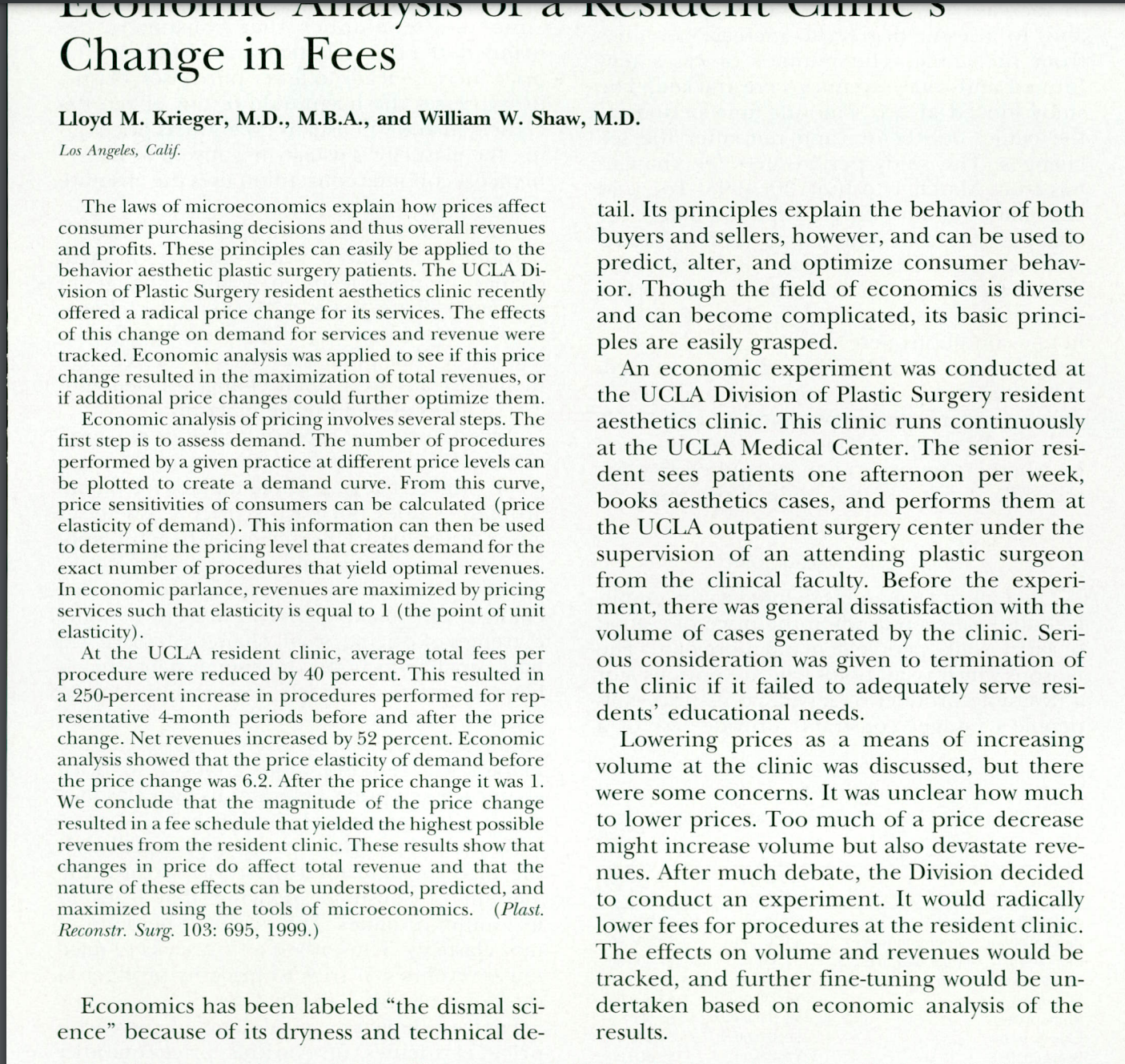
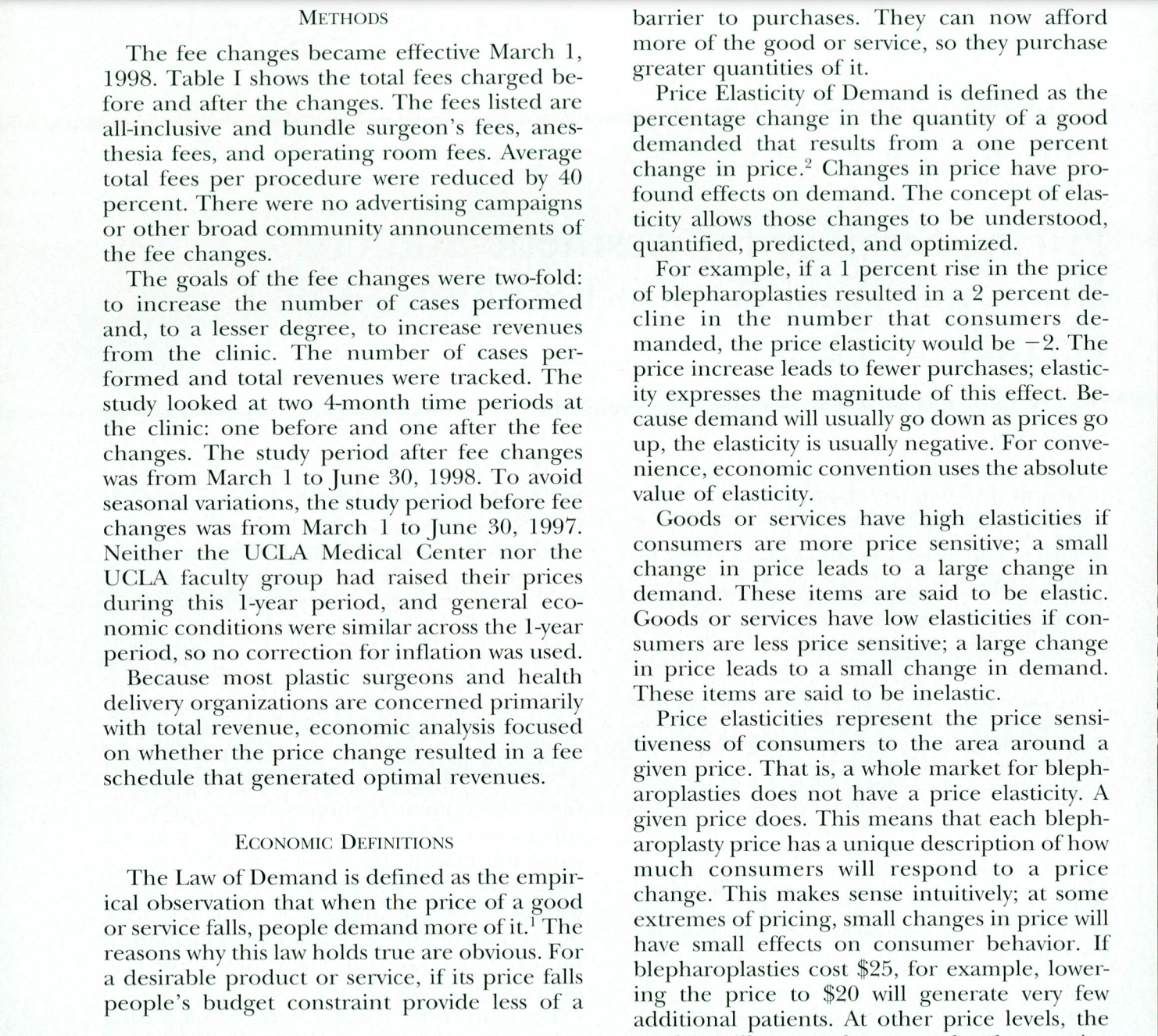
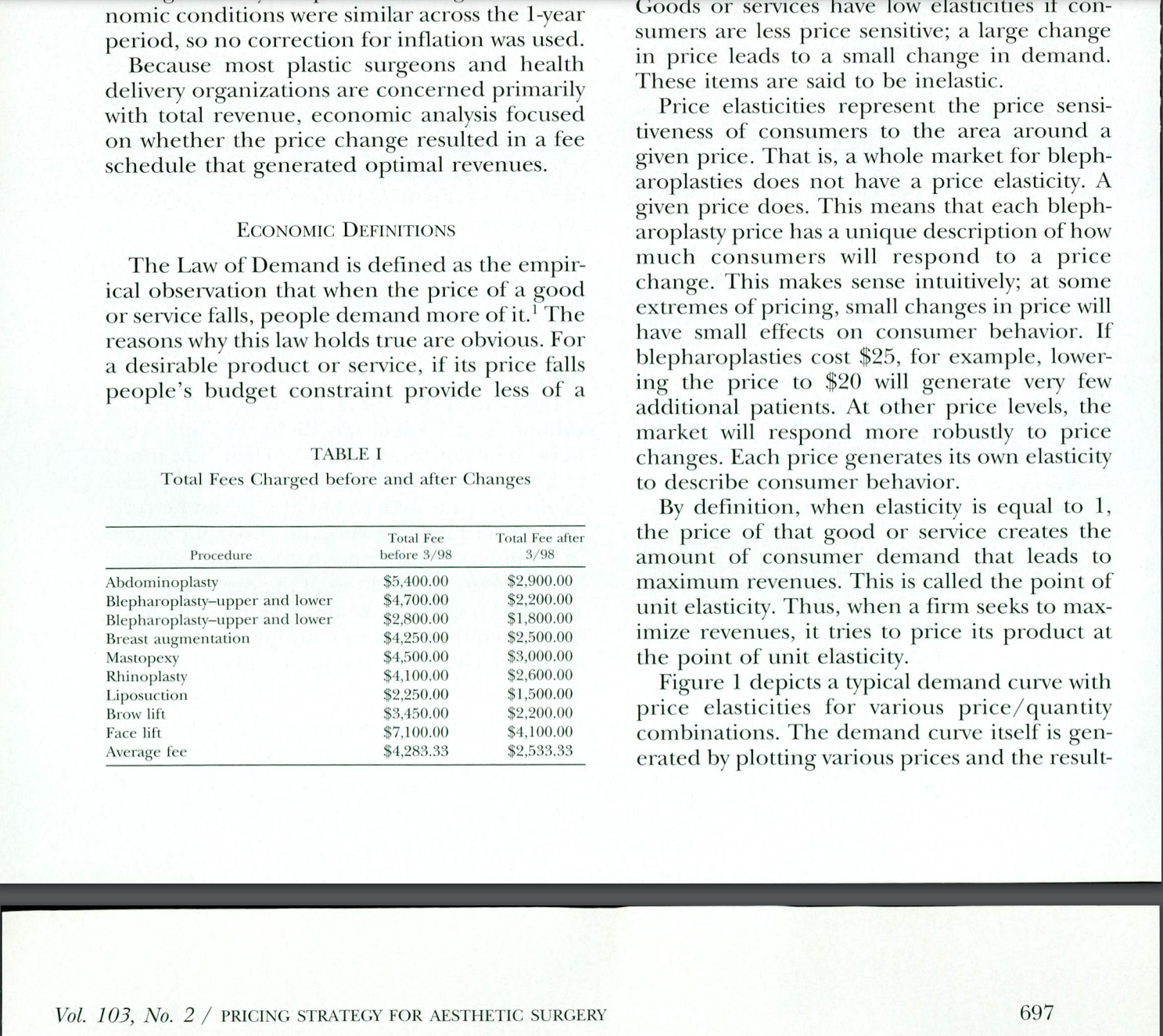
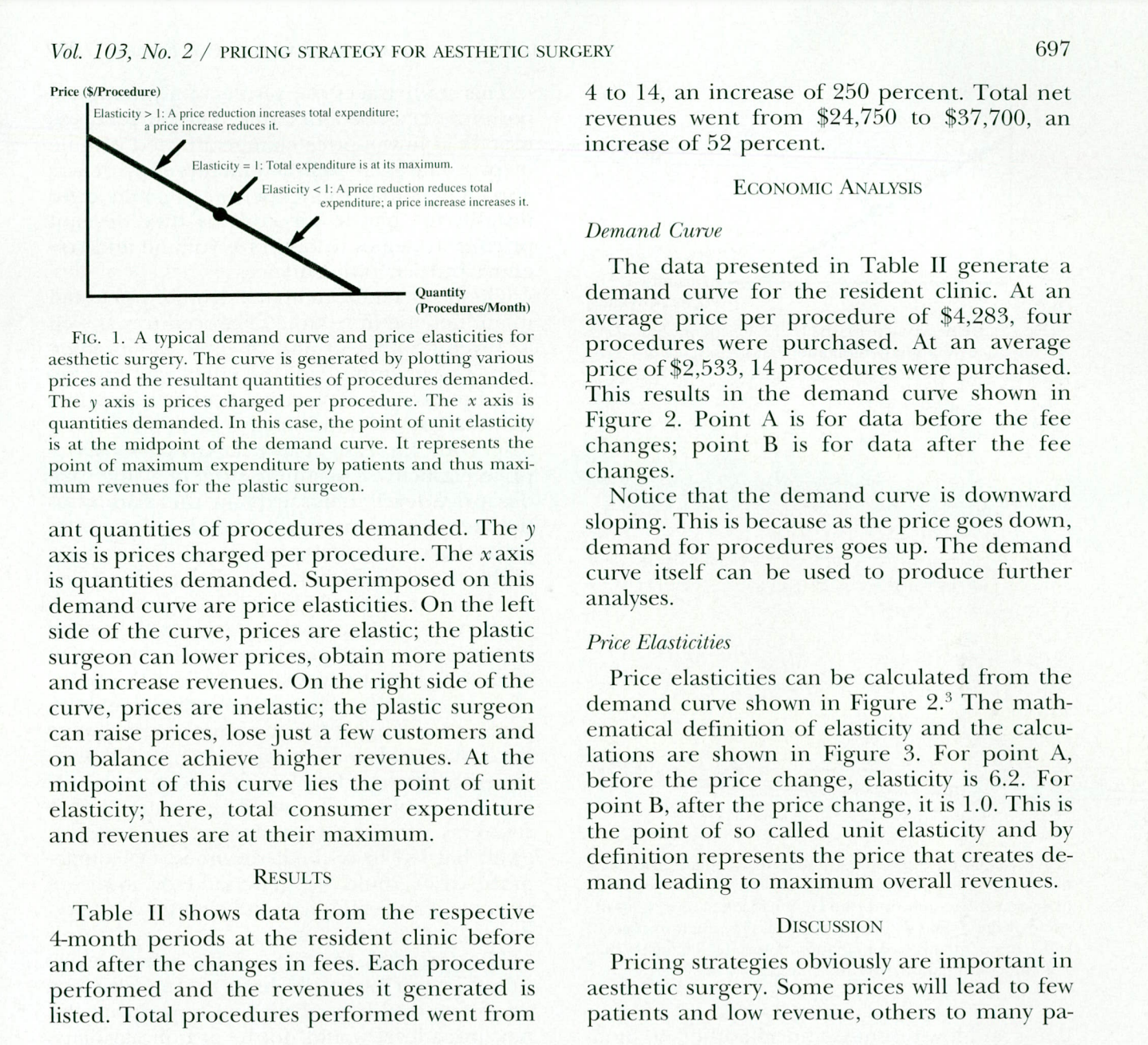
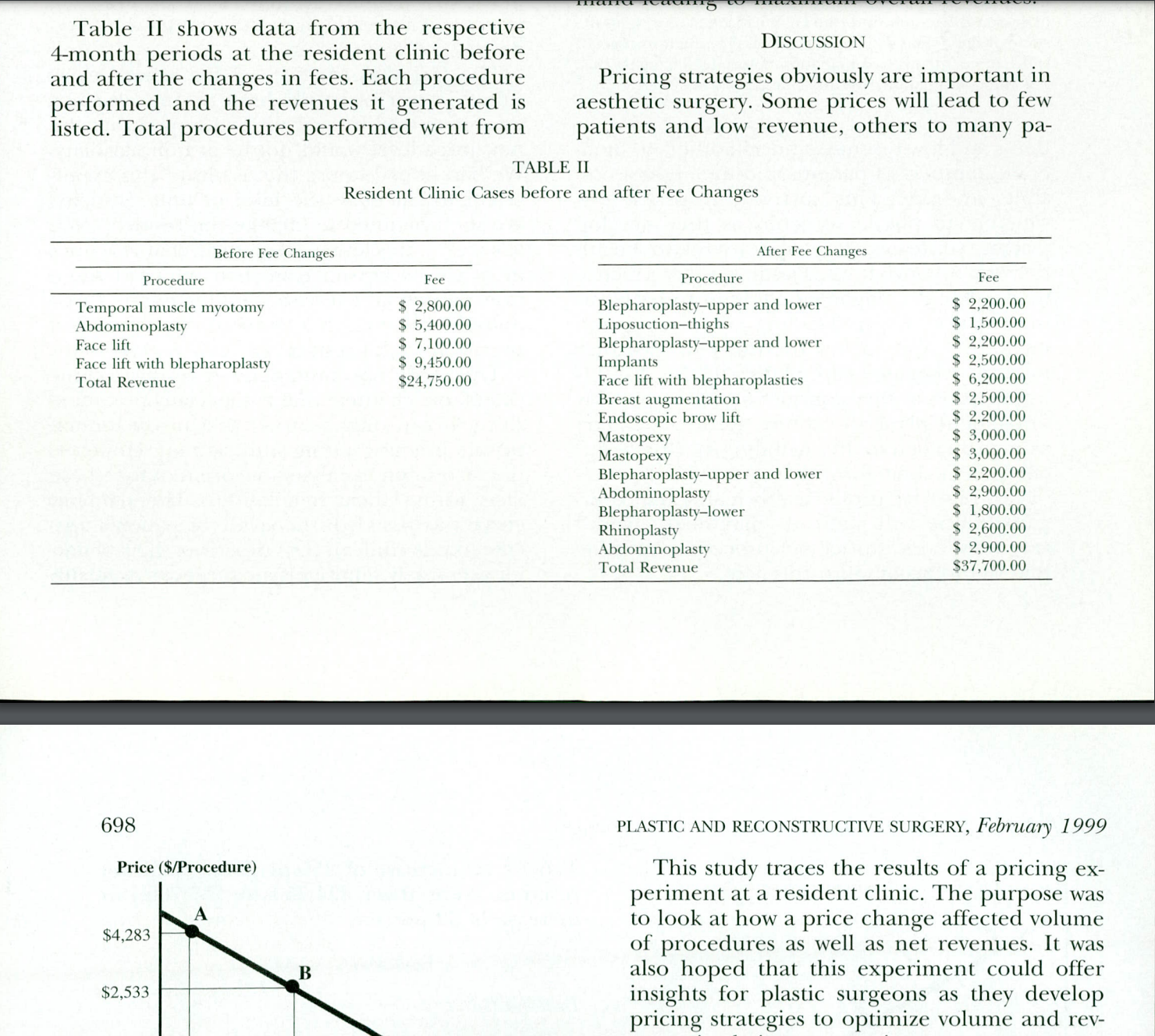
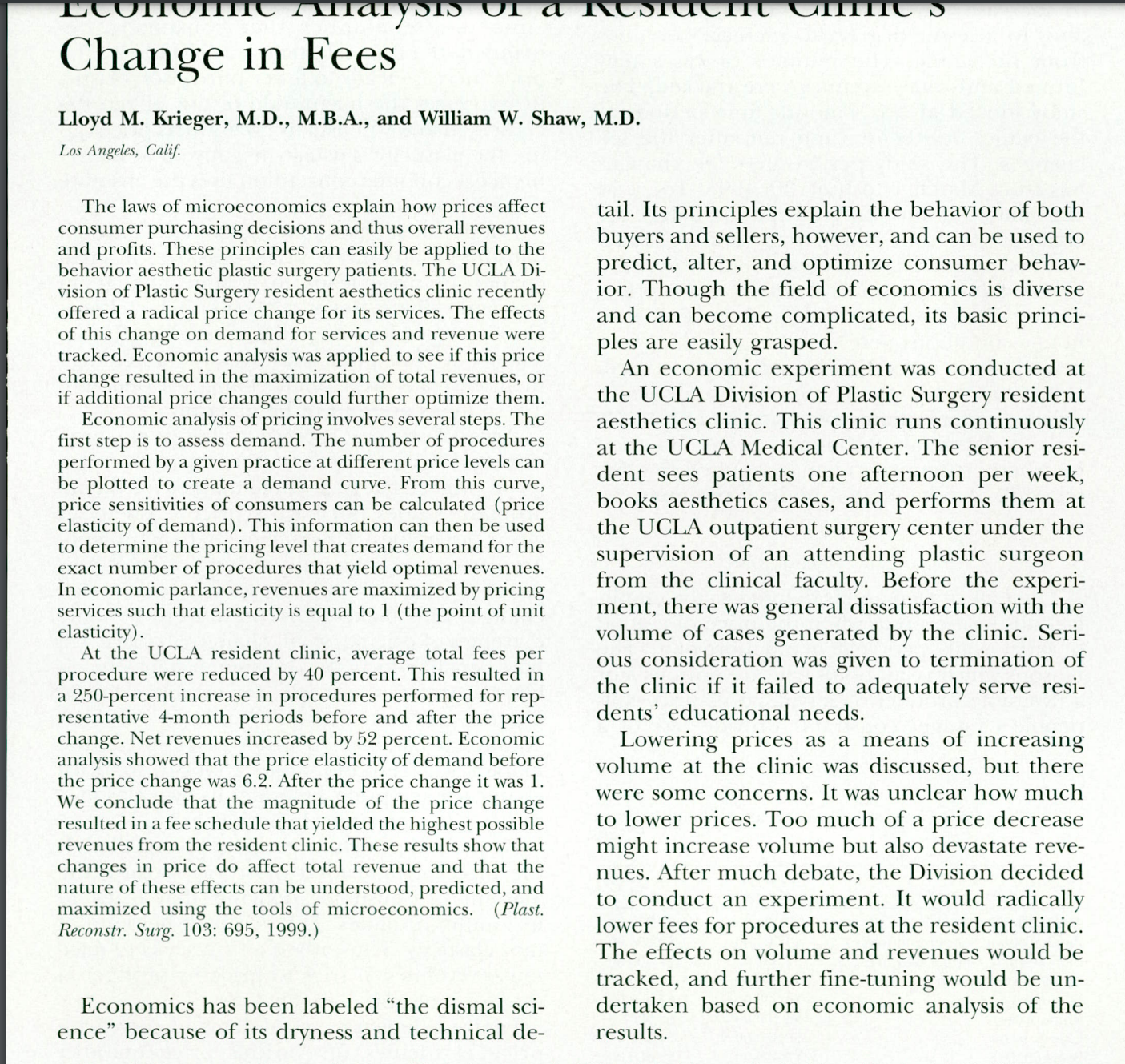
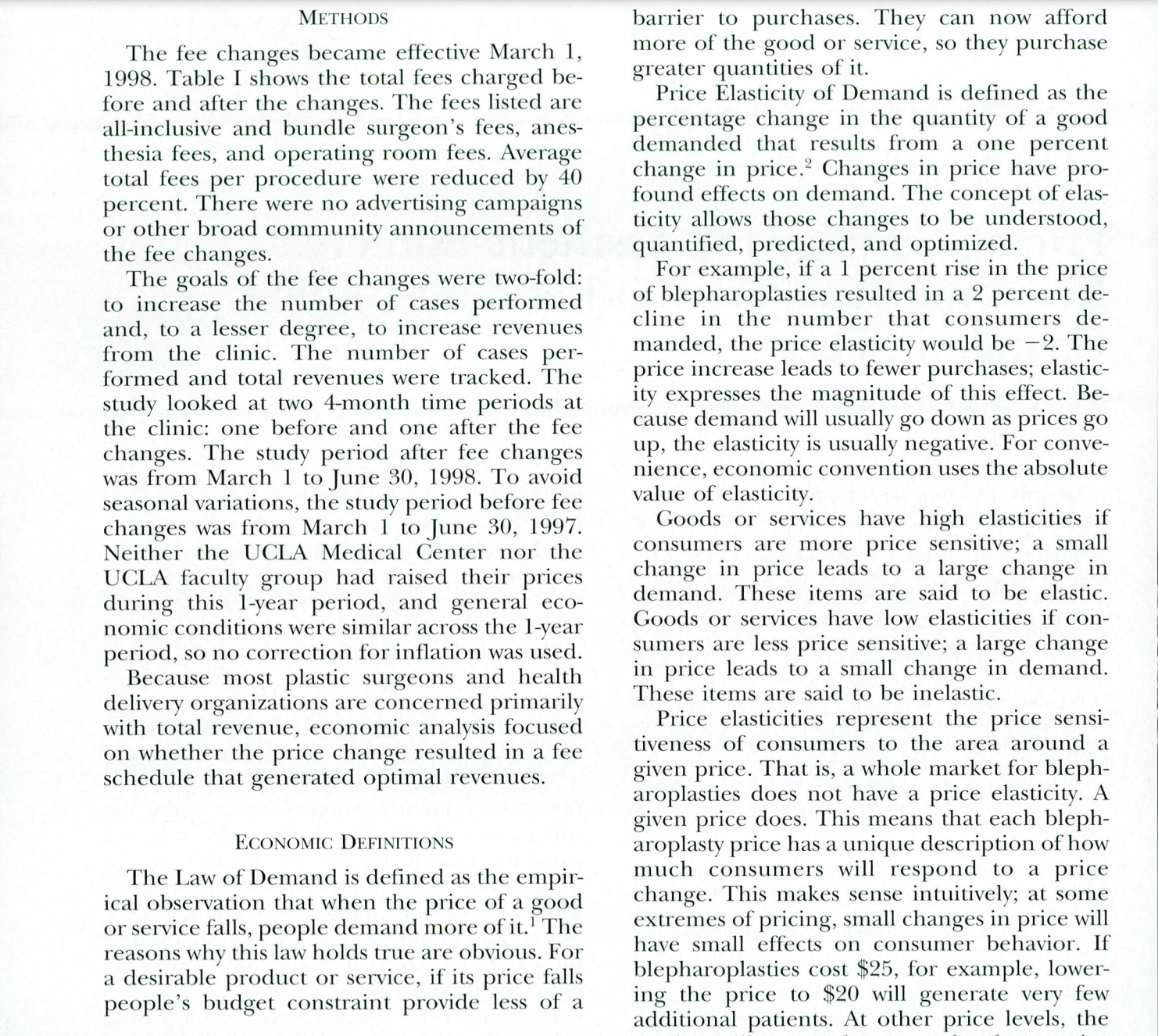
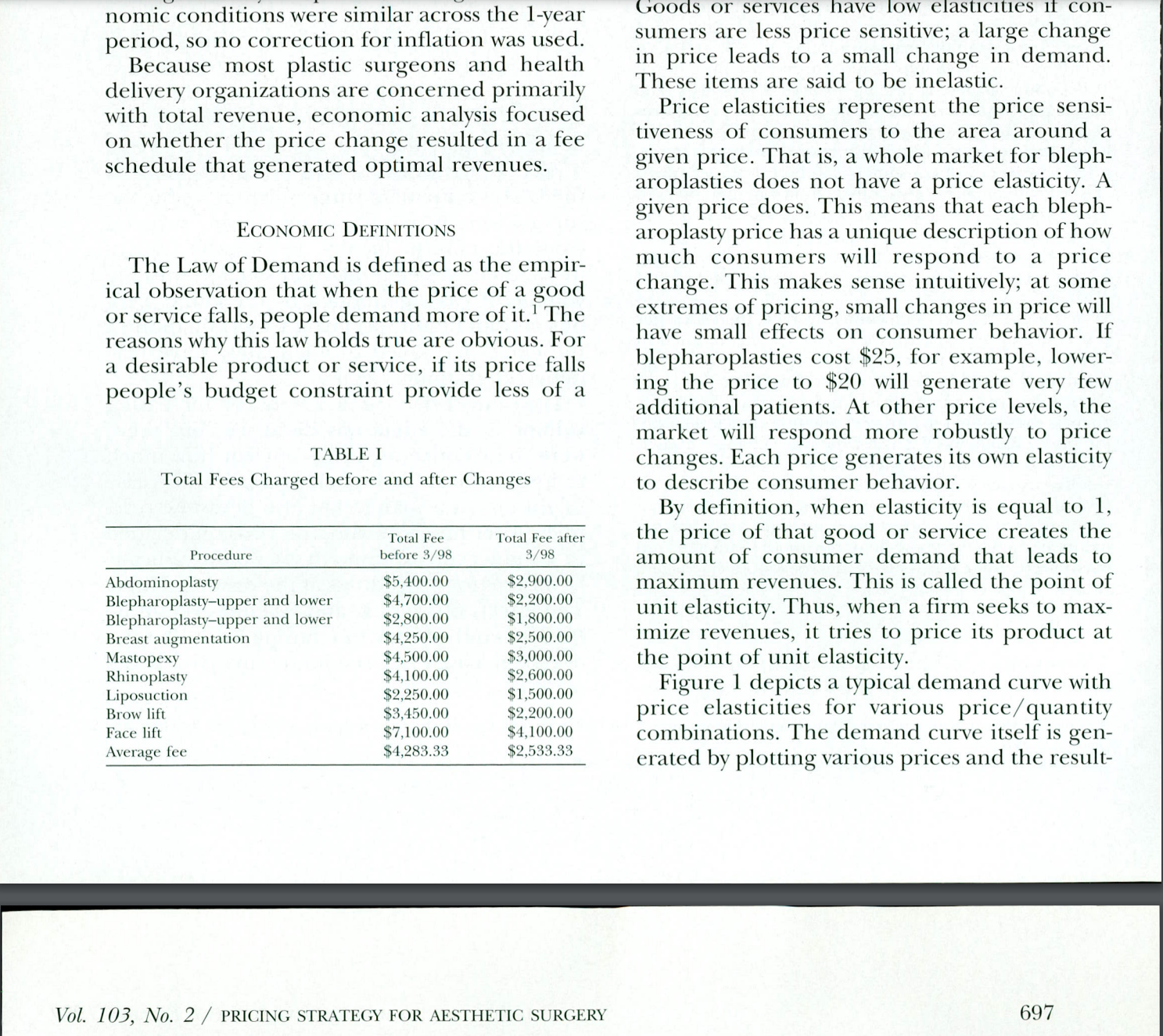
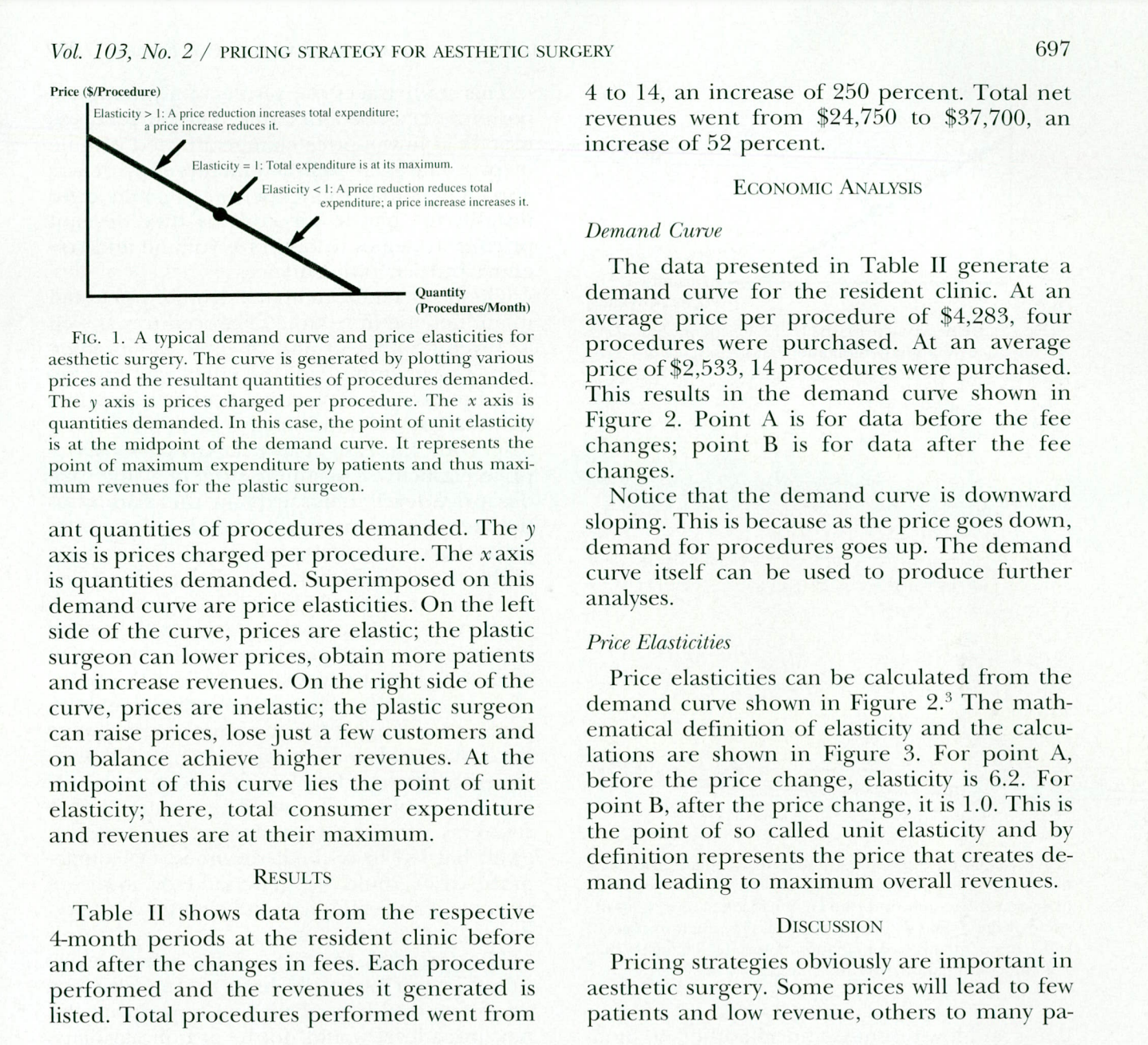
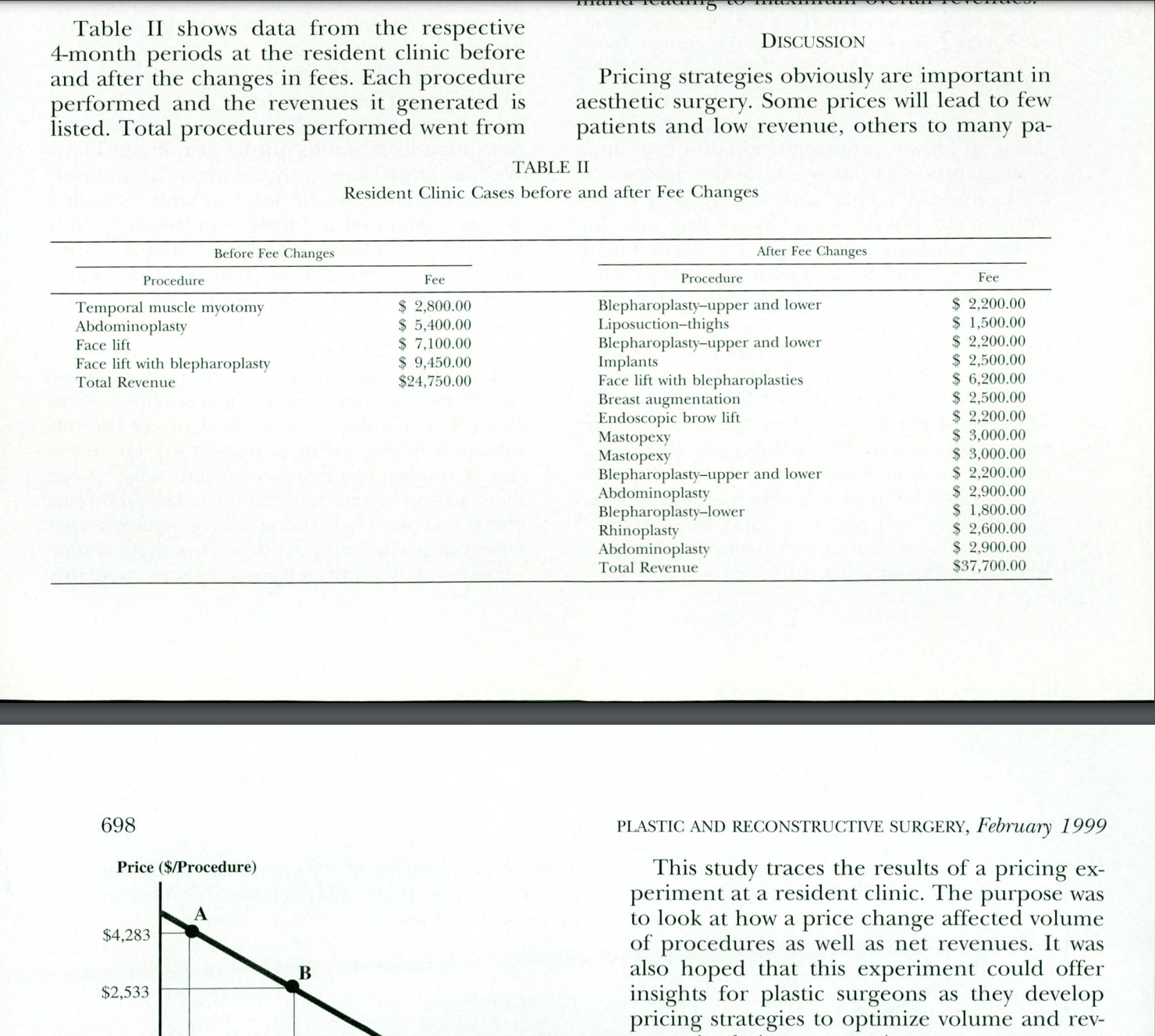
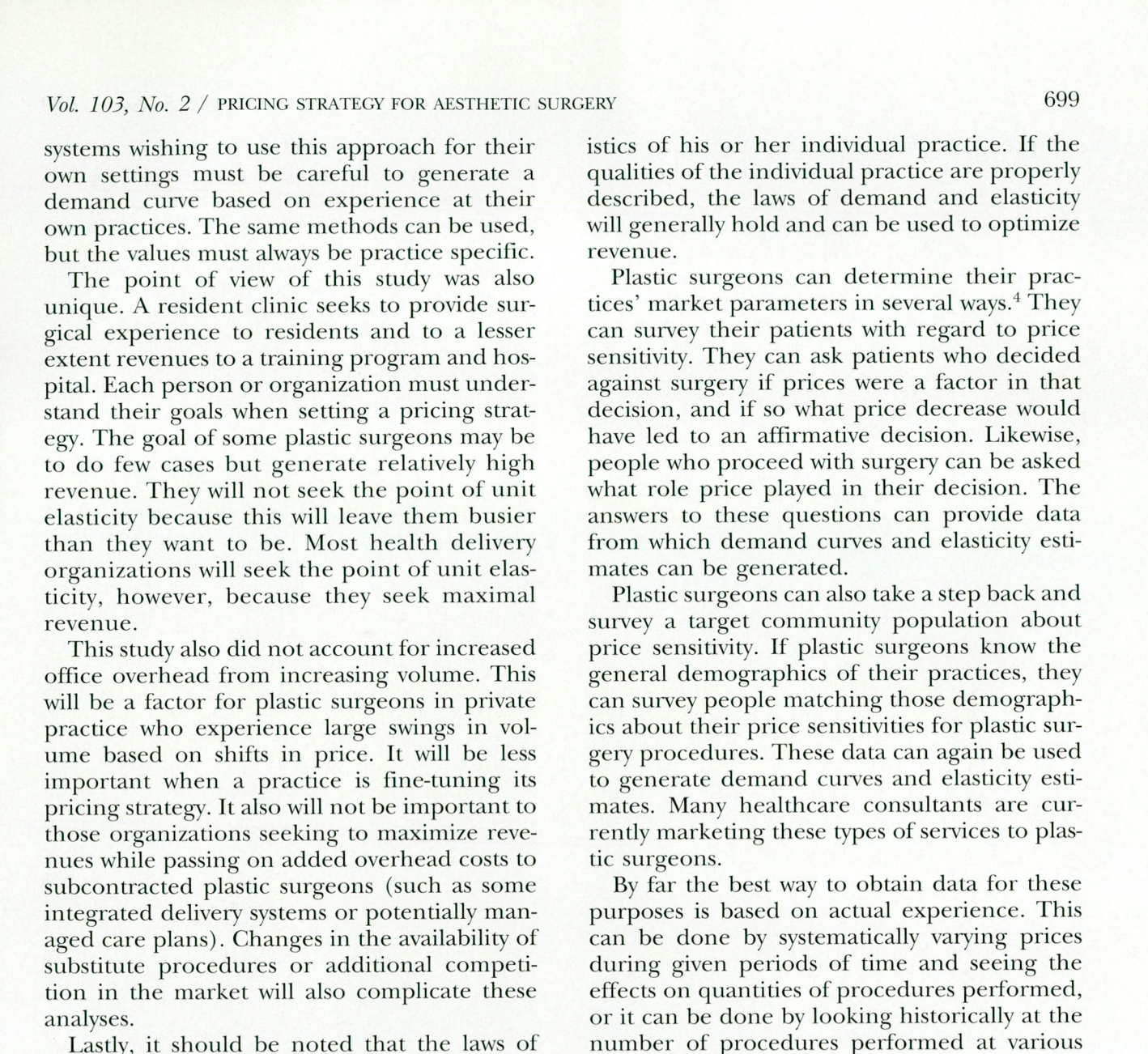
Change in Fees Lloyd M. Krieger, M.D., M.B.A., and William W. Shaw, M.D. L05 Angela, Cali The laws of microeconomics explain how prices affect consumer purchasing decisions and thus overall revenues and prots. These principles can easily be applied to the behavior aesthetic plastic surgery patients. The UCLA Di- vision of Plastic Surgery resident aesthetics clinic recently offered a radical price change for its services. The effects of this change on demand for services and revenue were tracked. Economic analysis was applied to see if this price change resulted in the maximization of total revenues, or if additional price changes could further optimize them. Economic analysis of pricing involves several steps. The rst step is to assess demand. The number of procedures performed by a given practice at different price levels can be plotted to create a demand curve. From this curve, price sensitivities of consumers can be calculated (price elasticity of demand) . This information can then be used to determine the pricing level that creates demand for the exact number of procedures that yield optimal revenues. In economic parlance, revenues are maximized by pricing services such that elasticity is equal to 1 (the point of unit elasticity). At the UCLA resident clinic, average total fees per procedure were reduced by 40 percent. This resulted in a 250-percent increase in procedures performed for rep- resentative 4~month periods before and after the price change. Net revenues increased by 52 percent. Economic analysis showed that the price elasticity of demand before the price change was 6.2. After the price change it was 1. We conclude that the magnitude of the price change resulted in a fee schedule that yielded the highest possible revenues from the resident clinic. These results show that changes in price do affect total revenue and that the nature of these effects can be understood. predicted, and maximized using the tools of microeconomics. (Plast. Reconstr. 3mg. 103: 695, 1999.) Economics has been labeled \"the dismal sci- ence" because of its dryness and technical de- tail. Its principles explain the behavior of both buyers and sellers, however, and can be used to predict, alter, and optimize consumer behav ior. Though the eld of economics is diverse and can become complicated, its basic princi- ples are easily grasped. An economic experiment was conducted at the UCLA Division of Plastic Surgery resident aesthetics clinic. This clinic runs continuously at the UCLA Medical Center. The senior resi- dent sees patients one afternoon per week, books aesthetics cases, and performs them at the UCLA outpatient surgery center under the supervision of an attending plastic surgeon from the clinical faculty. Before the experi- ment, there was general dissatisfaction with the volume of cases generated by the clinic. Seri ous consideration was given to termination of the clinic if it failed to adequately serve resi- dents' educational needs. Lowering prices as a means of increasing volume at the clinic was discussed, but there were some concerns. It was unclear how much to lower prices. Too much of a price decrease might increase volume but also devastate reve- nues. After much debate, the Division decided to conduct an experiment. It would radically lower fees for procedures at the resident clinic. The effects on volume and revenues would be tracked, and further ne-tuning would be un- dertaken based on economic analysis of the results. METHODS The fee changes became effective March 1, 1998. Table I shows the total fees charged be- fore and after the changes. The fees listed are all-inclusive and bundle surgeon's fees, anes- thesia fees, and operating room fees. Average total fees per procedure were reduced by 40 percent. There were no advertising campaigns or other broad community announcements of the fee changes. The goals of the fee changes were two-fold: to increase the number of cases performed and, to a lesser degree, to increase revenues from the clinic. The number of cases per- formed and total revenues were tracked. The study looked at two 4-month time periods at the clinic: one before and one after the fee changes. The study period after fee changes was from March 1 to June 30, 1998. To avoid seasonal variations, the study period before fee changes was from March 1 to june 30, 1997. Neither the UCLA Medical Center nor the UCLA faculty group had raised their prices during this 1-year period, and general eco- nomic conditions were similar across the 1-year period, so no correction for ination was used. Because most plastic surgeons and health delivery organizations are concerned primarily with total revenue, economic analysis focused on whether the price change resulted in a fee schedule that generated optimal revenues. ECONOMIC DEFINITIONS The Law of Demand is dened as the empir- ical observation that when the price of a good or service falls, people demand more of it.1 The reasons why this law holds true are obvious. For a desirable product or service, if its price falls people's budget constraint provide less of a barrier to purchases. They can now afford more of the good or service, so they purchase greater quantities of it. Price Elasticity of Demand is dened as the percentage change in the quantity of a good demanded that results from a one percent change in price.2 Changes in price have pro found effects on demand. The concept of elas- ticity allows those changes to be understood, quantied, predicted, and optimized. For example, if a 1 percent rise in the price of blepharoplasties resulted in a '2 percent de- cline in the number that consumers de- manded, the price elasticity would be 2. The price increase leads to fewer purchases; elastic- ity expresses the magnitude of this effect. Be cause demand will usually go down as prices go up, the elasticity is usually negative. For conve nience, economic convention uses the absolute Value of elasticity. Goods or services have high elasticities if consumers are more price sensitive; a small change in price leads to a large change in demand. These items are said to be elastic. Goods or services have low elasticities if con- sumers are less price sensitive; a large change in price leads to a small change in demand. These items are said to be inelastic. Price elasticities represent the price sensi- tiveness of consumers to the area around a given price. That is, a whole market for bleph- aroplasties does not have a price elasticity. A given price does. This means that each bleph aroplasty price has a unique description of how much consumers will respond to a price change. This makes sense intuitively; at some extremes of pricing, small changes in price will have small effects on consumer behavior. If blepharoplasties cost $25, for example, lower- ing the price to $20 will generate very few additional patients. At other price levels, the nomi; conditions were similar across the 1-year period, so no correction for ination was used. Because most plastic surgeons and health delivery organizations are concerned primarily with total revenue, economic analysis focused on whether the price change resulted in a fee schedule that generated optimal revenues. ECONOMIC DEFINITIONS The Law of Demand is dened as the empir- ical observation that when the price of a good or service falls, people demand more Ofit.1 The reasons why this law holds true are obvious. For a desirable product or service, if its price falls people's budget constraint provide less of a TABLE I Total Fees Charged before and after Changes Total Fee Total Fee uer Procedure before 3/98 3/93 Abdominoplasty $5,400.00 $2,900.00 Blepharoplastyupper and lower $4,700.00 $2,200.00 Blepharoplastyupper and lower $2,800.00 $1,800.00 Breast augmentation $4,250.00 $2,500.00 Mttstopexy $4,500.00 $3,000.00 Riiinoplasly $4,100.00 $2,600.00 LipOsurtion $2,250.00 $1,500.00 Brow lift $3,450.00 $2,200.00 Face lift $7,100.00 $4.]00.00 Average fee $4,283.33 $2,533.33 Vol. 103, N0. 2 / PRICING STRATEGY FOR AESTHETIC SURGERY Goods or semces have low elastICItIes 11' con sumers are less price sensitive; a large change in price leads to a small change in demand. These items are said to be inelastic. Price elasticities represent the price sensi- tiveness of consumers to the area around a given price. That is, a whole market for bleph aroplasties does not have a price elasticity. A given price does. This means that each bleph aroplasty price has a unique description of how much consumers will respond to a price change. This makes sense intuitively; at some extremes of pricing, small changes in price will have small effects on consumer behavior. If blepharoplasties cost $25, for example, lower- ing the price to $20 will generate very few additional patients. At other price levels, the market will respond more robustly to price changes. Each price generates its own elasticity to describe consumer behavior. By denition, when elasticity is equal to 1, the price of that good or service creates the amount of consumer demand that leads to maximum revenues. This is called the point of unit elasticity. Thus, when a rm seeks to max- imize revenues, it tries to price its product at the point of unit elasticity. Figure 1 depicts a typical demand curve with price elasticities for various price/ quantity combinations. The demand curve itself is gen- erated by plotting various prices and the result- Vol. 103, N0. 2 / PRICING STRATEGY FOR AESTHETIC SURGERY 697 Price (Wmdure) Einsticity > [: A price reduction increases total expenditure; 3 price increase reduces it. Elasticity = 1: Total expenditure is at its maximum. / Elastici1y
Step by Step Solution
There are 3 Steps involved in it

Get step-by-step solutions from verified subject matter experts
 Study Help