







Question: Please answer the following question: 1. There are 3 types of pathogenic bacteria in a lab, B1, B2, and B3, which cause a particular disease.
Please answer the following question:
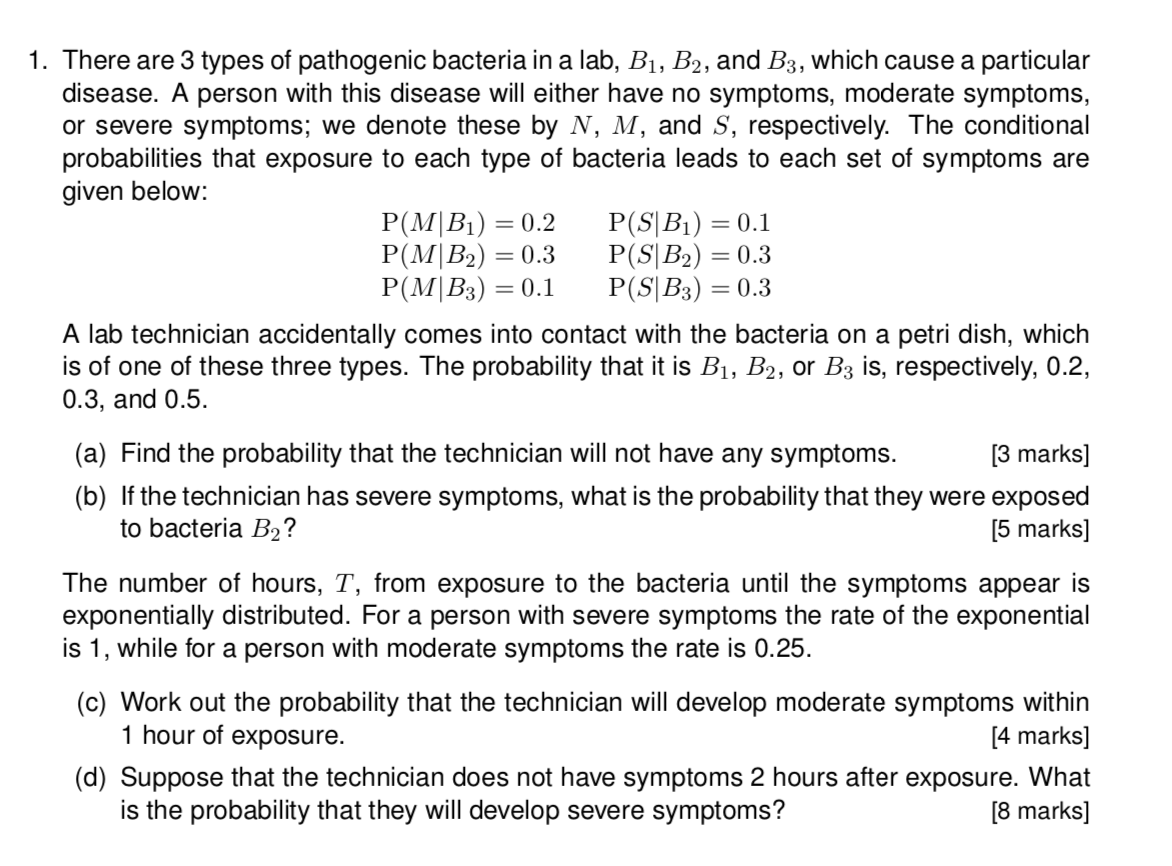
1. There are 3 types of pathogenic bacteria in a lab, B1, B2, and B3, which cause a particular disease. A person with this disease will either have no symptoms, moderate symptoms, or severe symptoms; we denote these by N, M, and S, respectively. The conditional probabilities that exposure to each type of bacteria leads to each set of symptoms are given below: P(M B1) = 0.2 P(S B1) = 0.1 P(M B2) = 0.3 P(S B2) = 0.3 P(M B3) = 0.1 P(S| B3) = 0.3 A lab technician accidentally comes into contact with the bacteria on a petri dish, which is of one of these three types. The probability that it is B1, B2, or B3 is, respectively, 0.2, 0.3, and 0.5. (a) Find the probability that the technician will not have any symptoms. [3 marks] (b) If the technician has severe symptoms, what is the probability that they were exposed to bacteria B2? [5 marks] The number of hours, T, from exposure to the bacteria until the symptoms appear is exponentially distributed. For a person with severe symptoms the rate of the exponential is 1, while for a person with moderate symptoms the rate is 0.25. (c) Work out the probability that the technician will develop moderate symptoms within 1 hour of exposure. [4 marks] (d) Suppose that the technician does not have symptoms 2 hours after exposure. What is the probability that they will develop severe symptoms? [8 marks]
Step by Step Solution
There are 3 Steps involved in it

Get step-by-step solutions from verified subject matter experts
 Study Help