







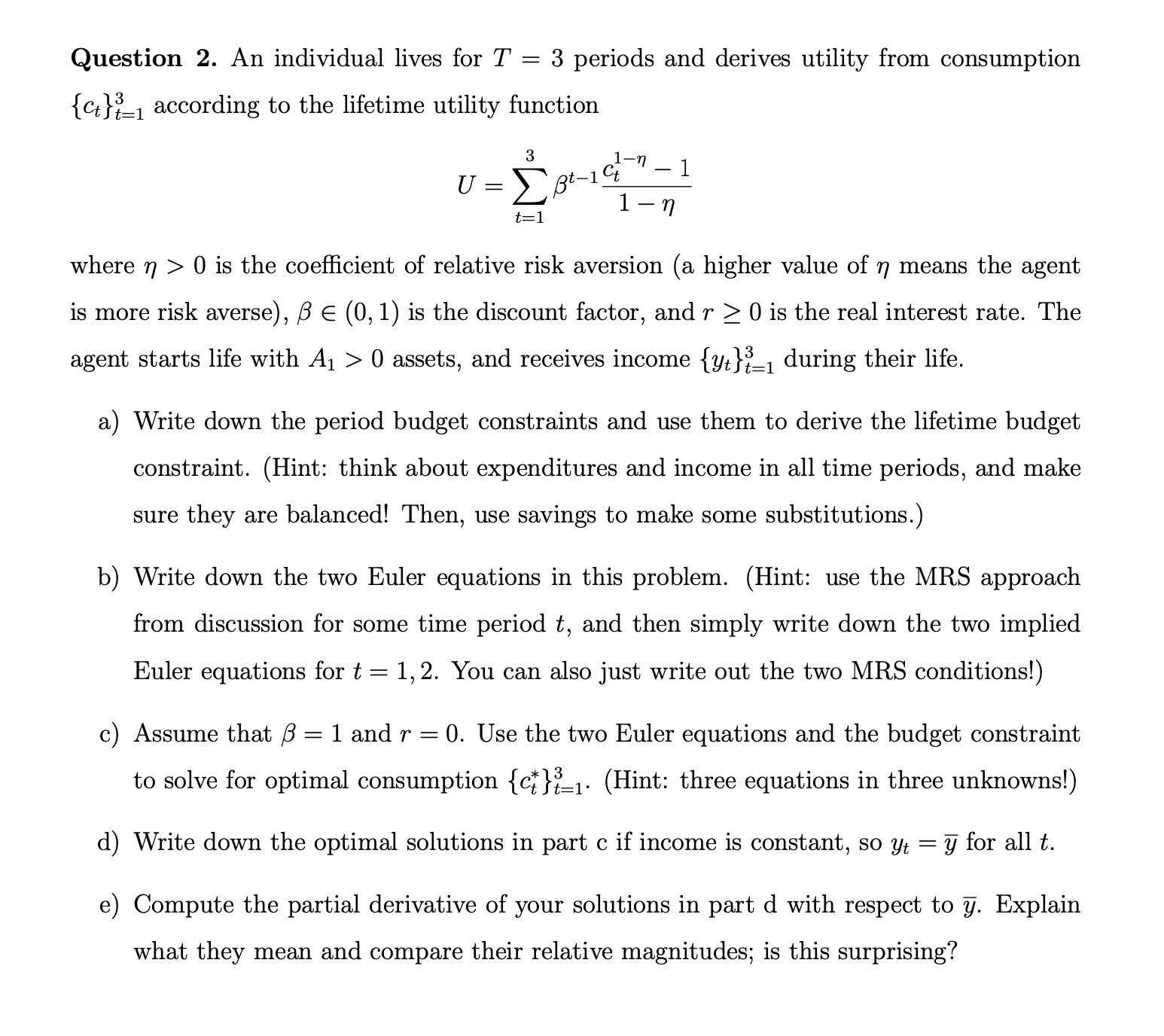
Question: Please answer the following question . Question 2. An individual lives for T = 3 periods and derives utility from consumption {ct}':1 according to the
Please answer the following question .
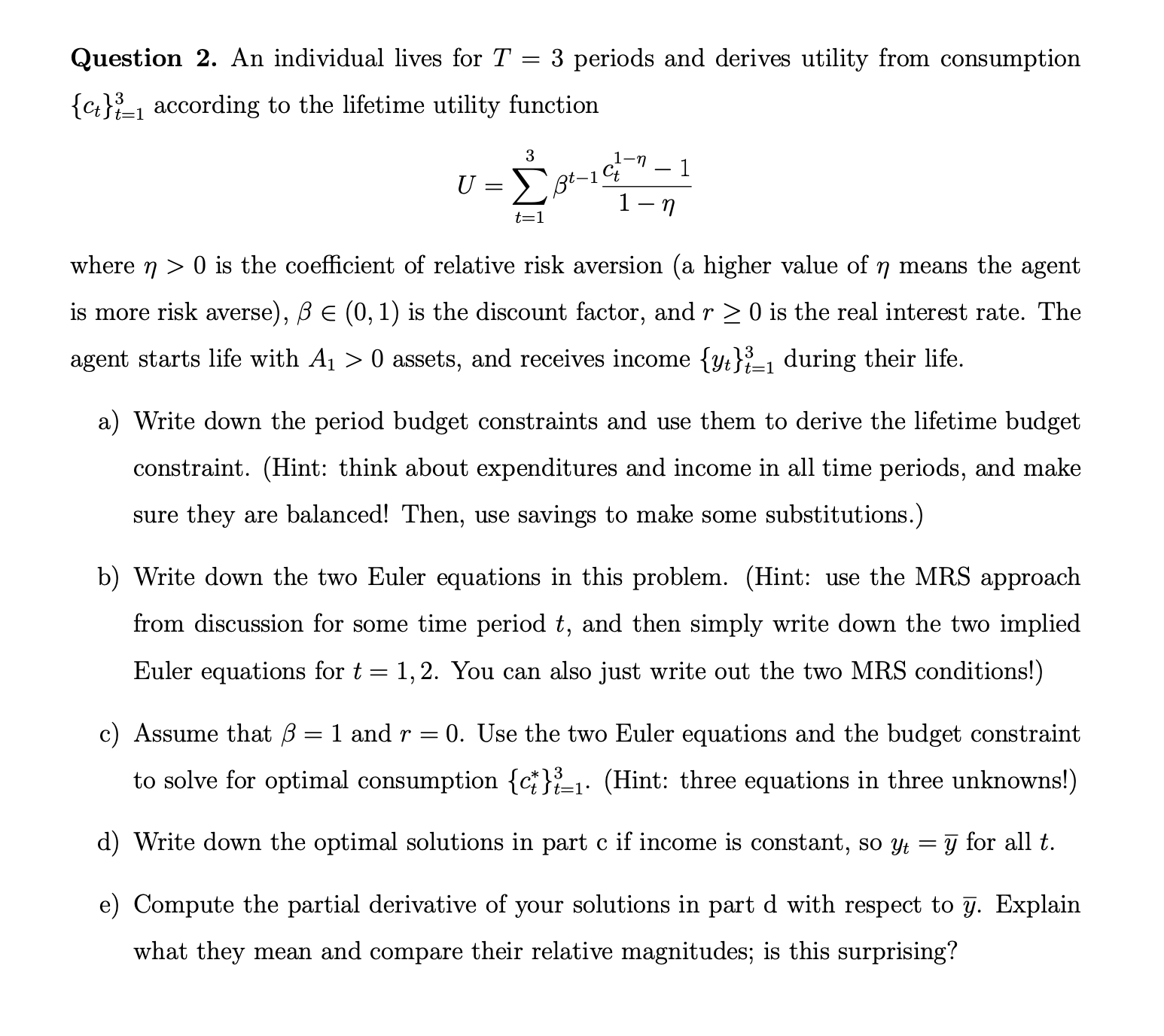
Question 2. An individual lives for T = 3 periods and derives utility from consumption {ct}':1 according to the lifetime utility function 3 02111 _ tl U_Z'6 17? t=1 where n > 0 is the coeicient of relative risk aversion (a higher value of 77 means the agent is more risk averse), [3 E (0, 1) is the discount factor, and 7" 2 0 is the real interest rate. The agent starts life with A1 > 0 assets, and receives income {:93}le during their life. a) Write down the period budget constraints and use them to derive the lifetime budget constraint. (Hint: think about expenditures and income in all time periods, and make sure they are balanced! Then, use savings to make some substitutions.) b) Write down the two Euler equations in this problem. (Hint: use the MRS approach from discussion for some time period t, and then simply write down the two implied Euler equations for t = 1,2. You can also just write out the two MRS conditions!) c) Assume that ,6 = 1 and 7' = 0. Use the two Euler equations and the budget constraint to solve for optimal consumption {c;}f=1. (Hint: three equations in three unknowns!) d) Write down the optimal solutions in part c if income is constant, so y, = y for all t. e) Compute the partial derivative of your solutions in part d with respect to y. Explain what they mean and compare their relative magnitudes; is this surprising
Step by Step Solution
There are 3 Steps involved in it

Get step-by-step solutions from verified subject matter experts
 Study Help