Question: Please answer the following questions for the case study: Orion is a large manufacturer of pharmaceuticals. One of its products is a pill for the
Please answer the following questions for the case study:
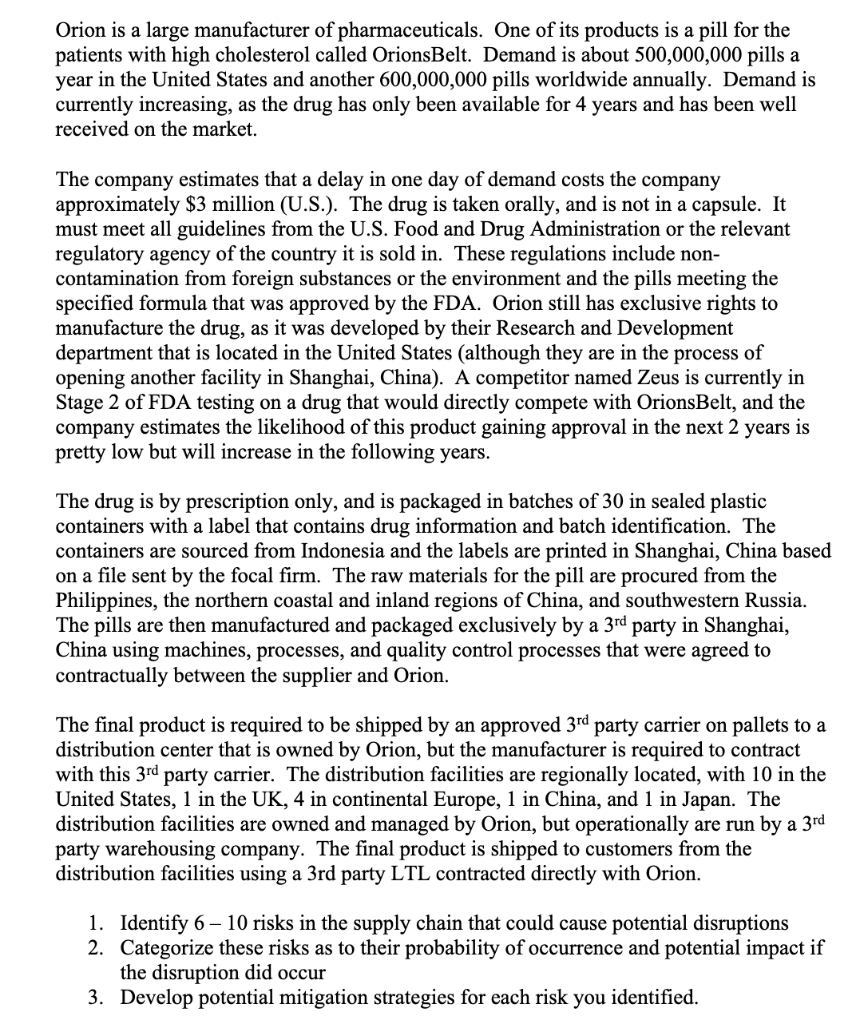
Orion is a large manufacturer of pharmaceuticals. One of its products is a pill for the patients with high cholesterol called OrionsBelt. Demand is about 500,000,000 pills a year in the United States and another 600,000,000 pills worldwide annually. Demand is currently increasing, as the drug has only been available for 4 years and has been well received on the market. The company estimates that a delay in one day of demand costs the company approximately $3 million (U.S.). The drug is taken orally, and is not in a capsule. It must meet all guidelines from the U.S. Food and Drug Administration or the relevant regulatory agency of the country it is sold in. These regulations include noncontamination from foreign substances or the environment and the pills meeting the specified formula that was approved by the FDA. Orion still has exclusive rights to manufacture the drug, as it was developed by their Research and Development department that is located in the United States (although they are in the process of opening another facility in Shanghai, China). A competitor named Zeus is currently in Stage 2 of FDA testing on a drug that would directly compete with OrionsBelt, and the company estimates the likelihood of this product gaining approval in the next 2 years is pretty low but will increase in the following years. The drug is by prescription only, and is packaged in batches of 30 in sealed plastic containers with a label that contains drug information and batch identification. The containers are sourced from Indonesia and the labels are printed in Shanghai, China based on a file sent by the focal firm. The raw materials for the pill are procured from the Philippines, the northern coastal and inland regions of China, and southwestern Russia. The pills are then manufactured and packaged exclusively by a 3rd party in Shanghai, China using machines, processes, and quality control processes that were agreed to contractually between the supplier and Orion. The final product is required to be shipped by an approved 3rd party carrier on pallets to a distribution center that is owned by Orion, but the manufacturer is required to contract with this 3rd party carrier. The distribution facilities are regionally located, with 10 in the United States, 1 in the UK, 4 in continental Europe, 1 in China, and 1 in Japan. The distribution facilities are owned and managed by Orion, but operationally are run by a 3rd party warehousing company. The final product is shipped to customers from the distribution facilities using a 3rd party LTL contracted directly with Orion. 1. Identify 610 risks in the supply chain that could cause potential disruptions 2. Categorize these risks as to their probability of occurrence and potential impact if the disruption did occur 3. Develop potential mitigation strategies for each risk you identified









 Study Help