Question: Please answer the following questions. See attached documents for reference. Thank you in advance. 1. Based on Illustration Capsule 10.3, what is the concept that
Please answer the following questions. See attached documents for reference. Thank you in advance.
1. Based on Illustration Capsule 10.3, what is the concept that explains Apple's decision to keep some activities in the value chain in-house and which ones to outsource? Discuss.
2. In the discussion of organizational structure and strategy, should strategy dictate structure, or the other way around? Discuss.
3. Illustration Capsule 10.2 discusses Zara's competitive advantage through its execution capabilities.
(a) Are there any vulnerabilities in the business model of Zara that competitors can exploit by providing more superior value proposition than Zara does? Discuss.
(b) What advice would you give to the management of Zara regarding how to "maintain" their competitive advantage over the competition? 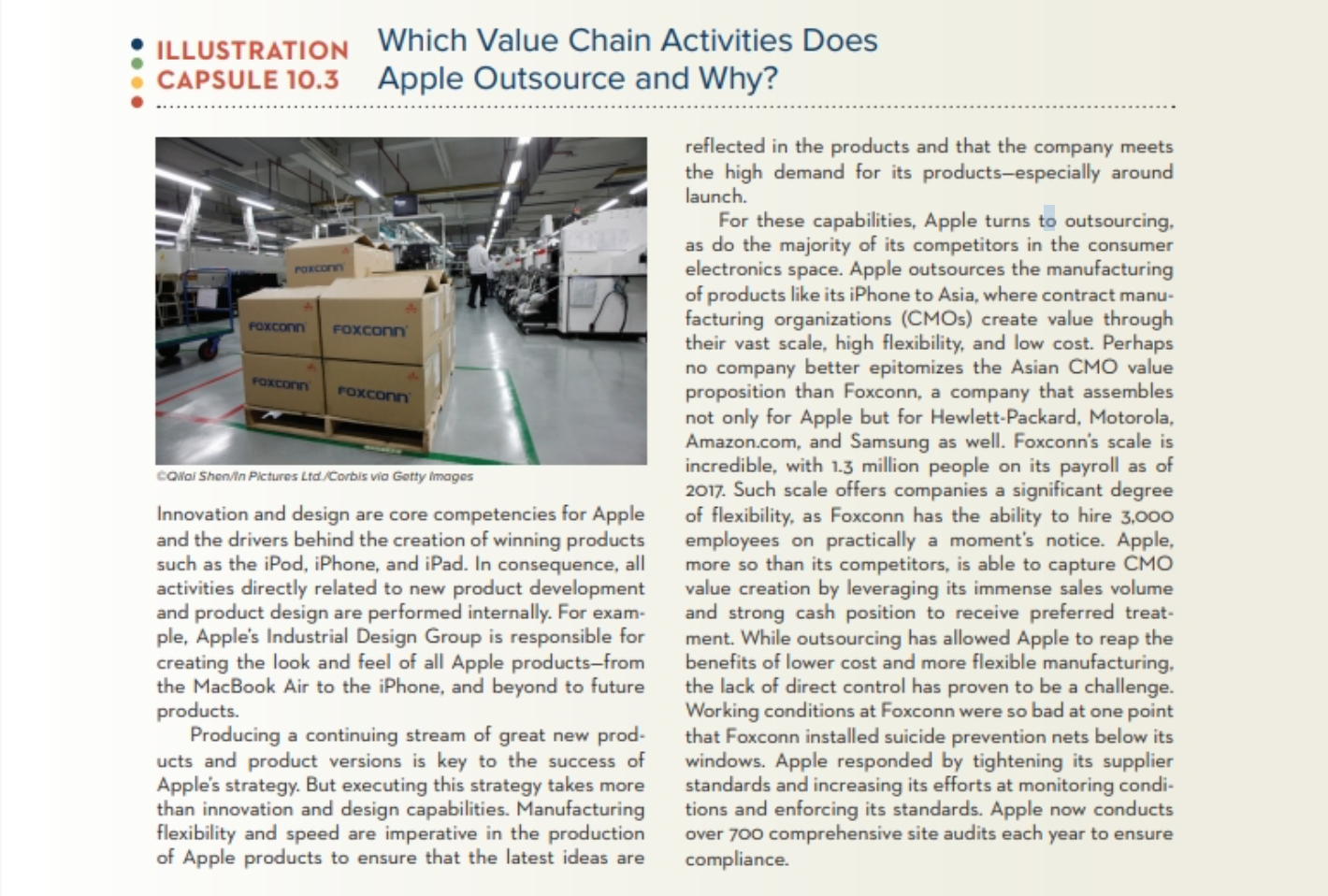
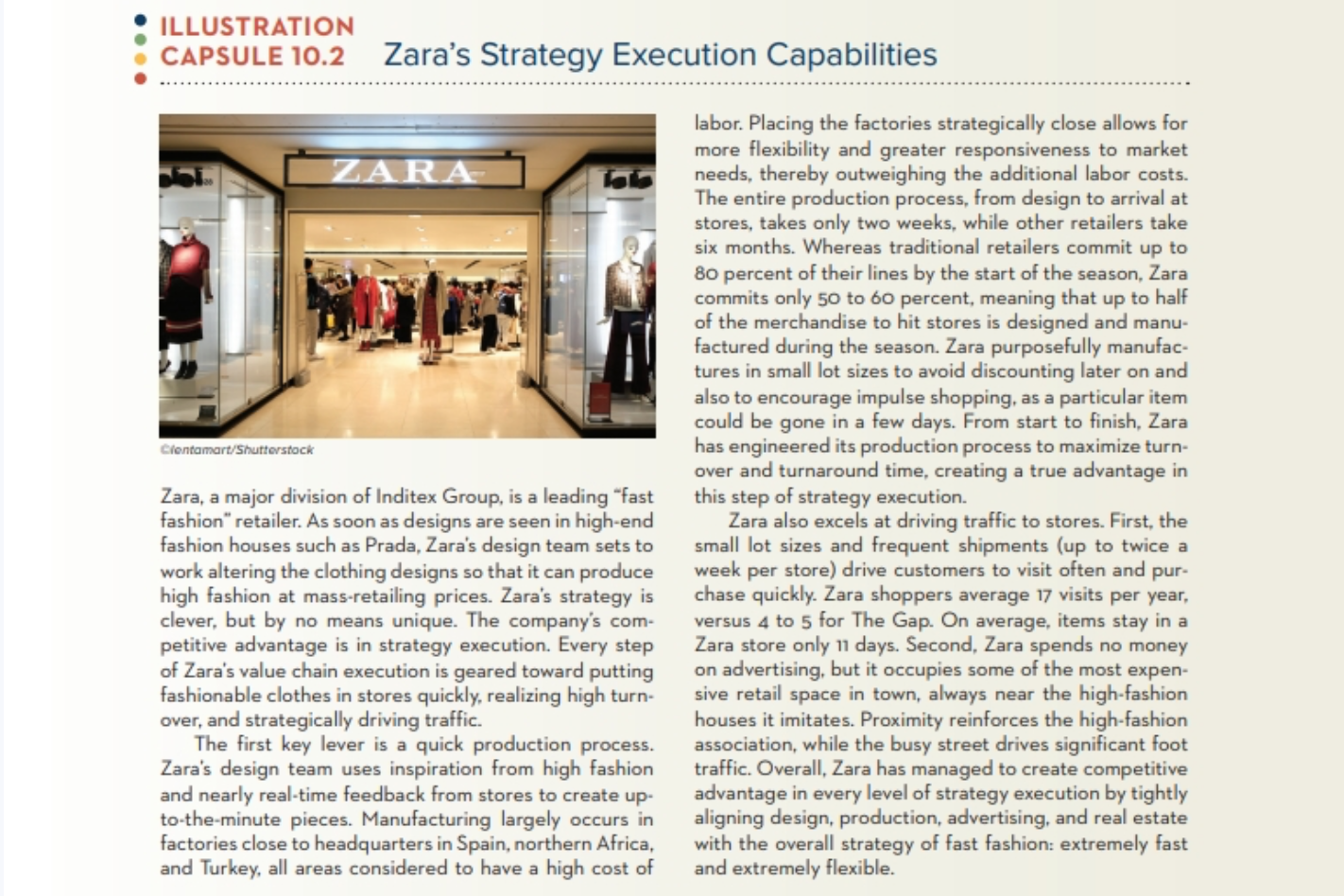
ILLUSTRATION Which Value Chain Activities Does CAPSULE 10.3 Apple Outsource and Why? HH Foxconn FOXConn Foxconn Foxconn Cool Shen in Pictures Ltd/Corbis via Getty Images Innovation and design are core competencies for Apple and the drivers behind the creation of winning products such as the iPod, iPhone, and iPad. In consequence, all activities directly related to new product development and product design are performed internally. For exam- ple, Apple's Industrial Design Group is responsible for creating the look and feel of all Apple products-from the MacBook Air to the iPhone, and beyond to future products. Producing a continuing stream of great new prod- ucts and product versions is key to the success of Apple's strategy. But executing this strategy takes more than innovation and design capabilities. Manufacturing flexibility and speed are imperative in the production of Apple products to ensure that the latest ideas are reflected in the products and that the company meets the high demand for its products-especially around launch. For these capabilities, Apple turns to outsourcing, as do the majority of its competitors in the consumer electronics space. Apple outsources the manufacturing of products like its iPhone to Asia, where contract manu- facturing organizations (CMOs) create value through their vast scale, high flexibility, and low cost. Perhaps no company better epitomizes the Asian CMO value proposition than Foxconn, a company that assembles not only for Apple but for Hewlett-Packard, Motorola, Amazon.com, and Samsung as well. Foxconn's scale is incredible, with 1.3 million people on its payroll as of 2017. Such scale offers companies a significant degree of flexibility, as Foxconn has the ability to hire 3,000 employees on practically a moment's notice. Apple, more so than its competitors, is able to capture CMO value creation by leveraging its immense sales volume and strong cash position to receive preferred treat- ment. While outsourcing has allowed Apple to reap the benefits of lower cost and more flexible manufacturing, the lack of direct control has proven to be a challenge. Working conditions at Foxconn were so bad at one point that Foxconn installed suicide prevention nets below its windows. Apple responded by tightening its supplier standards and increasing its efforts at monitoring condi- tions and enforcing its standards. Apple now conducts over 700 comprehensive site audits each year to ensure compliance. ILLUSTRATION CAPSULE 10.2 Zara's Strategy Execution Capabilities ZARA Clentamart/Shutterstock Zara, a major division of Inditex Group, is a leading "fast fashion" retailer. As soon as designs are seen in high-end fashion houses such as Prada, Zara's design team sets to work altering the clothing designs so that it can produce high fashion at mass-retailing prices. Zara's strategy is clever, but by no means unique. The company's com- petitive advantage is in strategy execution. Every step of Zara's value chain execution is geared toward putting fashionable clothes in stores quickly, realizing high turn- over, and strategically driving traffic. The first key lever is a quick production process. Zara's design team uses inspiration from high fashion and nearly real-time feedback from stores to create up- to-the-minute pieces. Manufacturing largely occurs in factories close to headquarters in Spain, northern Africa, and Turkey, all areas considered to have a high cost of labor. Placing the factories strategically close allows for more flexibility and greater responsiveness to market needs, thereby outweighing the additional labor costs. The entire production process, from design to arrival at stores, takes only two weeks, while other retailers take six months. Whereas traditional retailers commit up to 80 percent of their lines by the start of the season, Zara commits only 50 to 60 percent, meaning that up to half of the merchandise to hit stores is designed and manu- factured during the season. Zara purposefully manufac- tures in small lot sizes to avoid discounting later on and also to encourage impulse shopping, as a particular item could be gone in a few days. From start to finish, Zara has engineered its production process to maximize turn- over and turnaround time, creating a true advantage in this step of strategy execution. Zara also excels at driving traffic to stores. First, the small lot sizes and frequent shipments (up to twice a week per store) drive customers to visit often and pur- chase quickly. Zara shoppers average 17 visits per year, versus 4 to 5 for The Gap. On average, items stay in a Zara store only 11 days. Second, Zara spends no money on advertising, but it occupies some of the most expen- sive retail space in town, always near the high-fashion houses it imitates. Proximity reinforces the high-fashion association, while the busy street drives significant foot traffic. Overall , Zara has managed to create competitive advantage in every level of strategy execution by tightly aligning design, production, advertising, and real estate with the overall strategy of fast fashion: extremely fast and extremely flexible









 Study Help