



Question: Please answer the following questions, Thanks! Problem 2. Suppose there are two rms producing spring water which is homo geneous; that is, consumers don't particularly
Please answer the following questions, Thanks!
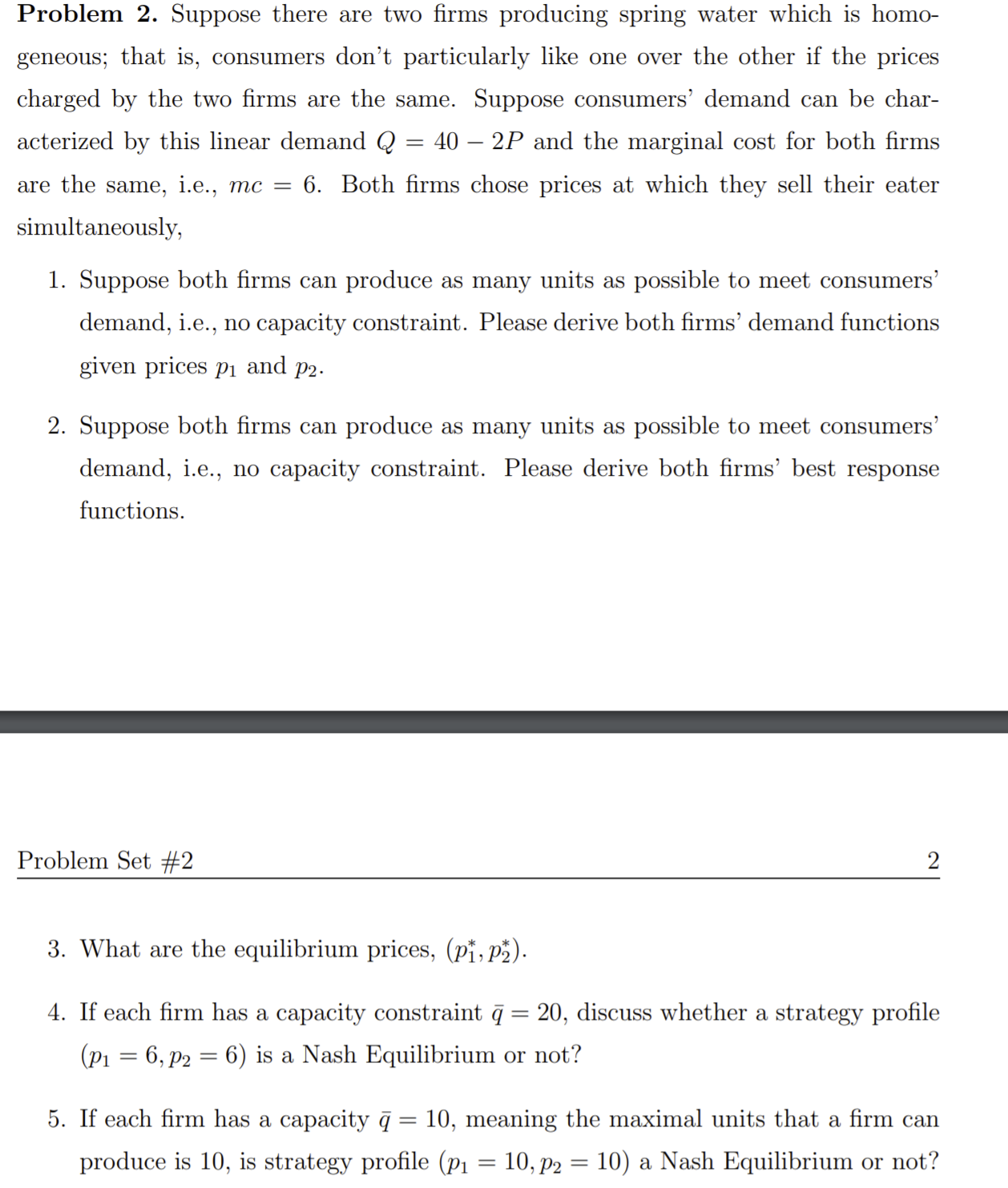
Problem 2. Suppose there are two rms producing spring water which is homo geneous; that is, consumers don't particularly like one over the other if the prices charged by the two rms are the same. Suppose consumers' demand can be char acterized by this linear demand Q = 40 2P and the marginal cost for both rms are the same, i.e., me = 6. Both rms chose prices at which they sell their eater simultaneously, 1. Suppose both rms can produce as many units as possible to meet consumers' demand, i.e., no capacity constraint. Please derive both rms' demand functions given prices 191 and pg. 2. Suppose both rms can produce as many units as possible to meet consumers' demand, i.e., n0 capacity constraint. Please derive both rms' best response functions. Problem Set #2 2 3. What are the equilibrium prices, (pi, p3). 4. If each rm has a capacity constraint 6 = 20, discuss Whether a strategy prole (P1 = 6, p2 = 6) is a Nash Equilibrium or not? 5. If each rm has a capacity (j = 10, meaning the maximal units that a rm can produce is 10, is strategy prole (331 = 10, p2 = 10) a Nash Equilibrium or not
Step by Step Solution
There are 3 Steps involved in it

Get step-by-step solutions from verified subject matter experts